

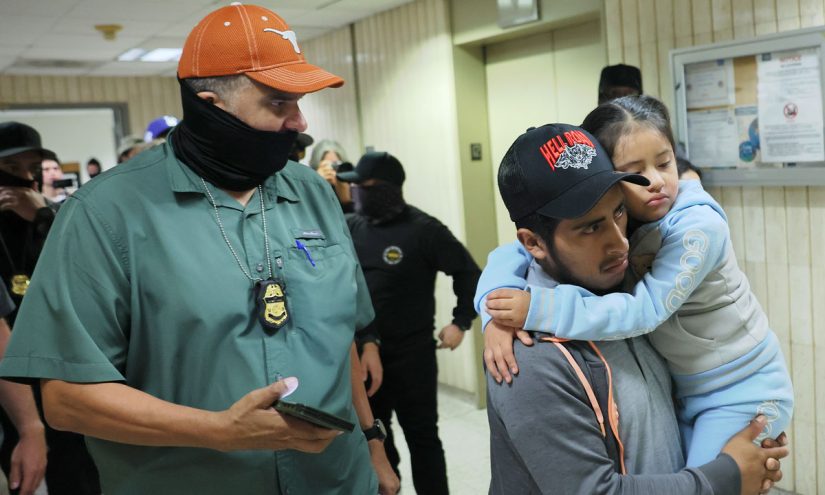
Children whose caretakers are detained or deported face not only the loss of their loved ones, but, oftentimes, removal from their homes and schools — abrupt upheavals that can land them in one of many places.
Some, freshly pressed passports in hand, end up in their parents’ country of origin — even when it’s not their own.
Others are sent to live with family or friends while an unlucky number are placed in foster care, their parents’ rights in jeopardy and reunification precarious.
The teenagers among them are sometimes thrust into a parenting role themselves: This overnight push into adulthood can leave them managing mortgages while their peers are picking prom dresses in the first of many sacrifices, immigrant advocates told The 74.
“A lot of these older siblings are forgoing college plans and looking for work, trying to figure out how to be mom and dad for their siblings,” said Wendy D. Cervantes, director of immigration and immigrant families for The Center for Law and Social Policy.
An 18-year-old Texas resident was left without parents or his U.S.-born siblings more than a year ago when his entire family was stopped by federal agents as they were driving to get medical care for his seriously ill sister. All ended up being sent to Mexico. Using the pseudonym Fernando Hernández García, the young man testified before a House and Senate hearing last week that he was forced to give up college in order to work full time to try and keep the family home.
While on her way to Texas Children’s Hospital for essential treatment & care, Fernando Hernandez Garcia’s young sister was detained by immigration agents & removed to Mexico—separating the siblings & leaving lasting trauma. pic.twitter.com/yoIEGw4udi
— Richard Blumenthal (@SenBlumenthal) March 25, 2026
There are measures in place to help families with this unwanted transition. In 2013, U.S. Immigration and Customs Enforcement issued the Parental Interests Directive, a federal guideline meant to ensure “immigration enforcement activities do not unnecessarily disrupt” parental rights.
It allowed ICE to consider whether it needed to hold these immigrants. And if they were detained, the directive encouraged the agency to house them near their families so they could participate in child placement hearings.
The agency was also advised to arrange transportation to and from court or otherwise allow parents or legal guardians to participate in such proceedings by phone or video.
Wendy D. Cervantes, The Center for Law and Social Policy
“It required some sort of cooperation between ICE and local child welfare agencies,” Cervantes said.
But this directive has been under attack for years. It was weakened during the first Trump administration, bolstered in the Biden era and diminished once again when Trump took office for the second time — and launched a mass deportation campaign.
A March 24 investigation by ProPublica found that the parents of at least 11,000 U.S. citizen children were arrested and detained in the first seven months of Trump’s second term. The news site also determined the Trump administration is deporting about four times as many mothers of U.S. citizen children per day as did the Biden administration.
The Pediatrician Moms Standing up For Children in Immigration Detention
That 11,000 number will have roughly doubled by now, ProPublica reported, if arrests and detentions continued at the same pace in the ensuing months.
The data obtained by ProPublica covers a period up to mid-August 2025. Some of the Trump administration’s most aggressive immigration enforcement sweeps occurred after that in targeted cities, including Chicago, Charlotte, North Carolina, and Minneapolis.
“I do fear in the months ahead that we could see more instances where kids unnecessarily end up in the child welfare system because of the way ICE has been conducting its raids,” Cervantes said, adding its tactics have been carried out “in a way that really doesn’t give us any assurances they are abiding by their own policy to allow parents to make decisions about what happens to their kids at the time of arrest.”
Resisting ICE in Many Cities Means Keeping Kids in School
Families too afraid to reach out
Added to this anxiety, the Department of Homeland Security, which oversees the execution of these and other directives, is in flux. The DHS is now in the second month of a partial government shutdown as congressional Democrats push to rein in the actions of federal immigrant agents and make them more publicly accountable.
The department is also in the midst of a leadership change: Oklahoma Republican Sen. Markwayne Mullin will replace former Secretary Kristi Noem, who was fired from the post March 5 by Trump.
Despite concerns about his temperament — a former cage fighter, Mullin once tried to coax a union leader into a physical altercation during a Senate committee hearing — his nomination was confirmed March 23 by a 54-to-45 Senate vote.
It’s unclear how Mullin, a 2020 election denier, would wield his authority. But he has said he supports the end of birthright citizenship and recently defended the killing of two Minneapolis residents who protested the government’s immigration enforcement efforts, calling victim Alex Pretti “deranged.” He later said he should not have made the comment, but declined to apologize for it.
Parents considering their family’s future in the current environment are sure to wonder what comes next as they contemplate the limited tools available to them, including Standby Guardianship, which allows people subject to immigration enforcement in some states to designate a caretaker for their kids.
Julie Babayeva, New York Legal Assistance Group
It’s a valuable lever, said Julie Babayeva, supervising attorney with the New York Legal Assistance Group: It goes into effect the moment someone is detained. But many families are reluctant to apply for it, she said.
“We have been talking to PTAs, schools and community organizations in heavily immigrant communities,” Babayeva said. “It’s just difficult for people to trust this. They think, ‘What if I tell you my phone number and that leads to ICE coming to my house?’ People don’t understand that we’re not giving this information out to anyone, that it is confidential.”
A 2025 KFF analysis shows 19 million children in the U.S. have at least one immigrant parent and that 1 in 6 — or 9 million school-aged children — live in a household with at least one noncitizen adult. An overwhelming majority of these kids are U.S. citizens.
A Los Angeles teacher, who asked to remain anonymous because of her own citizenship status, recalled the case of two elementary school-aged children — and a toddler — left with their nearly 80-year-old grandmother, who had to return to work to support them after their parents were taken by ICE.
Such disruptions inflict enormous psychological and emotional damage on children, she said.
“They’ve heard the rhetoric of Trump saying he’s going after criminals and though they know that’s not true, they still don’t understand why their parents would be targeted,” she said.
Roughly 500,000 immigrants were deported in Trump’s first year in office and of the 68,000 people in ICE detention as of February, more than 73% had no criminal convictions.
U.S.-Born Students Tell Congress About Lasting Toll of Harrowing ICE Encounters
Eric Marquez, a teacher at New York City’s ELLIS Preparatory Academy, which serves older, immigrant students, said that from a classroom perspective, what stands out most is that these newcomers often present as remarkably composed.
“They tend to put on a brave face, adapt quickly on the surface and rarely bring up in conversation the people in their lives who may have been detained or deported,” he said. “There’s often an understatedness to it.”
At the same time, teachers can sometimes see the impact indirectly, including shifts in focus, attendance and energy, he said.
Balloons and a welcome back poster greeted Dylan Contreras on his first day back at ELLIS Preparatory Academy after 10 months in federal detention. (ELLIS Preparatory Academy)
Ellis Prep’s own Dylan Contreras was among the first high school students to be detained by ICE when he was arrested after a May 2025 court appearance. Held in a Pennsylvania detention center for 10 months, he was released March 17 and returned to school for the first time March 24.
Educators Say Worst Fears Realized as High Schoolers Detained by ICE
Immigrant families are not the only ones puzzled and angry over the administration’s tactics. Residents in Springfield, Ohio, worried their Haitian neighbors will be deported because their Temporary Protective Status is in jeopardy, have stepped up to do something about it — in this case, house their children.
One woman, who asked not to be identified for fear of attracting anti-Haitian animus stirred up by Trump, secured emergency foster care credentials to support kids who might need somewhere safe to stay while they wait for a more permanent placement. The process took eight weeks to complete, she told The 74.
“I am ready for 0 to 18,” she said of the age of children she could take in at a moment’s notice. “I want to keep siblings together.”
A sudden rush of unhoused kids felt imminent earlier this year when Haitians’ protective status was set to expire and word spread that federal immigration agents would soon arrive in Springfield to deport them. After some 600,000 Venezuelans lost their TPS status last year, a lawyer representing the group said “hundreds and potentially thousands of Venezuelan nationals (had) been deported from the U.S.”
Earlier this month, the Supreme Court prohibited the Trump administration from ending Haitian deportation protections and will hear oral arguments in the case in late April.
Separation not easily undone
Once separated, family reunification can be difficult, notes Gabrielle Oliveira, an associate professor at Harvard’s Graduate School of Education who has studied immigration for years. Bureaucratic hurdles mean it can take months for a U.S. citizen child to get a passport to join their parents in a foreign country.
Oliveira said, too, some of the children who enter foster care have family eager to shelter them but they won’t step forward because they are too afraid to interact with the government.
These new forms of family separation are among many fears undocumented immigrants face. But it’s not the worst of them, Oliveira and other advocates said: Detention is by far the most frightening prospect.
Gabrielle Oliveira, Harvard
“It’s been harder and harder to get in touch with people who are detained,” Oliveira said. “Sometimes months go by and (federal authorities) don’t even tell you where they are. So, parents are even more worried about that than the actual deportation.”
And, she said, limited communication with family makes it challenging to come to a conclusion on child care.
“You can’t make decisions,” Oliveira said. “You can’t make phone calls. You can’t figure out what the plan is.”
Already, Cervantes said, her office has seen the fallout.
“We’ve heard about 15- and 16-year-olds living by themselves for several weeks because their parents were detained and they had no idea where they were,” she said. “ICE was not checking to make sure they were OK. These are U.S. citizen kids.”
And there are other, practical issues that make it hard to reunite in a foreign country, Oliveira said, recalling one family trying to meet up in South America.
“The dad got deported and the mom was here with the kids, and then she was trying to leave and go back to Brazil — but she was nervous that if she went to the airport, she would be arrested,” Oliveira said.
When children are left with undocumented relatives, it’s nearly impossible for them to leave the United States to deliver the kids to their parents, said Shaina Simenas, co-director for the Young Center’s Technical Assistance Program.
“If you have a young child that is left with another relative who has their own immigration needs, how would you get them to the country of origin?” she said. “We’re working with a lot of families who are from Venezuela, and there are so many challenges even getting Venezuelan passports — or getting flights to Venezuela. And, of course, there is the financial toll of buying international flights and paying for passports and travel documents.”
Simenas believes poor record-keeping on the part of the government means a lack of accountability.
“ICE doesn’t consistently and reliably identify whether adults are caregivers for children and so that alone makes it harder to track what might have happened to their children after a parent was taken,” she said.
A 2-year-old Honduran asylum seeker crying as her mother is searched and detained near the U.S.-Mexico border on June 12, 2018 in McAllen, Texas. (Photo by John Moore/Getty Images)
Many families separated during Trump’s first term have not seen justice, she noted. Nearly 1,000 children were still waiting to reunite with their parents in 2023, according to government records.
“For families being separated now,” she said, “I think there are even fewer ways to track them, to be able to support and ensure they have access to reunify.”
Did you use this article in your work?
We’d love to hear how The 74’s reporting is helping educators, researchers, and policymakers. Tell us how
