

Get stories like this delivered straight to your inbox. Sign up for The 74 Newsletter
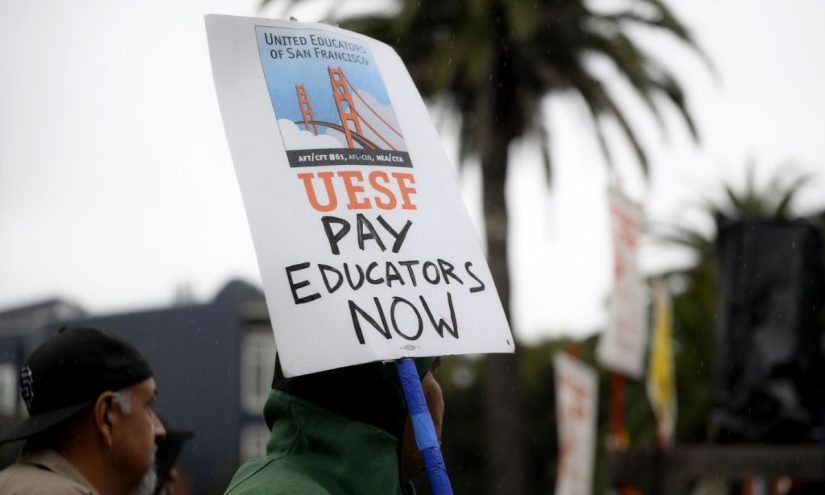
The San Francisco teacher strike was a harbinger. As school budgets tighten, the gap between union demands and what districts can responsibly afford is widening. How leaders respond in moments like this matters — not just for their districts’ long-term fiscal health, but for children they serve today, and for years to come.
As in San Francisco, unions will make demands that benefit their members. District leaders, wanting to avoid a high-profile labor conflict, will fold.
The consequences come later.
To balance the budget, districts will issue pink slips, cut some electives, Advanced Placement classes and sports, eliminate supports for high-needs children, freeze hiring and close schools.
Some families will leave. Enrollment will drop. Revenues will fall. The districts will begin a downward financial spiral.
High-poverty schools will suffer the most. With more junior staff, they’ll be first on the list for pink slips. And with higher turnover rates, a hiring freeze could leave a senior French teacher teaching math (earning $140,000 after a raise that delivered double the cash to veteran educators).
With so much of their budgets tied up in union negotiated agreements, districts won’t be able to compete with charter schools. Even more families will leave. The cycle will continue.
It’s a dire forecast. And completely foreseeable.
The problem isn’t so much with unions — they’re doing exactly what they are supposed to do: advocate aggressively for the interests of their voting members.
San Francisco Teachers Strike Ends With Tentative Agreement on Raises, Benefits
Rather, districts need to learn to play their corresponding part — aggressively pursue what’s best for students amid constrained dollars.
Those. Are. Different. Roles.
Many district leaders, including those in San Francisco, appear uncomfortable with the head-to-head conflict that comes with labor negotiations, especially when unions align with their political sensibilities. That’s understandable. But discomfort is not an excuse for abdicating the district’s responsibility in labor conflicts.’
San Francisco board commissioner Matt Alexander misunderstood his role entirely when he praised the strike, saying he was “proud of these educators for standing up for what is right.”
When districts, like Seattle, offer the public little rationale for their proposals during a strike, they cede the narrative to unions that frame their demands as being “for students.” Unions, in contrast, work hard to win over parents and media, knowing that the strike works only as long as the public stays on the union’s side.
But with more strikes likely on the horizon, district leaders need to ensure that the public hears the other side. What does that look like? What should leaders do?
First, be clear about who controls revenues. It’s not the districts. Want more money in the system? Unions should take that up with their state legislature or with local voters.
Explain tradeoffs. In West Contra Costa, California, a December strike resulted in $105 million in new costs and a massive budget gap. With some 80% to 90% of district spending on labor, the district will have no choice but to shrink its staff or face a state takeover. San Francisco faces the same pressures — adding $111 million in new costs for the labor agreement is the equivalent of reducing jobs for about 800 employees. That’s just the math. It means that schools could lose electives, AP classes and added supports for vulnerable students.
Be crisp with numbers. San Francisco teacher salaries range from about $67,000 to $131,000, depending on experience and credits. The union’s ask was another $12,000 for senior teachers — and $6,000 for junior ones. Where the union is wrong on the numbers, district leaders can and should say so.
Keep students at the center. Demands for fully funded health care for teachers’ families would require gutting services for students whose families don’t have anywhere near those same benefits. And it means more employees could be let go. The district’s job is to teach kids to read and do math, and in places like San Francisco, only about half of students are at grade level in math. If leaders believe that investments in counselors, social workers and specialists matter, trading these investments away for a more costly labor contract means trading away these children’s future.
Expose gaps in union narratives: Unions claim larger raises would retain early-career teachers of color. But the resulting costs could trigger reductions in force — and under California’s last-in, first-out rules, it is those same educators who would be laid off first.
Address long-running contract terms that don’t serve students. District leaders often lament that their hands are tied by decades-old provisions. But those contracts didn’t materialize on their own; districts signed them. If they are no longer serving students, or are actively constraining districts’ ability to do so, leaders have an obligation to address them.
Los Angeles, San Francisco Teachers Unions OK Strikes Over Pay, Staffing Demands
Some district leaders mistakenly think federal labor law prevents them from being blunt with the public, and it is true that the National Labor Relations Board prohibits bargaining directly with employees outside negotiations. But it does not bar districts from publicly making their case or challenging union claims.
None of this is to suggest that district leaders should be mean, rude or dismissive, even when union rhetoric goes there. They can be firm and professional, remembering that families need to trust them to do what’s best for their children.
District leadership is not about avoiding hard conversations. It’s about having them — clearly, publicly and with an unapologetic focus on students.
Did you use this article in your work?
We’d love to hear how The 74’s reporting is helping educators, researchers, and policymakers. Tell us how
