

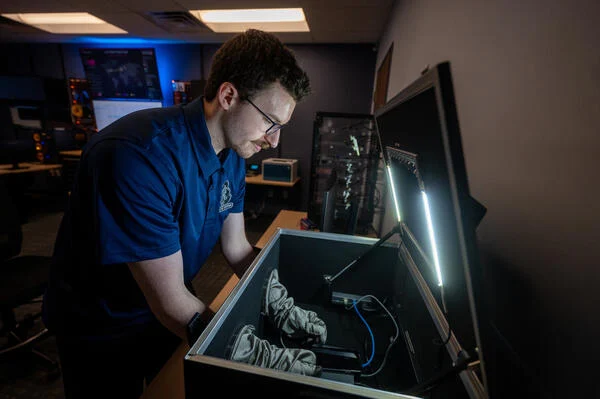
Chase Cochran originally came to Neumann University outside Philadelphia intending to study criminal justice and work toward becoming an FBI agent. But after his first semester, he realized that path wasn’t for him.
Today, the fourth-year cybersecurity major said working for the FBI is still on his mind—but instead of becoming an agent, he hopes to work in digital forensics. Cochran credits that clarity to his internship at Neumann’s forensics lab.
The lab launched in 2024, and Cochran is among the more than 30 students who have worked there since. Student interns have participated in nearly 400 investigations and about 500 real-time crime incidents—ranging from homicides and missing-persons cases to cybercrime and organized theft.
“It’s really great knowing you’re making a difference,” Cochran said. “You see on the news all the time all these terrible things happening, and being able to be part of the reason that some of these things are being solved, being prevented—it’s a really great feeling.”
In partnership with the Delaware County District Attorney’s Office and the Aston Township Police Department, the lab analyzes seized digital devices, reviews surveillance footage from crime scenes and monitors live video feeds during active investigations.
Joe Walsh, the forensic lab’s director, said the program prepares students for careers in law enforcement, cybersecurity and digital forensics while also supporting active investigations by local police.
“Students are deeply involved in the investigative work,” Walsh said. “They have different levels of involvement depending on what type of case it is and how much analysis work needs to be done, but everything we do in the lab is all real cases, real work.”
About 10 to 12 interns work in Neumann’s forensics lab each semester, gaining hands-on experience with digital forensics.
The internship: Walsh said the lab has become a highly sought-after internship for students majoring in cybersecurity, criminal justice or psychology. Interns typically work 10 to 15 hours weekly under the supervision of a police officer or analyst and assist with approximately five cases each week.
“We’re very careful about the chain of custody of evidence,” Walsh said, noting that all students must pass a background check and sign a confidentiality agreement.
“They don’t ever touch the original evidence,” Walsh said. “So when they’re going to analyze a phone or computer, a law enforcement professional would do the extraction from the device first, get a copy, and then that copy would be given to the student.”
Forensics Education in Action
Other institutions have also combined forensics with experiential learning.
- At the University of Arkansas at Little Rock, students participate in a forensics lab, in partnership with the Arkansas attorney general’s office and state law enforcement agencies, to analyze digital evidence and support investigations.
- In fall 2025, Gwynedd Mercy University launched Crime Scene House, a three-story home with staged rooms where students conduct simulated criminal investigations.
Walsh said that process is important because it ensures students are not required to testify in court after their internship ends or they graduate.
The program benefits both students and law enforcement, Walsh added.
“We’re able to solve crimes that we were previously not able to solve, and that’s because we use them as a force multiplier,” Walsh said. “We typically have 10 or 12 interns a semester, so that’s 10 or 12 extra detectives that can look at evidence and that can help us watch video.”
Cochran said the experience has helped him develop a new way of thinking about investigations.
“You really have to develop a different mindset when you’re investigating crimes, because criminals are smart and they hide their tracks,” Cochran said. “So you have to develop a certain sense to track them down and make sure you’re getting the right information.”
Walsh echoed that point, noting that working on real cases gives students experience that can’t easily be replicated in the classroom.
“We’re certainly giving the students in the classroom good experience and getting them ready for working with these tools in the law enforcement world, but I think there’s nothing like a real case,” he said.
Joe Walsh, director of Neumann’s forensics lab, guides a student intern working on a real-time investigation.
Why it matters: The program is already having a measurable impact on student outcomes. Four interns have gone on to careers in law enforcement and digital forensics, landing roles with the county district attorney’s office, Homeland Security Investigations and local police departments, said Walsh.
He noted Neumann’s model shows how universities can prepare students for careers while contributing to real work happening in the community.
“It’s very different for me to tell them about digital forensics in the classroom and for them to actually see it and work on a case,” Walsh said. “Doing this work in real life makes [students] feel more connected to the major, to the profession.”
Cochran agreed, adding that he has enjoyed working in the lab so much that he plans to return to Neumann for his master’s degree while continuing to work in the lab.
“When you see hit-and-runs being solved, you see burglaries being solved, it’s really just great on your conscience,” Cochran said. “You’re in there, you’re making a difference, and it’s a visible difference.”
Get more content like this directly to your inbox. Subscribe here.
