

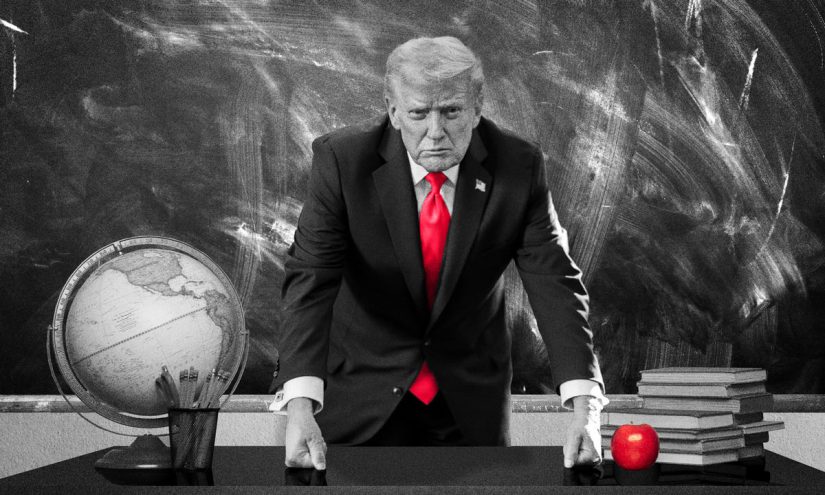
Before she became education secretary, Linda McMahon spent four years strategizing President Donald Trump’s return to the White House. His election was a triumph for conservatives and a chance to unwind decades of what they consider intrusions into state and local education matters.
One year ago today, Trump took the oath of office for a second time and set it all in motion.
Through executive orders, layoffs and canceled contracts, he and McMahon carried out a frontal assault on a federal agency Congress created in 1979, the U.S. Department of Education.
The nation has experienced “some of the most rapid and likely consequential changes in education policy,” since the mid-1960s, when lawmakers passed the Civil Rights Act and the law creating Title I funding for children in poverty, said Jeffrey Henig, a professor emeritus at Teachers College, Columbia University. Under President George W. Bush, the No Child Left Behind Act further deepened Washington’s involvement in schools.
But those initiatives used the strength of the federal government to expand educational opportunities for poor and minority students, Henig said, while this administration is turning away from a focus on equity.
The gameplan hasn’t always gone smoothly. On three occasions, McMahon has called back staff she fired. The department has frozen and unfrozen funds for programs like afterschool care and suspended long-running research projects. To those who have lost their jobs or seen their civil rights complaints ignored, it’s been a traumatic year. Others who believe in McMahon’s “final mission” to make the department obsolete say the pain is necessary.
“I realize it has sometimes been messy, but that’s inevitable when the federal role has been built up by special interests over six decades,” said Jim Blew, an Education Department official during Trump’s first term and the co-founder of the conservative Defense of Freedom Institute. McMahon, he said, is “reversing that history by relinquishing power.”
The agenda is somewhat paradoxical. McMahon likes to say Washington bureaucrats should get out of the way so education can be “closest to the child.” But the administration has tried to exert more control over districts that resist Trump’s orders. The Office for Civil Rights has launched multiple investigations, threatened to pull funding from states and districts with gender-inclusive policies and curbed efforts to improve achievement among minority students.
Blue states, teachers unions and advocacy groups have fought back in court. A Brookings Institution tracker notes more than 20 active cases over the administration’s anti-DEI mandates and eight related to dismantling the department. Several more lawsuits challenge canceled grants and contracts.
Trump’s crackdown on immigration has been one of the more tangible ways the disruption in D.C. has filtered down to local districts. Some children are afraid to come to school or wait for the bus, while high school students have been swept up in immigration raids.
Interruptions in funding made it hard for states and districts to plan ahead. But some experts say the long-term financial impact of the Trump 2.0 shake-up may be minimal. Superintendents are more concerned about declining enrollment than which federal department is distributing their money, said Marguerite Roza, the director of the Edunomics Lab at Georgetown University.
“The second grader still goes to school. The teacher is still there. The district budget looks pretty much identical to what it did before,” she said.
In addition to firing staff, McMahon is moving the department’s major functions to other agencies. But the transition of career and technical education programs to the Labor Department has not been without complications, and that program represents just a fraction of the $18 billion budget for Title I, making some state leaders wary of what will come this year.
U.S. President Donald Trump signs an executive order to eliminate the Department of Education in Washington, D.C. on March 20, 2025. (Getty Images)
“If this is some form of experimental policymaking, I know of no parent who wants their child to be used in an experiment,” Eric Davis, chair of the North Carolina State Board of Education, said at a December meeting. “This self-inflicted disruption runs counter to the many decades in which the Department of Education was instrumental in improving the education and academic achievement of millions of Americans.”
Here are eight areas where the Trump administration has radically recast the federal role in education in its first 12 months:
The rapidly shrinking Education Department
Eliminating the Department of Education has been a goal of Republicans since President Ronald Reagan first took office in 1981.
They’re closer than ever to reaching it. The agency is now less than half the size it was a year ago as the administration aims to drastically reduce education’s federal footprint.
In addition to the more than 1,300 jobs she cut in March, McMahon slashed 450 positions during the seven-week government shutdown in the fall. Congress and a federal judge forced her to reinstate them. But the moratorium on those layoffs runs out Jan. 30, and some who were targeted by that action expect she’ll try to terminate them again.
Court Blocks Shutdown Layoffs, But Experts Say Ed Dept. Programs Still in Danger
“We’ve never seen an administration so actively hostile to career civil servants,” said one current employee who asked to remain anonymous to protect her job. With more than a decade at the agency, she’s among those who have been reassigned to handle basic tasks. Some with “20-plus years of professional experience are doing things like scheduling rooms.”
McMahon and others who back the administration’s goal of abolishing the agency say those staffers won’t be missed. But blue states are challenging the layoffs in court, saying the department performs essential functions, from increasing opportunities for disadvantaged students and protecting civil rights to gathering critical data on the state of the nation’s schools.
Protesters demonstrated outside the U.S. Department of Education in March after the first round of layoffs affecting over 1,300 staff. (Bryan Dozier / Middle East Images / Middle East Images via AFP)
As she continues to transfer jobs to other agencies, McMahon will hear from tribal leaders early next month on plans to move services for American Indian and other Native students to the Department of the Interior. Advocates are battling to keep her from moving oversight of special education as well, but at a meeting in December, McMahon maintained, “Nothing shall remain,” said Jennifer Coco, the interim executive director of the Center for Learner Equity, who attended the meeting.
Unless Congress makes those moves stick through legislation, a future administration could reverse them. It’s also unclear whether attempts to reduce staff and rearrange federal oversight “will pass court muster with the many legal challenges underway,” said Patrick McGuinn, a political science and education professor at Drew University in New Jersey.
The year culminated with an event in a small Iowa town in which McMahon granted the state more flexibility to spend $9 million in federal funds. It’s a preview of how the administration wants to distribute all federal education funds, “through no-strings-attached block grants,” said Blew, of the Defense of Freedom Institute.
The department is expected to grant more waivers, and whether Democratic or Republican, most state and local education chiefs are relieved that McMahon wants to reduce paperwork, Blew said. Gustavo Balderas, superintendent of the Beaverton, Oregon, schools, agreed.
“I don’t think you’re going to find a superintendent who’s going to say, ‘Give me more reporting,’ ” he said.
But some found the news from Iowa underwhelming.
“After all of last year’s public posturing and back-and-forth, it felt like weak sauce,” said Dale Chu, a consultant who focuses on assessment and accountability. It was a “symbolic win for Iowa,” he said, “but the jury’s out as to whether it ultimately makes a difference on student outcomes.”
— Linda Jacobson
Immigration
While the drama unfolds in Washington, Trump’s immigration enforcement actions have hit closer to home. He rolled back longstanding guidance that kept federal immigration agents off school grounds, making K-12 campuses fair game. And despite the Department of Homeland Security’s claims that it is not targeting students or schools, Immigration and Customs Enforcement and Border Patrol officers have been on or near K-12 campuses across the country ever since, arresting and deporting parents and kids — often at drop-off and pick-up times.
A federal-agent inspired melee at a Minneapolis high school earlier this month — hours after an ICE agent fatally shot an unarmed motorist nearby — prompted a two-day districtwide shutdown. Absenteeism has skyrocketed in heavily patrolled areas throughout the country, and many families have chosen to self-deport. Others have joined a nationwide resistance movement.
Some 300 demonstrators participate in a Waukegan, Illinois, rally on Feb. 1 to draw attention to an increase in Immigration and Customs Enforcement activity in the area. Privacy advocates warn student records could be used to assist deportations. (Scott Olson/Getty Images)
“Since January 2025, the administration has blanketed communities with ICE agents, which — predictably — has only brought chaos, cruelty and violence to our schools,” said Alejandra Vázquez Baur, a fellow at The Century Foundation, a progressive think tank. “And we anticipate this is just the beginning. This year, education leaders will need to be even more bold to defend their students and the sanctity of the learning environment.”
Resisting ICE in Many Cities Means Keeping Kids in School
In some cases, schools and other groups that serve undocumented students have gone underground, scrubbing their locations off their websites and using secure messaging to communicate, fearing any attention from the Trump administration could jeopardize their funding or tax status.
The gutting of the Education Department has left the nation’s 5 million English learners with little oversight — or guidance as to their rights. The president, who has espoused an English-only agenda, at one point sought to eliminate $890 million to support these students.
Undocumented immigrants, banned from Head Start, career and technical education programs and adult education last year, have received a temporary reprieve as related lawsuits are decided. Some states, including Florida and Texas, have rescinded in-state college tuition for those here illegally, keeping education — the reason so many immigrants cite for coming to America — out of reach.
— Jo Napolitano
Students with disabilities
As the department shrinks, education leaders are especially concerned over how McMahon plans to adhere to the many congressional mandates for oversight of disability services for children in schools.
In December, she told advocates that the Department of Health and Human Services and the Labor Department would most likely be tasked with oversight going forward. That pronouncement means continued uncertainty for schools, said Coco, of the Center for Learner Equity.
Isolation & Neglect: Disability Advocates Fear Return to a Bleak Past Under HHS
“There is a sense of fear and chaos in schools,” she said. “They’re already operating on razor-thin margins. What they can neither handle nor sustain is more delays. Or the notion that federal reporting is now getting spread across multiple agencies with multiple streams of paperwork.”
McMahon said she hoped eventually to let states seek waivers freeing them from guidelines on how funding meant for children with disabilities is to be spent, and how school systems will be held accountable for meeting those children’s needs. Adding to the uncertainty: In October, numerous department staffers with the hard-to-acquire expertise needed to oversee services for students with profound disabilities and particular needs were fired.
Once the temporary prohibition on those mass layoffs lifts at the end of this month, advocates hope they won’t be terminated again.
“There is a real disconnect between what’s mandated in law and what’s happening,” said Coco. “People are anxious the other shoe is going to drop.”
— Beth Hawkins
Civil rights
No area of education policy has been upended more by the Trump administration than civil rights. McMahon gutted the office dedicated to resolving discrimination complaints and has focused its remaining resources on fighting antisemitism and restricting transgender students’ access to women’s sports and bathrooms.
The department has de-prioritized complaints of racism against Black students, advocates say, even as it publicized an investigation into the Green Bay, Wisconsin, school district for allegedly denying tutoring services to a white student with dyslexia. Meanwhile, the department is tied up in litigation with states and districts that allow trans students to compete on teams and use facilities consistent with their gender identity.
Conservatives cheered McMahon’s aggressive posture.
“Parents are overjoyed,” Nicole Neily, president of the advocacy group Defending Education, said on Fox News in February, after the Office for Civil Rights launched an investigation into Denver Public Schools for creating gender-neutral bathrooms. “For this to be a priority of the administration, I think, really sets the tone from the top down.”
But others say the move has left victims of discrimination, bullying or sexual assault without a place to turn.
Nonprofit Wants to Take on Civil Rights Cases Trump’s Ed Department Left Behind
The department closed seven of 12 regional OCR offices, including Boston’s, which was handling a complaint against a Massachusetts district where a teacher held a mock slave auction involving two Black fifth graders in 2024.
The district placed the teacher on leave, but “more should have been done for these children, including assemblies to educate all teachers and children on the horrific impact of slavery,” said Marcie Lipsitt, a Michigan-based advocate who filed the complaint. “It’s been radio silence since.”
McMahon brought back more than 250 laid-off OCR employees in December, but some think their job now is closing complaints rather than investigating. Lipsitt said five that she filed on behalf of students with disabilities have been dismissed in the past month. Sandra Hodgin, a Title IX consultant, said when she asked OCR about cases she was working on, she was told ‘We’re no longer looking at those.’ “
McMahon hasn’t said where she would move OCR if she continues to offload offices to other federal agencies. One Senate bill calls for the Department of Justice’s civil rights division to absorb it, but Johnathan Smith, chief of staff and general counsel at the National Center for Youth Law and a former DOJ official, sees problems ahead.
“There’s no staff there, either,” he said.
— Linda Jacobson
LGBTQ and DEI issues
Trump’s policies have affected local school staff as well. His executive orders against diversity, equity and inclusion initiatives and environmental justice-related work resulted in the elimination of more than $1.5 billion in “divisive” grants for training teachers and researching educator effectiveness and retention. In many diverse school systems, the loss of funding meant the immediate shuttering of programs that were graduating large numbers of new educators of color.
Under the guise of outlawing “gender ideology or discriminatory equity ideology,” the orders also called for limiting LGBTQ students’ rights and eliminating classroom materials referencing slavery, Native American history and sexual harassment and abuse. U.S. law specifically prohibits federal interference in schools’ choice of classroom topics and materials.
The breadth and scope of what this administration did in just one year was pretty astonishing.
Naomi Goldberg, executive director, Movement Advancement Project
The Department of Education followed up with guidance saying race-conscious policies or initiatives are considered illegal discrimination. Federal officials did not appeal a court order declaring the letter unlawful.
With 2026 marking the nation’s 250th anniversary, it’s likely the administration will become more deliberate about trying to reshape history curricula, said Andre Perry, a senior Brookings fellow.
Rising Need, Falling Finances: Layoffs Hit LGBTQ Student Support Groups Hard
“The first year was about dismantling policy structures,” he said. “The second year will be about putting in place things they deem important. [And] schools are going to have to do a lot of these things.”
The White House also made good last year on Trump’s campaign promise to curtail the rights of transgender students, issuing an order declaring “sex as an immutable binary biological classification.” The administration then demanded that several states stop letting transgender students play sports, filing lawsuits and threatening to withhold federal funds. Last week, OCR launched investigations into 14 school districts, along with three colleges and the state of Hawaii, over those policies.
People gather in Union Square for the Together We Win rally in support of transgender youth held in New York City on Jan. 10. The rally was held ahead of upcoming U.S. Supreme Court hearings for West Virginia v. B.P.J. and Little v. Hecox, cases that will determine the constitutionality of state bans on transgender students’ participation in school sports and could have broader impacts on transgender rights. (Getty Images)
“The breadth and scope of what this administration did in just one year was pretty astonishing,” said Naomi Goldberg, executive director of the Movement Advancement Project. “What’s really critical to recognize is how much of it is outside of what agencies typically can do without legislation from Congress, and so much of it violates established case law.”
In 2025, more than 700 anti-LGBTQ bills were introduced in states throughout the country — but just 90 were enacted, according to the organization’s policy tracker.
That relatively low legislative success rate may be one reason the groups behind the push appear to be focusing on state-level ballot measures in 2026, said Goldberg. Measures curtailing trans youth access to medical care and sports will potentially go before voters in Colorado, Maine, Missouri and Washington.
— Beth Hawkins
Head Start
Head Start, the federally funded preschool program, hasn’t been immune to funding disruptions and the administration’s anti-DEI agenda. Officials initially called for a temporary federal funding freeze. The move led to confusion and closures and served as a warning shot: The early education and support program for low-income children and their families would become a target of Trump’s second term.
Over the next 12 months, the administration continued to delay funding, shuttered five regional offices, fired scores of employees and issued a number of rule changes leading to an ongoing lawsuit. Of particular concern: A ban on any practices perceived to be DEI-related and an unprecedented edict barring enrollment to thousands of kids based on their immigration status. During the prolonged government shutdown, roughly 10,000 kids across 22 programs lost access to services.
Wave of Washington Head Starts Shut Down as Chaos Engulfs Federal Program
Causing further alarm was a leaked 2026 budget proposal — ultimately scrapped — that zeroed out funding for Head Start.
Providers got some relief through court orders pausing some policies, but they say the program’s future under Trump remains precarious. The right-wing Project 2025 playbook, elements of which have been carried out by the president, calls for Head Start’s elimination. Program foes argue that its $12.2 billion budget is bloated, local centers have been caught up in scandal and Head Start does not produce long-term academic benefits.
Children in a Head Start classroom in the Carl and Norma Millers Childrens Center on March 13, 2023 in Frederick, Maryland. (Getty Images)
Last year was meant to be a 60th anniversary celebration of the War on Poverty-era program, which has reached more than 40 million children and their families since its inception. Instead, Head Start has weathered the administration’s “death-by-a-thousand-cuts approach,” said Katie Hamm, deputy assistant secretary for early childhood development under former President Joe Biden.
She worries that in the coming year, “the attacks on Head Start will continue,” pointing to a number of already-delayed January grants and ramped-up child care fraud investigations in Minnesota and other states.
— Amanda Geduld
Research
Others are concerned about losing valuable education data and statistics that guide efforts to improve schools.
In February, with the Department of Government Efficiency’s help, officials canceled dozens of contracts through the Institute for Education Sciences, effectively shutting down the department’s primary knowledge-gathering agency. The following month brought the news that nearly 90% of IES’s workforce had been terminated.
A year later, plans to restore that research infrastructure are still murky.
The impact on the world of K–12 research was swift, with major federal contractors announcing sweeping layoffs and dozens of scholars suing to compel the return of funds and jobs. Dan Goldhaber, a professor at the University of Washington and frequent recipient of federal research support, said that while he believes the department’s data collection needed to be brought up to date, the “tearing down of the institution” had made improvement harder.
‘Back to the Dark Ages’: Education Research Staggered by Trump Cuts
“Best-case scenario, this has been incredibly disruptive,” he said. “Even if you’re not facing cuts, and your project hasn’t just disappeared, there’s a lot of uncertainty about the future of this work.”
After the barrage of withdrawn funding and reductions in force, Washington issued conflicting messages about the future of IES, with Congress proposing roughly triple the budget for the organization that the White House requested. Researcher Amber Northern was also recruited to help guide a modernization process, suggesting that the razing may be complete.
Mark Schneider, who led IES during the Biden and first Trump administrations and has become one of the agency’s most prominent critics, said that while it was easy to void contracts, the true challenge for Trump’s team would be to design a modern system for K–12 research and development. No plan was yet in evidence, he added.
“My biggest disappointment is not that DOGE and the department cleaned out the detritus at IES, it’s that there’s no evidence that they thought enough about how to rebuild,” Schneider remarked. “That, to me, is the loss.”
— Kevin Mahnken
School choice
To the administration, the best judges of school quality are parents. That’s their chief reason for advancing a bold school choice agenda.
In July, Trump signed the first national tax credit scholarship program into law, a “breakthrough” that school choice advocates have long sought. Because it’s intended to reach students in public schools as well, even prominent Democrats like former Education Secretary Arne Duncan have gotten behind it and urged governors in blue states to participate.
The Educational Choice for Children Act, which kicks in next year, gives taxpayers a $1,700 dollar-for-dollar tax credit when they donate to a nonprofit that awards scholarships. It’s unlike education savings accounts, which allow parents to use state dollars for tuition or homeschooling expenses.
As School Choice Tax Credit Goes National, the Battle over Regulation Begins
But depending on taxpayers to fund the program means scholarship groups will need to recruit multiple donors just to cover private school tuition for one student, said Michael McShane, director of national research at EdChoice, an advocacy organization.
“That is a lot of donors and outreach and accounting,” he said. Overall, he gives the administration “an incomplete” on its school choice agenda, adding that the Treasury Department’s upcoming regulations tied to the program “will matter a great deal.”
Choice advocates don’t want governors to add their own rules, while others want strict accountability on how the funds are spent. Further details of how the program will layer on top of existing private school choice programs will emerge in the coming months. But Norton Rainey, CEO of ACE Scholarships, an organization already operating in multiple states, said the tax credit scholarships will ideally complement state-funded ESAs.
“For families,” he said, “the experience should feel additive rather than confusing.”
If the program primarily serves students already in private schools and opens doors to tutoring and afterschool programs for public school kids, it might not be the threat to public education that some fear.
“However, it is also possible that this program may prompt a portion of public school students to seek enrollment in private schools,” said Kristin Blagg, a researcher at the Urban Institute, a left-leaning think tank. If that’s the case, she said, states could see “substantial public school enrollment declines.”
In September, Education Secretary Linda McMahon visited Columbus Classical Academy, a private school in Ohio, as part of her nationwide tour. (Department of Education)
The administration’s support of private school choice is one way it has aligned itself with Christian conservatives who want religious schools to maintain their admission criteria even if they accept public funds. Many religious schools don’t accept LGBTQ students, children with disabilities or those from a different faith.
But that’s not the only way Trump is trying to blur the line between church and state. He supported Oklahoma Catholics in their failed effort to open the nation’s first religious charter school. The religious right, a key faction of the MAGA movement, has been working to inject the Bible into K-12 public curriculum in several states, and the president announced in September that the Education Department would issue guidance on school prayer, which some experts expect to emphasize Christianity.
In mid-May, McMahon supported Trump’s school choice agenda by announcing an additional $60 million for charters, reportedly redirecting funds from programs like family engagement centers and educational TV for preschoolers.
She often showcases private and charter schools in her tour stops across the country, like the Bronx, New York, charter with a classical model she visited in March.
“School choice,” she said afterwards, “is crucial for students and parents to access learning environments that best fit their needs.”
— Linda Jacobson
Did you use this article in your work?
We’d love to hear how The 74’s reporting is helping educators, researchers, and policymakers. Tell us how
