

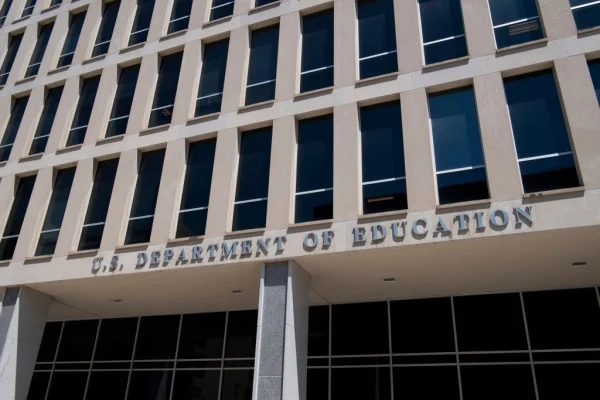
The Education Department’s National Center for Education Statistics is being reimagined.
Caroline Brehman/CQ–Roll Call Inc./Getty Images
A group has formed to recommend changes to the National Center for Education Statistics, a fundamental higher ed data source, after the Trump administration laid off almost all NCES employees last year.
The Institute for Higher Education Policy has launched a 22-member NCES Next Task Force, which includes former NCES associate commissioners, two members of the conservative-leaning American Enterprise Institute think tank, a former New Jersey higher ed secretary under Democratic governor Phil Murphy, professors of education and others.
“With critical federal data systems facing unprecedented uncertainty, our latest project will tackle some of the most pressing questions about how to modernize and streamline vital federal data collections and create a shared vision for strengthening the evidence base for postsecondary policy and practice,” said Erin Dunlop Velez, vice president of research at IHEP, in a Thursday news release.
The task force will work over the next two years to produce papers on “the federal role in data collection and dissemination, leveraging state and administrative data in federal data collections, increasing data access while protecting privacy, and utilizing emerging technologies, including the role of artificial intelligence.” The series will lead to ”a comprehensive IHEP-authored blueprint for rebuilding and strengthening our federal postsecondary data system.”
NCES houses the Integrated Postsecondary Education Data System and the connected College Navigator website, which parents and prospective students can use to research colleges they’re interested in.
The Education Department is itself considering the future of NCES. Late last month, it released recommendations on “reimagining” the Institute of Education Sciences, which includes NCES. The recommendations included that NCES “should develop a streamlined and coordinated data strategy while preserving and strengthening its vital core functions” rather than “funding multiple data collections and longitudinal surveys that may be redundant or outdated.”
