

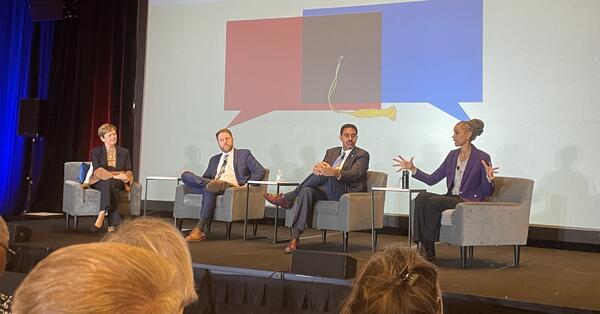
A free expression lawyer, a university system leader and a civil rights activist were unified in their call to higher ed leaders to “stand up” against violations of First Amendment rights and the stifling of free speech on campuses at the annual meeting of the American Association of Colleges and Universities in Washington, D.C., on Thursday.
At the opening plenary, the legal director at the Foundation for Individual Rights and Expression, Will Creeley, joined John King, chancellor of the State University of New York, and Maya Wiley, president and CEO of the Leadership Conference on Civil and Human Rights, in condemning institutions that have bent to political pressure. They warned that threats to constitutional rights are no longer a red-state problem.
“I never thought I’d live in a country where you’d be snatched off the street for writing an op-ed, but that is most definitely our country now,” Creeley said, referring to the 2025 arrest and detention of Rümeysa Öztürk, a Turkish international student studying at Tufts University.
Without naming the University of Arkansas or the professor directly, Creeley said it was “galling” that an institution “rolled over” when conservative politicians pressured it to rescind an offer to a law school dean—presumably Emily Suski—after discovering she signed an amicus brief in support of transgender athletes.
“Too often that kind of expedient capitulation, that kind of quiet cowardice, is seen as the easiest way to get through it,” he said. “Folks, I don’t think that’s going to work. We’ve got a serious challenge here. The time is now for institutions to stand up and fight.”
King acknowledged his “place of privilege” heading a public institution system under a Democratic governor, but he urged leaders in Republican-led states not to compromise their values.
“I have to say, in my view, some folks in leadership roles across the higher education sector have lost their sense of where the line is, and they are complicit in a dismantling, not only of core values in higher education, but frankly of our democracy,” he said.
King also warned against the “chilling effect” the attacks on speech are having on college campuses. “For people thinking, ‘I could teach this book but I don’t want to deal with the headache’ or ‘I could ask students to debate this question, but I think it could get out of hand and I don’t want to do it’—that day-to-day creeping fear is diminishing the quality of discourse on campuses,” he said. “And that is not just a red-state issue. That is a purple-state, blue-state issue that’s happening all over, and it’s very dangerous.”
Wiley, who has also served as a faculty member and senior vice president for social justice at the New School, suggested institutions take inspiration from the strategic planning behind the civil rights protests of the 1960s by creating courses and syllabi that would provoke “conflict-based constructive engagement,” including litigation.
“There’s an opportunity to understand our power where we’re willing to figure out a play and relationships to have the conflict-based constructive engagement because, in this period, there is no winning without conflict,” she said.
Both Wiley and Creeley called for greater coalition-building across colleges to respond to the attacks on the entire sector. For his part, King praised what he saw as greater cross-institutional collaboration to rebuild trust in higher ed, but he said institutions should be careful to avoid the “unforced errors” they made after the Oct. 7 attack on Israel.
“That handed opponents of higher education the ability to structure this attack,” he said, calling for clear, content-neutral time, place and manner restrictions for student protests. “Those kinds of reasonable things were not necessarily communicated, were not necessarily enforced and the chaos that resulted became an opportunity for enemies of higher education to have a basis for attack,” he added. “We have to be very disciplined about that.”
In response to a question from the audience about increased surveillance of faculty and students online, Creeley said students in Oklahoma and Texas “manufactured outrage and made-for-TV moments” when they complained about a grade on an essay referencing the Bible and secretly recorded a confrontation with a professor who used the word “gender” in their classroom, respectively.
“[These incidents are] manufactured to go viral—a culture war sugar rush for all kinds of media outlets. To the extent you can prepare your educators for that … I think is for the better.”
Correction: King used the word “chaos” not “payoff” to describe the student protests after Oct. 7.
