

MINNEAPOLIS — On a frigid February afternoon at a Spanish-immersion child care center, toddlers grabbed puffy coats out of cubbies as parents helped them pull on mittens and hats before heading home.
In an office down the hall, Michael, the husband of the center’s director, stared intently at a computer monitor streaming footage from the building’s security cameras. During dismissal, he watches for any vehicles that might be carrying agents from the U.S. Immigration and Customs Enforcement. Since January, when federal agents descended on the Twin Cities as part of Operation Metro Surge, he started leaving his own job early every afternoon to volunteer here.
As the last children left, other volunteers arrived. Most of them are in their 70s, and they’re now here regularly, too. In fact they’ve become so familiar the staff has affectionately nicknamed them the “abuelitas,” even though their own grandchildren don’t attend the center.
Their mission has been to drive 10 of the center’s staff members home and to serve as observers and translators should federal agents pull them over. The staffers are immigrants, and even though the center director says they are all authorized to be in the country and working, the aggressive enforcement left them too afraid to drive to the center on their own.
“I’m just doing what I can do. And I obviously feel less vulnerable than she would be,” said Sarah, one volunteer driver. “I’m white, I’m 71. I think I would not be treated like she might be treated.” Those interviewed for this story agreed to talk only if the center wasn’t named and their full names were not included, for fear of attracting the attention of federal authorities.
The effort has been both a feat of organization and a time-consuming daily grind: Some 60 volunteers, many of whom live in suburbs, have worked in shifts taking the center’s staff members to and from their homes in neighborhoods across the city.
Related: America’s child care system relies on immigrants. Without them, it could collapse
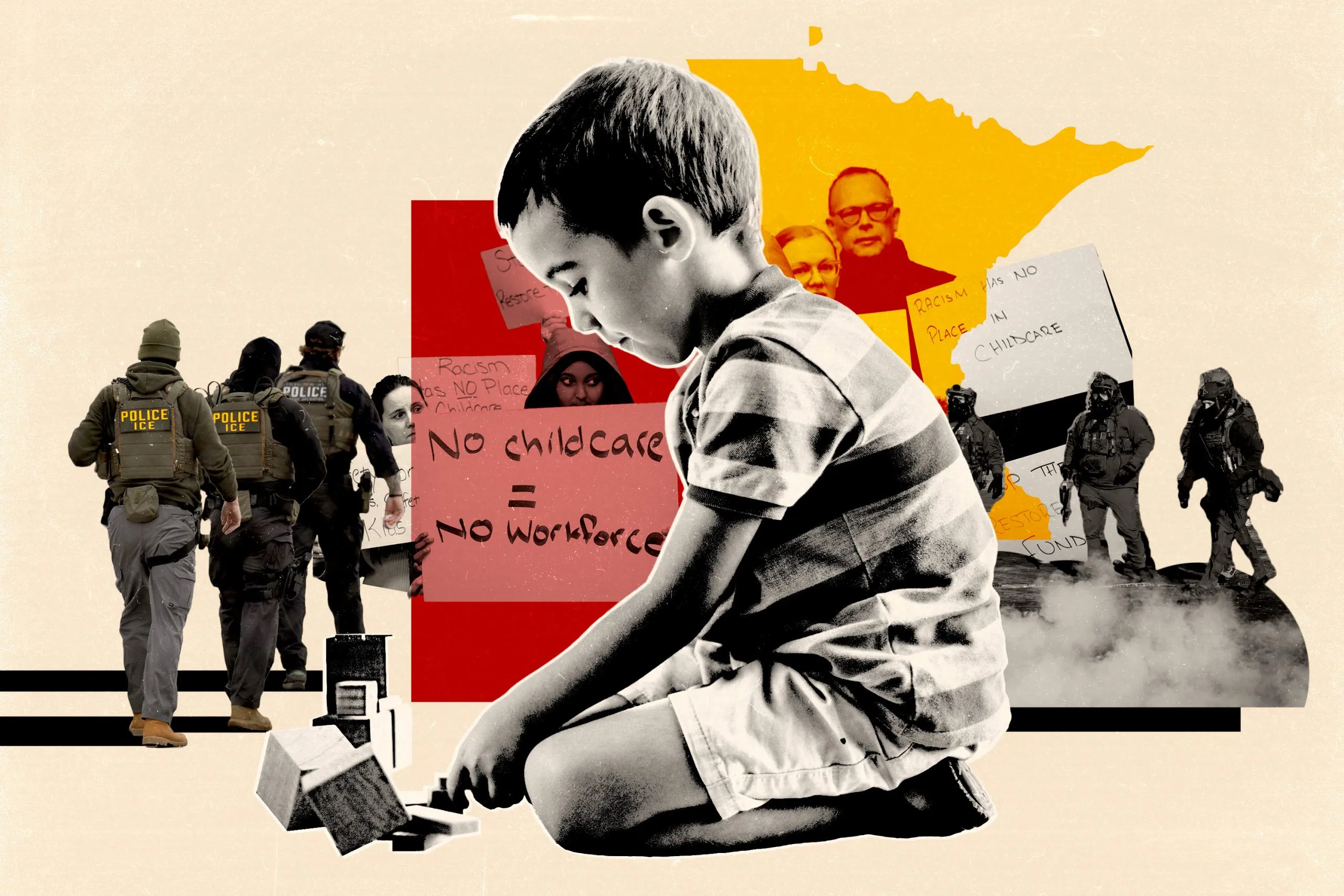
The volunteer drivers are just one example of the elaborate systems of mutual aid and support that child care centers have set up in the Twin Cities. The immigration surge in Minnesota was linked to debunked claims that many daycare programs in Minneapolis and in St. Paul were taking public money but not caring for children, putting the entire sector under a microscope.
This one center had to cope not just with fearful employees, but with threatening anonymous phone calls and families withdrawing their children.
Nationwide, 1 in 5 workers in the child care field are immigrants, so enforcement actions around the country have had an outsized impact on child care providers.
The effort that has kept this center open offers lessons for child care facilities in other communities that may face similar actions. While Minneapolis and this center’s staff slowly get back to something like normal, other areas may have to develop volunteer networks of their own.
“You literally have to have a good network to survive, because it’s not as though there is a government organization coming to help,” said Lily Crooks, the director of a child care center in St. Paul who is active in local networks to help providers. At her center, for instance, Crooks held a fundraiser that raised $5,000 for Lyft gift cards so that employees and parents could pay for a ride rather than stand at a bus stop where ICE agents have been known to operate.
“It’s both really amazing to see the way that people are sticking up for their neighbors and supporting them, and then it also kind of feels bleak realizing that there isn’t going to be some saving entity coming,” Crooks said.
But even as Bruce Springsteen, U2 and others rush out anthems celebrating the mass resistance efforts by folks in the Twin Cities to help their immigrant neighbors, some worry about what will come next as the surge recedes from public view, and if such volunteer efforts will be sustainable in the long run.
“This is not over,” said Diana, the director of the child care center. “And maybe it’s going to take years.”
Related: Young children have unique needs and providing the right care can be a challenge. Our free early childhood education newsletter tracks the issues.
In November, employees at the Minneapolis daycare center started hearing murmurs that immigration agents were detaining people even if they had legal status.
“They are not respecting the due process — like, what is happening?” said Diana, whose center serves about 50 children from 3 months to 5 years old. “Then some teachers started to say, ‘I’m not gonna go out.’”
The employees started limiting how often they left their homes, only venturing out to work. All of her employees are authorized to work in the country, Diana said, but since English is not their first language, they worried about explaining their situations if stopped by ICE.
“We had to cancel our holiday party because they were afraid to go out at night,” she said. Diana, who grew up in South America but is now a U.S. citizen, started carrying her passport in her purse, just in case.
Then the day after Christmas, Nick Shirley, a 23-year-old right-wing influencer, posted a video on YouTube alleging fraud in Somali-run daycares in Minneapolis. The video — which included many claims that were later shown to be false and misleading — went viral, quickly attracting millions of views and amplification on social media by Vice President JD Vance and Attorney General Pam Bondi.
Suddenly the child care system in the Twin Cities became the focus, with Shirley visiting centers run by Somali immigrants that he claimed collected government handouts despite serving no kids. Reporters visited some of the same centers soon afterward and found them operating normally, but the Trump administration quickly announced that it would freeze federal child care payments for low-income families in Minnesota because of what it said was widespread fraud.
Only a few of the families in Diana’s privately owned center are on public assistance, but she knew plenty of other centers in the area that would be plunged into a financial crisis without federal funding; an estimated 23,000 children in the state rely on it. (In February, a federal judge ordered the funds unfrozen while a legal challenge to Trump’s action plays out.)
Shortly after the freeze announcement, on New Year’s Eve, Diana’s center received a threatening phone call.
“He was saying, ‘You guys are not safe. You guys have to leave,’” Diana said. “And I was like, ‘Who is this?’” The line went dead. “I was thinking, ‘Do I have to go into lockdown? Is this someone who will come and shoot, you know, use guns?’”
She called the police to report what she felt was a threatening call but said officers told her there wasn’t enough detail to investigate. Still, Diana notified families, wanting to be transparent about any risks. She heard from other child care center directors who’d received phone calls from people making more direct threats against staff members and about social media influencers knocking on their doors trying to record videos of children.
On Jan. 5, the Trump administration cited the Nick Shirley video as justification for adding 2,000 ICE and Border Patrol agents to its Operation Metro Surge in Minnesota. That brought the total number to some 3,000 officers, about three times the number of police officers in St. Paul and Minneapolis.
Then, two days later, ICE agent Jonathan Ross shot and killed Renee Macklin Good, one of the thousands of residents who’d taken on the role of volunteer observers during the enforcement surge. The shock of the event sent most of Diana’s employees into hiding. So many employees stayed home that she closed the center for six days as she tried to figure out how to move forward.
Some families were spooked, too. Families withdrew 12 kids, forcing Diana to lay off one staff member.
To persuade her remaining staff to return, she reached out to people and nonprofit groups she knew for help on how to keep her staff safe. A local immigrant rights group offered to coordinate the system of volunteer drivers to escort staff to and from their homes.
The staff members all agreed to try it. Every morning, Diana checked to make sure no one was detained.
“We say on the radio, ‘Everyone is here,’” said Diana, tearing up. “The kids don’t know what we mean. But every day it’s: Who is going to make it? Are we all going to make it?”
The drivers said volunteering was an obvious decision, even though they also feel unsafe doing it. Most don’t consider themselves activists.
“Oh, it’s risky,” said Sarah, who has been driving one of the child care employees home two or three times a week, often with her 76-year-old husband as backup. “I still need to find the strength and courage to do what I know is right.”
The volunteers have been coached about what to do if they are stopped by ICE: Crack the window, don’t lie, see if the agents have a warrant signed by a judge and dated.
If she were stopped, said Sarah, “I would do the best I can. I would follow the protocol. I would ask all those questions — and what would happen, would happen.”
Sarah takes precautions to avoid being tracked. She always turns off her smartphone’s location services when giving rides. She wishes she had a second car so she could alternate vehicles.
She is also careful when talking about her volunteering, since she knows that not everyone sees things the way she does. At a recent meeting of her neighborhood book club, “one of the women said, ‘The Somalis don’t belong here.’ Another one said, ‘They’re only rounding up criminals,’” she said. “It’s really disheartening to me that people can see things and interpret it so differently.”
Sarah was a teenager during the Civil Rights Movement, she said, “and this feels like a similar moment for our generation to stand up and against oppression in various ways.”
And she has formed a bond with the child care worker she drives home, P. “We’ve kind of adopted her — we really want to protect her,” she said. Sarah and her husband have brought her food and are reaching out to their network to try to get her husband a job.
The language barrier makes the 30-minute car rides pretty quiet. P’s English is limited, and Sarah doesn’t speak Spanish.
“She’s so shy,” Sarah said. “But she’s hard-working — a real asset to this community.”
Related: Immigration enforcement is driving away early childhood educators
P. said that she is thankful for the help and wouldn’t be able to work or eat without it. But, in an interview conducted partly in English and partly with the help of a Spanish interpreter, she said she’s frustrated that this kind of help is necessary at all.
“It’s not OK that someone feels unsafe in a safe country,” she said, putting the word “safe” in air quotes.
As a substitute teacher, she fills in when any of the other employees go on breaks, changing the diapers of the youngest kids and helping out with pre-K students as well. She’s able to forget about the situation when engaging with the kids. But she misses being able to move about without concern.
“I’m free,” the staffer said, again with air quotes. “But I can’t do anything. It’s very hard.”
Though Trump administration officials have announced that Operation Metro Surge is winding down, residents are gradually seeing a change: Crowdsourced sites like IceOut continued to record ICE actions. Local media said that agents were getting stealthier and targeting the suburbs rather than urban areas.
Even so, leaders of the volunteer driving effort have started looking for signs that the situation is safe enough for them to wind down their efforts. In early March, all but two of the employees said they were comfortable enough to start driving to work on their own again.
P is still being driven to work, but she expects that soon she will go back to driving herself. “I need a job. It’s not possible to stop for me,” she said. “We have to try and just do it. We have to survive. We have to ‘resistir.’”
Diana, the center director, explained that “in Spanish we use that word a lot — ‘resistencia.’” The meaning carries a blend of resistance and endurance.
“It means that you don’t give up, you keep fighting,” she said. “We are going to get through it. This is going to pass.”
Contact editor Christina A. Samuels at 212-678-3635 or samuels@hechingerreport.org.
This story about ICE raids was produced by The Hechinger Report, a nonprofit, independent news organization focused on inequality and innovation in education. Sign up for the Hechinger newsletter.
This <a target=”_blank” href=”https://hechingerreport.org/minneapolis-child-care-center-immigration-surge-moving-forward/”>article</a> first appeared on <a target=”_blank” href=”https://hechingerreport.org”>The Hechinger Report</a> and is republished here under a <a target=”_blank” href=”https://creativecommons.org/licenses/by-nc-nd/4.0/”>Creative Commons Attribution-NonCommercial-NoDerivatives 4.0 International License</a>.<img src=”https://i0.wp.com/hechingerreport.org/wp-content/uploads/2018/06/cropped-favicon.jpg?fit=150%2C150&ssl=1″ style=”width:1em;height:1em;margin-left:10px;”>
<img id=”republication-tracker-tool-source” src=”https://hechingerreport.org/?republication-pixel=true&post=115312&ga4=G-03KPHXDF3H” style=”width:1px;height:1px;”><script> PARSELY = { autotrack: false, onload: function() { PARSELY.beacon.trackPageView({ url: “https://hechingerreport.org/minneapolis-child-care-center-immigration-surge-moving-forward/”, urlref: window.location.href }); } } </script> <script id=”parsely-cfg” src=”//cdn.parsely.com/keys/hechingerreport.org/p.js”></script>
