

Over the past 18 months, I’ve had the privilege of exploring the intricacies of Indigenous education and leadership alongside my co-host, Jason Cummins. Together, we’ve delved into the nuances of culturally responsive classrooms, educational equity, and how Indigenous communities are fostering cultural preservation through innovative practices. These conversations have been both inspiring and transformative, and today’s episode continues that journey.
I’m excited to welcome Kelly Berry, an enrolled citizen of the Apache Tribe of Oklahoma with Kiowa and Choctaw affiliations, to the podcast. Kelly is a Mellon Impact Post-Doctoral Fellow and Lecturer at the University of Oklahoma in the Department of Native American Studies. His work centers on the intersection of Indigenous ways of knowing, education, and technology, with a focus on Indigenous futurism, esports, and 21st-century skills.
Kelly brings a wealth of experience, having served as a teacher, faculty member, and curriculum advisor in various institutions, including Kansas State University, Bacone College, and Comanche Nation College. As a passionate advocate for cultural revitalization, Kelly’s research explores how technology and storytelling can dismantle stereotypes, preserve heritage, and empower Native youth to thrive in both traditional and modern contexts.
Jason Cummins: Good to see you this week, Mason. I’m Jason Cummins, from South Central—the region of South Central Montana, Northern Wyoming. That’s our territory, our ancestral homelands. Really happy to have our guest here with us today. Kelly, would you mind giving us a little introduction?
Kelly Berry: Sure, I’m excited to be here, and thanks for the invitation.
Kelly Berry: My name is Kelly Berry. I’m a citizen of the Apache Tribe of Oklahoma with Kiowa and Choctaw relations. I’m from southwest Oklahoma, where there are about seven tribes located within about 60 miles of each other.
So we all know each other, we all participate in the ceremonies and dances together. Right now, I am a postdoc fellow/lecturer at the University of Oklahoma, where I teach in the Native American Studies Department. I’m also a certified high school social studies teacher and a certified high school principal.
Jason Cummins: The one thing I’ve noticed with a lot of our interviews is a lot of Indigenous scholars will share their background and positionality. Why do you think that is?
Kelly Berry: For me, I’ve learned this going through my doctoral studies. It seems like when I mention my background or my subjectivity, it always gives more credibility within the audience. They know that I’m coming from a position where I know what I’m talking about.
Or if it’s a K-12 issue, it’s because I’ve taught in a K-12 system. If it’s a Bureau of Indian Education (BIE) issue, it’s because I’ve taught in a BIE Indian boarding school. So it lends credibility to who I am, especially coming from an Indigenous lens. So that’s my positionality—I have this background and know what I’m talking about.
If it’s coming from something like an Indian boarding school issue, then I’ve been there and experienced it. Whereas a lot of people talk about it, but they’ve never experienced teaching in a boarding school. So that’s where my positionality comes into play.
Jason Cummins: I always appreciate hearing somebody’s positionality because rather than assuming to come from a positivist view where we pretend we’re neutral, it’s like, okay, here’s my lens. This is how I view these issues. And that lends some credibility. And also to find out where someone is in community.
Like, okay, how are we connected? Where’s the degree of separation? And academically, I think you belong to Cornell and Alex’s academic family too. And so we’ve had Dr. Alex Redcorn on and—
Kelly Berry: Dr. Redcorn and Dr. Ward taught me the ropes going through academia. They put me in a position where I’m at right now, and I’ve met a lot of mentors and friends along the road. It’s been a very exciting journey—not just through K-12, but higher ed—and, you know, learning the nuances of what higher ed is, the setbacks, the obstacles, the barriers.
The wins we have. So I appreciate Jason’s mentorship along the way.
Mason Pashia: I was reading a book recently—I think it’s Pollution Is Colonialism, I think is what it was called. And the form of it was very engaged with how you honor intellectual and cultural ancestors as you’re writing. A lot of the footnotes were very casual, but they would mention where they heard this thing from, and they’d name-drop like 20 people from their tribe who helped them see this. The way that you were talking about Dr. Redcorn right then—how does reference or citation exist within Indigenous scholarship or leadership? Is it a different approach to citation and bringing along this kind of legacy of references and histories, or is it kind of mapped now onto our more Western conception of bibliographies, annotations, that kind of thing?
Kelly Berry: For the most part, it is mapped in Western thinking. But what I’ve been taught by Dr. Redcorn and Dr. Ward is the use of oral stories. From my teachings in my classrooms—from K-12 to higher ed—I always bring in an oral story that’s not written down in the textbooks, and my students are not familiar with that way because they’re used to straightforward textbooks.
That’s all they’ve known growing up. So when I bring in the oral story from the 1800s that was passed down from my ancestors, my relatives, it really gives an idea about the value of oral stories. You can cite oral stories, and I know sometimes my colleagues in Western thought will tell me oral stories don’t really mean a lot. Yeah, they do to our culture. Just because they’re not relevant to what you’re citing doesn’t mean I’m not going to cite it. I’ve had pushback from oral stories being cited, but when it gets down to it, I’m going to cite it no matter what because that’s our way of citing stories that are not written down. That’s how I see it.
Jason Cummins: Yeah, I agree with that. That’s very insightful. Acknowledging your sources is big in the community as well—acknowledging where you heard the story, who told it, and showing the unbroken chain of the sources. Adding to that is just the accountability piece—relational accountability.
Mason Pashia: Hmm.
Jason Cummins: Whereas in a Western academy, there’s a free market society. But in the Indigenous scholarship community, those practicing relational accountability will seek out permission first and be sure to acknowledge where they heard it.
And so it’s a bit different—a little more accountability to your relationships.
Kelly Berry: Yeah, if I went by the textbooks, then my students would never know these stories that have been handed down for generations. They would never know those horrible stories of Indian boarding schools because, as a certified high school teacher—and Jason knows this—not much is covered in the textbooks because you have to hit every standard throughout the year.
You’re only spending like half a day on a topic. So if I can bring in more about the Indigenous ways of knowing, then that’s going to give my students a more insightful view of Indigenous peoples throughout the centuries. So that’s why I do it, and it may buck the trend of going by the textbook.
Non-Native colleagues do, but I don’t follow their game plan. I want to be my own Indigenous teacher in the classroom.
Mason Pashia: Hmm.
Kelly Berry: Yep.
Mason Pashia: That makes a lot of sense. Jason, I may take this into the future real quick and then come back because that’s an interesting jumping-off point for Indigenous futurism, which, Kelly, is something I read about in your bio and some of the other things that you’ve published and written. Obviously, futurism doesn’t have a textbook for—it hasn’t happened yet. How are you thinking about, I guess, what is Indigenous futurism, and how does it relate to something like a futures thinking or an Afrofuturism? And then how does this show up in your practice and with your students?
Indigenous Futurism & Video Games
Kelly Berry: I use Indigenous futurism to reclaim the narrative or present what life would be like for Indigenous peoples if first contact never happened.
Indigenous futurism is an alternative timeline. I know we always point to 1492 as first contact. What if that contact never happened? Where would we be at?
Would we still be living in teepees? Would we still be living in longhouses or hogans and not seeing the colonization we’re seeing today through health disparities and certain traditions? That’s how I see Indigenous futures in my work—presenting this as a bird’s-eye view of the non-Natives not being here anymore.
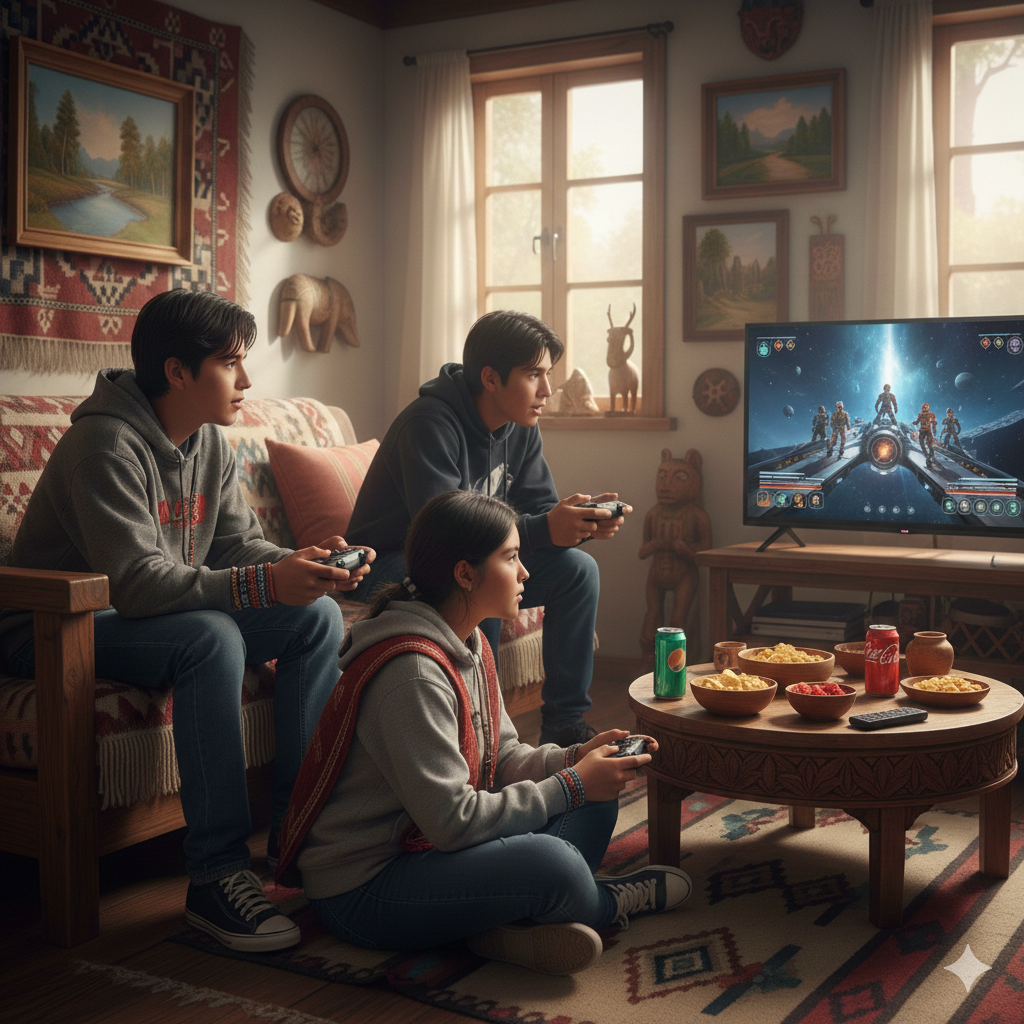
Not having to go through what we call the Ghost Dance and wish that the non-Natives would go back across the pond. None of that would have happened if Indigenous futurism had played out where we never had contact. The way I use it in my research is video games. How do we see games going in the future where it privileges Indigenous voices but also gives us control over the narrative. One of the really good responses from a gamer I was talking to was the fact that he said, why don’t we make a lacrosse game where it privileges the Iroquois Nations because they’re the ones that the Creator gave the game to.
They’re the ones that created lacrosse, so why can’t we make a video game, an eSports game, and say, this is the history of lacrosse from the Iroquois point of view? And then have a team that’s playable in the game that you can play as the Iroquois, with names from that nation on there, and have the language thrown across the screen where it shows Indigenous ways of knowing and reclaims the narrative instead of you having these other sports games where there’s nothing Native about it. Even if you look at certain sporting events such as the Women’s College World Series, they had 10 Native girls playing during that World Series. Why can’t we have a video game where we can play those Native girls? Why can’t we have Lindy Waters III on an NBA 2K cover, where we can play him as a character?
Instead of playing all these superstar characters, it’s about privileging those voices in video games and making sure that we have authentic representation and collaboration with tribal communities. That way, we have our voice in the game instead of these early video games. W-H-O-M-P’ P-A, and it has a little stereotypical Indian character with a stereotypical feather and a breechcloth that does nothing true to our Indigenous culture. So going forth, it’s about having those characters that I can see as truly reflective of the Indigenous cultures. That’s what I see.
Mason Pashia: And is that in service to Native youth and adults playing the game and seeing themselves reflected in it? Or is it actually more long-term re-narrativizing, like what it means to be a Native American in this context? Like I’m thinking partially through the lens of something like AI, right? Where in the future, it’s probably very likely that you could have an AI video game giving you whatever you want out of it as far as who the main character is. That’s probably not too far off. However, that doesn’t really serve this re-narrativizing work. It more just serves representation for whoever happens to be playing that game. So I’m curious which one is more important, but how are you thinking about the impact?
Kelly Berry: I’m looking at long term. Right now, we’re at baby steps because it’s just been a few years since we had a video game where the developers reached out to the tribal communities and asked their advice and told them, can you help us put your story in the game where it truly reflects your culture?
The very first one, if you look at it going back, is called Never Alone. And game developers reached out to Alaskan communities and had them help with the input about who the character was and the storyline. And that’s only been a few years ago. So when I’m looking at these video games going forth, I’m looking at long term.
What other video games can we reclaim the narrative in instead of going back to those stereotypical images that we see in Mortal Kombat 3 with Nightwolf or Turok: Dinosaur Hunter? Why can’t we move forward? And, you know, I’m going to say this—those games I just mentioned, Mortal Kombat 3 and Turok, growing up, those were my favorite games.
I didn’t know at the time, and I didn’t realize or even think about that. The reason I figured that out is because I had students ask me, if you look at Turok, he wears a breastplate in the game and he fights dinosaurs. I’ve had students ask me time and time again, “Dr. Berry, do you fight dinosaurs all the time because that’s what the game shows? Do you still—are you able to change into a coyote or a wolf because that’s what the game shows in Mortal Kombat 3 with Nightwolf?” So going forth, it’s a long-term plan of mine to dismantle those stereotypes in those video games.
Because if you look at the history of video games, which is less than 70 years old, there are about 30 or 40 games out there that have stereotypical images of Native Americans. But going forward since about 2010, there are only about four or five or six games that really have Indigenous characters that truly represent who the culture is.
No matter what culture or tribe it is, it steps toward that goal of dismantling those stereotypes in video games.
Jason Cummins: As a school leader, how would we reframe video games? Because I have to tell you that it was kind of frowned upon when I was growing up.
Kelly Berry: If you look at the percentages, 87% of textbooks in social studies show Indigenous peoples from that pre-1900 context. And they still show us as that savage Indian, that romanticized version where, you know, we’re just out there, you know, raping and killing white women. That’s what the textbooks show sometimes—the pre-1900 context.
But for school leaders—and I’ll use a game that really helps me out in my social studies—it’s called Assassin’s Creed III. And Assassin’s Creed III has a Mohawk character. The game developers reached out to the Mohawk Tribe, cultural experts, and said, “Hey, can you help us out?” So they did that, but at the same time, students that play Assassin’s Creed III get to experience the Revolutionary War, get to experience aspects of that time period.
From student feedback, the game explains more about that time period than the textbooks do. So you have video games teaching students these history lessons that can apply to exams and test well. Instead of just showing a small paragraph or a two-page topic over the Revolutionary War, they’re actually playing it.
And because 90% of students are video gamers, you’re teaching to their strengths. You’re actually letting them enjoy a video game and also learn history at the same time. My advice to school leaders is, if you want a game or a couple of games to use about history, use Assassin’s Creed. I guarantee students may score higher on exams about Revolutionary times than they would just learning from the textbooks. So that’s what I would advise the school leaders.
And what’s sad, though, is that they made that game, and it truly reflects who we are and also helps out student learning. But the next game that was planned to come out was Assassin’s Creed: Civil War. And it was going to teach about the Civil War.
And I was all for that. I was going to have that in my classrooms because I wanted students to play it and learn about the Civil War, but it got canceled because of DEI issues. They’re not going forth with that game anymore, and I wish they would have because it would have been another video game to use in classrooms. But sadly, because of the climate we are in now, you will not see that game ever produced.
Jason Cummins: Yep. Switching up a little bit from futurism, I remember Dr. Yellowbird saying, you know, Indigenous peoples have always embraced technology. And so when people think of that romanticized view of Indigenous people, it’s often of people in the past and wondering why we use duct tape.
Kelly Berry: Right.
Jason Cummins: Why we’re talking about video games and learning.
But switching up from that, I’m thinking—you did some really interesting work on colonial schools, I think they’re called. And that’s a topic of Indian education that a lot of us are unaware of. Can you speak to that?
Kelly Berry: Yeah. So, you know, the title’s kind of changed a little bit.
Colonial Indian Schools
Kelly Berry: I don’t really use “colonial schools” anymore because it doesn’t give the timeframe. What I use now is called “Indian schools in the 13 colonies.” That’s kind of where I can place that, and people in the audience really know that’s the time period I’m talking about—the 13 colonies. I’m a descendant of the federal Indian boarding schools. My great-grandparents went to Carlisle Indian School, Chilocco Indian School, and Rainy Mountain Indian School.
I also taught at a contemporary Indian boarding school, Riverside Indian School in Oklahoma. A couple of years ago, I was on a teacher’s workshop in Virginia, and it was on the campus of William & Mary. One of my faculty colleagues said, “Hey, Kelly, let’s take a walk.” I said, “Okay, where are we going?”
He said, “We’re going to take a walk across campus.” Well, I had no idea that campus was about three or four miles wide. Did not know that. If you’re in Virginia in the summer, you know it’s very hot.
Jason Cummins: Humid.
Kelly Berry: So my colleague took me on a walk about 15 or 20 minutes across campus, and we got to this building. He said, “Look around. I want you to look around.” I said, “Okay.” And all these buildings looked the same. I’m thinking, we could have saved 15 minutes. I could have looked around at those buildings where we were at instead of going in the heat where I’m sweating and looking for some water.
And he says, “I want you to look at that building behind you.” And I looked at it—same building I could have seen 15 minutes down the road. And I said, “What’s so special about this building?” He said, “You’re looking at the oldest still-standing Indian school on this continent.” And I said, “What do you mean the oldest Indian school?”
He said, “This was called the Brafferton Indian School, and it’s from the early 1700s.” And my thinking at the time—and I asked him, “What do you mean Indian school?” Because I thought the only schools were the federal Indian boarding schools after 1819. He said, “No, no. You had Indian schools that were educating Native students in the 1500s, the 1600s, and the 1700s.” Blew my mind because the textbooks and classrooms only talk about the federal Indian boarding schools. Many scholars out there only talk about the federal Indian era boarding schools, and I had no idea that those schools existed. There are only about seven or eight of them that you can name by name, and I mentioned one as the Brafferton Indian School.
They were what I call the first formal phase of Indian education in this country. Because I use the word “formal,” Indian people always had education, whether it’s hunting and gathering, putting up a tipi, gutting a buffalo, or butchering a sheep. We’ve always had that.
But by the powers that be, our education was deemed inferior or hedonistic at times. So that’s why I use the word “formal,” because it was white institutions. And so going forth, you look at those schools that I’m researching right now—they had the same assimilation going on through language and school subjects.
But here’s the thing about this difference between those schools and the federals: a lot of the students got to keep their hair. They didn’t make them cut their hair like the federal Indian boarding schools. A lot of them got to keep their language. And some of these tribes, some of these schools such as Brafferton, they allowed what’s called proctors coming from those tribes to make sure the students were well-fed, they kept their language intact, and they weren’t kidnapped. Because during that time period, kidnapping and slavery were really prevalent. That was unheard of in the federal Indian boarding schools, where only students were taken and nobody from that tribe was able to go with them to make sure of their well-being.
So those schools set their first stage—similar, but different at the same time as far as wearing a uniform. Sometimes, like the Brafferton, it was solely just for Native boys. It wasn’t co-ed like you see at other schools. But that’s why I like to tell people, when I always hear a presentation, they always say, “We’re going to talk about the histories of boarding schools.”
Great. We’re going to talk about all three eras—the colonial, the federals, and what we call the self-determination schools of today. I always hear scholars talk about the federal Indian boarding schools, the second phase, which is great because those stories need to be told.
But when you say “histories of boarding schools,” make sure you talk about all three eras. That’s what I advocate.
Jason Cummins: Yeah, I would say that we have to think a lot about power, and even with the word “formal,” let’s say “conventional” or “sanctioned by a Eurocentric worldview.” And there are only 13 colonies, so of course they’re going to have to guarantee student safety because it could create a war with the surrounding nations.
Kelly Berry: Yep.
Jason Cummins: And what were some of the other schools during that time?
Kelly Berry: So Harvard—everybody says, “Oh yeah, Harvard. Harvard Indian College.” At this time, some of these schools weren’t called schools. They were called colleges, but they were still teaching that K-12 curriculum about reading, writing, science, and English.
For the most part, those students stayed on campus. That’s why I still refer to them as boarding schools because they stayed on campus. But if you go back, you can name Harvard as one, Brafferton, Fort Christanna, which is in Virginia, Catawba Creek Indian School, which is in relation to the Meherrin Tribe on the East Coast, and then you have a couple of others. They’re mentioned as schools but not named. If you want to go back to the very first one, you go back to 1536 in Mexico, and it was a college for Indigenous children in Mexico that was preparing them for service in the ministry.
I’m not great at Spanish, so I can’t really give it justice, but those are about five or six schools I mentioned. And then you have, which I left out, the prelude to Dartmouth University called Moore’s Charity Indian School. That was the Indian school that Eleazar Wheelock started and then took those students to Dartmouth to start Dartmouth University.
That school was actually co-ed for Native students. Those are about five or six schools I mentioned that are rarely talked about in classrooms because I’ve heard from teachers say that they didn’t know it’s not part of U.S. history.
And I get that it’s pre-1776, but it may not be part of U.S. history—it’s part of Indigenous history. Those schools really set the foundation for the schools coming afterward, whether they were similar or not. They were part of that first phase of teaching a white education to Native students who had no clue what was going on.
They were innocent, just like the federal Indian boarding school students, and they’re innocent now. We just decided to educate what they, at that time period, deemed the children of the infidels. That was the motto. If you look at the federals, it was “Kill the Indian, save the man,” and, you know, Richard Pratt, all he did was rehash what they were doing in the first phase.
So I always tell people, don’t give all the credit to Richard Pratt because he was just rehashing what they were already doing. That’s my argument a lot of times in my presentations.
Jason Cummins: Infidels.
Kelly Berry: That was the motto. They called us the infidels.
Mason Pashia: What are the criteria or hallmarks of the current-day classification of the school? You said it was a self-determination school. Like, I feel like we’ve, in this conversation and past ones, sort of outlined this distinction of the first two phases. But how would you create criteria for the modern-day one?
Self-Determination Schools
Kelly Berry: I always point people back to about 1966.
Mason Pashia: Okay.
Kelly Berry: So there’s a school called the Rough Rock Demonstration School, and it was on—it’s on—the Navajo reservation. And that was the very first school that had the autonomy and was dictating their curriculum, dictating hiring practices of hiring Native faculty, which those federal Indian boarding schools and those colonial Indian schools didn’t do.
So this is the first time in history with these schools—Indian boarding schools—that we actually had Natives teaching Natives. We actually had Natives overseeing decisions in these schools. So about 1966 is when you start to see the self-determination schools show up, and today, Riverside Indian School is part of those schools of self-determination.
Even though it was a federal Indian boarding school, it’s now self-determination. Rough Rock Demonstration School is the very first one for Native students taught by Native teachers.
Mason Pashia: Hmm.
Jason Cummins: That’s interesting. Generationally, families will send their kids to those types of schools like Riverside and Flandreau, and I don’t know the names of the others.
Kelly Berry: Yeah, and you know what I’m excited about is that we still have 183 Indian boarding schools or tribally controlled schools across the United States. There are always going to be issues with schools. But for the most part, you know, my time at Riverside—
These students were coming from areas, reservations that, you know, there was high drug use, suicides, alcoholism, domestic violence. And we gave them a home. We provided three meals a day for them. There were times at Christmas when students didn’t want to go home, and I asked them, “Why don’t you want to go home?”
And they said, “Well, when I go home, I don’t know where my next meal’s coming from. I don’t know if we’re going to have lights at home. I don’t know if my father’s going to beat me when I go home.” So we gave them a safe haven. And through boarding schools, even though boarding schools have that stigma of being trauma-induced for our people, today’s schools, it’s all about families and that self-determination where we provide a safe haven for our people.
Mason Pashia: Huh.
Jason Cummins: That’s interesting. The whole Indian education spectrum is really complex. People like to say all boarding schools are bad, but currently, there are some schools trying to combat the negative effects of colonialism or settler colonialism, and it’s interesting.
Kelly Berry: Yeah, and there are families that I’ve talked to where they didn’t want to send their kids to schools like Riverside because of that stigma. I’ve had a grandma say when she called me, she said, “Hey, Mr. Berry, do y’all still beat people there? Do y’all still cut their hair there?”
She went to a boarding school where those things happened, and she didn’t send her kid or grandchildren there. But I had to explain to her that it’s far different than what you experienced. But that’s where we’re at now.
We’re not cutting people’s hair. We’re not making them learn religion. We’re actually giving a free reign of what to learn, what to research. And the thing about Riverside and other schools is that we get to infuse Indigenous ways of knowing into the curriculum. That’s one of the highlights of what I like to talk about—these boarding schools of today.
Jason Cummins: I’m just thinking—my grandmother went to a boarding school, but it was in the community. Previously, she went to Catholic school, and it was really funny because in our community, each tribe has their own relationship, right? There’s not one narrative for everybody, although they share similarities.
The Catholic school was the high-achieving school. So they would say, “Yeah, we can sure read,” but then public schools were having a tough time.
Mason Pashia: Oh.
Jason Cummins: There was definitely a competition, and some would call each other “public” on that—close to the community.
Mason Pashia: Kelly, I appreciate learning more about that spectrum. I think that’s really helpful to helping our listeners kind of ground themselves in where we are today and where we’ve been. I asked a question to a guest we talked to a couple of months ago when we spoke with Kara Bobroff—also, listen to that episode—from the NACA Schools Network. I asked her how she defined innovation within her network of Native schools. I think that’s a word we throw around all the time, but I don’t think especially people who are sort of saying, “What is a great school?” have nearly a wide enough aperture for what that can mean.
And you just talked about the incorporation of Indigenous ways of knowing. From the position where you’re in now, how do you think about innovation within schools and maybe specifically within Indigenous-serving schools? And is that different from the Western conception of what innovation is or means?
Innovation & Cultural Preservation
Kelly Berry: Yeah. When people think about innovation, some people think about STEM, which is great. People do think that. But for me, innovation—if I look at these boarding schools versus a public school—I think about the opportunity to offer Native language courses in these classrooms.
If you look at Oklahoma, not every school offers a Native language. We only have seven Native languages being taught in Oklahoma, which has 39 federally recognized tribes. So if we’re going to talk about innovation, it’s about having every school system—whether or not they have Native students—offering a Native language.
Less than 100 years ago, our Native languages weren’t allowed to be spoken in classrooms. For me, it’s about getting a Native language—even if it’s one language. I know some schools have five or six being taught. Where I teach, we have five different languages being taught for students.
But in the K-12 system, even if you have just one, that’s making strides to show you want to honor Indigenous peoples. You want to make sure Indigenous students’ needs are being met. One part of innovation is to add languages to schools. Keep adding those languages.
But I understand the barriers, such as finding qualified instructors to teach those languages, because a lot of tribes don’t have fluent instructors, and a lot of the tribes don’t have those programs that are building those instructors. My tribe—we don’t have a program building instructors for Apache language teachers, so we can’t offer those in the classrooms.
But if you go 20 miles to the west, the Kiowa Tribe—they have seven language instructors in eight different schools, so they’re making strides on that. Also, innovation is having cultural classes. At Riverside, we had ribbon skirt-making classes. We had drum-making classes. We had drum etiquette classes.
So those are courses you don’t see in public schools. I think sometimes people just don’t want that culture in the classroom, or they just don’t understand how to bring that culture into the classroom. But it’s offering courses and opportunities for our students who may not have grown up in the tribal community.
And there are a bunch of those students everywhere that are kind of disconnected from the tribe. But you give them the opportunity to learn who they are. And to me, that’s innovation—being creative and making sure you have culture in the classroom that wasn’t seen less than 100 years ago.
Mason Pashia: Hmm. This might be an unfair question, and forgive me if it comes off wrong. I’m trying to kind of square both this futurism piece and what you just shared, which is like—I guess where, in this definition of innovation, what you just described sounds a little bit like surviving rather than thriving.
It sounds like keeping something alive from the past. There are so many reasons to do that. I think that is justified and fantastic. I’m just curious—when you’re thinking about the futurism component, how do you take this thing that is the idea of survival—whether that be knowledge or practices or a culture—and really turn that corner into something that is more thriving and generative toward new futures, new traditions, new things? Is that a conversation that’s had? Is that something like, “We’re at the first phase; we just need to go slow and make sure that in order to start it all, we have to have this one piece, like staying alive?”
How are you thinking about that as someone who’s not newer in your role, but you are probably a younger person within your institution who’s really trying to shake things up?
Kelly Berry: So for me, I mentioned those cultural classes, but from my background and my strong points—my strong suits—is technology. And earlier, you mentioned AI. And so for me to go forward, to keep that culture in a classroom with AI, it’s about showing the histories of Indigenous peoples—maybe in southwest Oklahoma—about how we lived 300 years ago, because AI has been doing that.
I have a colleague up in Alaska, and they have an AI program where they’re showing, 3,000 years ago, an Alaskan village—what it looked like 3,000 years ago. With, you know, hunting and gathering, drying the food out, building canoes. So for me, I want to show the past of where we were, the present of where we’re at, and then the future.
But where we can go—in my terms and in what I see as sci-fi. I’m a sci-fi person, so how can we go forward and show what sci-fi looks like in about 100 years with Indigenous peoples? When I present this, people ask me, “So what you’re talking about—are we going to be fighting predators in the future?”
That’s one thing we could show, but it’s basically just showing different viewpoints of where we can go in the future. And not just necessarily an alternative timeline, but showing us in, you know, administrative roles that we don’t have today.
Show us in careers where our studies can go 100 years from now with the use of AI and what Indigenous peoples in ceremonies and traditions may look like 100 years in the future. There are new dances coming about every day with our tribes. There are new songs.
What do songs look like 100 years in the future? It’s not about just surviving, but it’s also about making sure these students understand, as Indigenous peoples, where we can go. We’re not limited to what the classroom or what Eurocentric studies show us. We can be our own people just like we were in the past and what we are today.
And I always tell people, when people ask me, “Are you Indigenous?” I say, “Every day.” Every day, I’m Indigenous because that’s who I am. And I’m going to continue to be Indigenous every day, and 100 years from now, if I’m still living, I’m going to be Indigenous in 100 years.
Using AI to show what we can do in the realm of possibilities with sci-fi—movies, books, songs, dances, and clothing. Because we’ve got a lot of people that are making clothes now. So what does our clothing look like in 100 years?
Mason Pashia: Thanks for that answer. It reminds me of the Ursula Le Guin book Always Coming Home. I don’t know if you’ve ever read that, but it’s a sci-fi book set in the future where the world has ended for some reason. Everybody forms tribes again. The science fiction book is a collection of fictional songs, recipes, and dances from the people that are alive.
And it is like the stories we tell, the stories we keep, and these things that are some of our earliest technologies for remembering or for keeping people in step together or worshipping. They are some of the most longstanding and also the most important to continue to iterate on and keep around.
Kelly Berry: And I want to ask Jason a question on this one because he and I are both what we call powwow people.
Jason Cummins: Me? I’m not a powwow person.
Kelly Berry: So—
Jason Cummins: My wife dances, but not me.
Kelly Berry: Okay.
Jason Cummins: I’m the support. I’m like pit crew.
Kelly Berry: Critical role.
So one of the questions that got asked when I was talking about what does 100 years look like for us was, what do powwows look like in 100 years? I didn’t know how to answer that, Jason. So I was going to see if you got your thoughts about what do powwows look like in 100 years, because as you know, powwows are always changing, always evolving to new dances and new dance styles and songs. So what do you see?
Jason Cummins: I think what we have now is—and I can only speak for my community—a lot of it is similar because we kind of pride ourselves on the traditional dances. Like, so there’s the crow hop—it’s a Crow dance—and there’s a Crow traditional women’s dance. And a lot of the meaning is still there, although some probably has changed a bit.
The daytime dance is what we used to have, what people call the powwow now. My grandmother told me when she was little, when the men would war dance, it was fierce and scary, and kids would cry. It still happens now, but I think that’s changed a bit.
But she said that was because those men were actually reenacting their deeds through dance. And so it was pretty fierce. Other than that, the breastplates my father-in-law told me used to be made out of buffalo ribs because it was body armor. So that’s changed so far.
Now it’s more for display, but there’s still meaning behind it. A lot of the traditional teachings are contained within those elements of the regalia. And each tribe is different. So like in my tribe, paint is inherited. You have to have inherited the right to use certain paints.
And I know maybe some other tribes—maybe, for example, the fancy dance is more of like a social dance. It’s, you know, for fun. People can use the colors they want, from what I understand. But then there are some traditional aspects that are inherited.
You can’t just look at somebody’s paint and copy it. You have to have that relational responsibility and cite your sources. My granddaughter inherited a certain type of necklace from my mother, and it’s passed down.
Not everybody can just look at it and say, “Oh, that’s cool. I’m going to copy one.” That’s like the free place market of ideas, right? Where you can just look at something and copy it. And I think just being in community, you know that type of stuff. So there are some songs that are for entertainment purposes.
And so you can sing those songs, but then when you’re in community and in connection, you realize, okay, those songs—you have to have permission for them, or they’re for certain functions. Whereas in regular American society, if you hear a song on the radio, you can sing it all you want. You can even change up the lyrics if you want.
You can do a cover. There’s the element of the modern, social, and entertainment-wise. Then there’s the sacred, the traditional, and I’m reconnecting. I think it’s very important for that reason to understand drum etiquette, the protocols with drums, and so just different approaches to knowledge and different ways of keeping a proper relationship with your knowledge.
So I don’t know what they’re going to look like, Kelly, but I know what they look like now versus what I’ve heard in the past.
Kelly Berry: Yeah.
Mason Pashia: And it’s possible that they’ll look the same, but the context of the present will help them find new meaning or new people. The thing itself might not be the thing that changes.
Jason Cummins: There was one little piece, like in our tribe, there’s different beadwork, and they use buckskin drawstrings to tie armbands or the leggings on and stuff. And so while I was being powwow pit crew, I was like, “Why don’t we just use Velcro?”
Mason Pashia: That would be so much easier.
Jason Cummins: And I did not receive a favorable response. They said, “If you want to do this other type of stuff, you do it. But this is how we learn. So it’s how we’re going to continue.”
Mason Pashia: That’s funny.
Kelly Berry: If I was there, Jason, I probably would’ve said, “On your own time, Jason.”
Jason Cummins: “Make your own outfit. You can do what you want. It’s brilliant.”
Mason Pashia: That is funny.
Jason Cummins: Even within designs within my tribe, certain families will have certain designs.
Mason Pashia: Hmm.
Jason Cummins: And of course, there are makers that can make stuff. But in the area of Indigenous knowledge with regard to respect, reciprocity, relationality—all those R’s—it’s pretty strong.
Kelly Berry: And then, Mason, what Jason’s talking about is actually what I use as teaching and learning moments in my classrooms because a lot of people just assume—I got asked a question a couple of weeks ago from a student. He asked me, “Dr. Berry, do all Native Americans speak Native American?” And that was the question I got. I said, “No, we don’t all speak Native American. We speak our own specific tribal languages.” And I told them that there are 574 federally recognized tribes in this country, many more in Canada, and many state-recognized tribes.
We’re all distinct in our languages, our traditions, our ceremonies. So it was a teaching moment where he knows now that there’s no such thing as speaking Native American. There’s such a thing as speaking Crow, Apache, Kiowa, and Choctaw. When we talk about powwows, that’s another teaching moment that I do. I send my students to powwows. Sometimes I have to bribe them with bonus points. They all want bonus points, so I’ll send them, and then they’ll do reflections. They come back knowing that we all have different regalia.
We don’t call it costumes because that’s what some of my students really said in the classroom is, “What kind of costume do y’all wear?” That’s a no-no. So now they use regalia. Those teaching and learning moments have provided a foundation for my students’ learning about Indigenous ways of knowing.
I’m glad we talked about powwows and, you know, the distinctness of it because it reminds me of my teaching and learning moments in classrooms.
Mason Pashia: That’s great. Thank you, Kelly. All right. I think we need to start to bring this to a close. Jason, do you have any closing questions for Kelly or any gratitude you want to express?
Jason Cummins: No, I don’t. But thanks for joining us today. That was interesting and intriguing. You know, just that 1776 and the schools that happened before that date, as well as the other Indigenous school in what is now known as Mexico but is North America. So that was fascinating. To think about the currents of that ideology that still takes place in all of our schools on our continent, especially towards Indigenous communities, is thought-provoking. So thanks for sharing all that.
Kelly Berry: Yeah.
Mason Pashia: Thanks for sticking with us, Kelly. It’s been great to chat with you today, and it’s lovely to meet you. Thanks for the time.
Kelly Berry: Yeah. I appreciate the time. And, you know, Mason, going forward—and Jason knows this—that if you ever catch a presentation of mine about boarding schools, it won’t be in the federals, it won’t be in the self-determination. It’ll be in those 13 colonies context and everything.
Mason Pashia: That’s good to know. All right, thank you so much, and have a good one.
Kelly Berry: Thank you.
Guest Bio
Kelly Berry
Is an enrolled citizen of the Apache Tribe of Oklahoma with affiliations to the Kiowa and Choctaw Nations. He is a Mellon Impact Post-Doctoral Fellow/Lecturer at the University of Oklahoma in the Department of Native American Studies. Prior to his academic appointment at OU, he served as the Indigenous Initiatives Research Associate, instructor, and curriculum advisory team member for the Indigenous Education Leadership Certificate Graduate Program at Kansas State University. Dr. Berry has served as faculty at Upper Iowa University, Bacone College, Cameron University, and Comanche Nation College and is a certified 5-12 social studies teacher in Oklahoma and Kansas. He is a past fellow of Harvard University’s Management Development Program and current fellow in the University of Arizona Native Nations Institute Tribal Professional Governance Program and Arizona State University’s American Indian Policy Institute Indigenous Peoples Leadership Academy. He is a University Council for Educational Administration Barbara L. Jackson Scholar and currently sits on the American Educational Research Association Indigenous Peoples of the Americas Special Interest Committee. Dr. Berry holds a Bachelor of Science in sociology from OU, a Master of Public Health from the OU Health Sciences Center, and holds a Doctor of Education in Educational Leadership from Kansas State University.
His research focuses on the intersection esports, 21st Century Skills, and Indigenous futurisms and ways of knowing.
Jason Cummins
Jason D. Cummins (Awachíikaate) is an Indigenous scholar with over 20 years of experience in education, having served in various roles including teacher, instructional coach, and administrator. He is a contributing author of The School Wellness Wheel, coauthor of Humanized Education, and a professor of educational leadership at Montana State University. Jason has worked with schools on a range of initiatives, from implementing traditional school improvement efforts to culturally sustaining, trauma-informed, and restorative approaches.
