

Get stories like this delivered straight to your inbox. Sign up for The 74 Newsletter
During an afternoon in the nation’s capital, a high school cafeteria buzzed with conversation as teachers, staff and students gathered around circular tables. It wasn’t lunchtime, it was a staff meeting at Columbia Heights Education Campus (CHEC) in Northwest D.C., one of our district’s 117 schools.
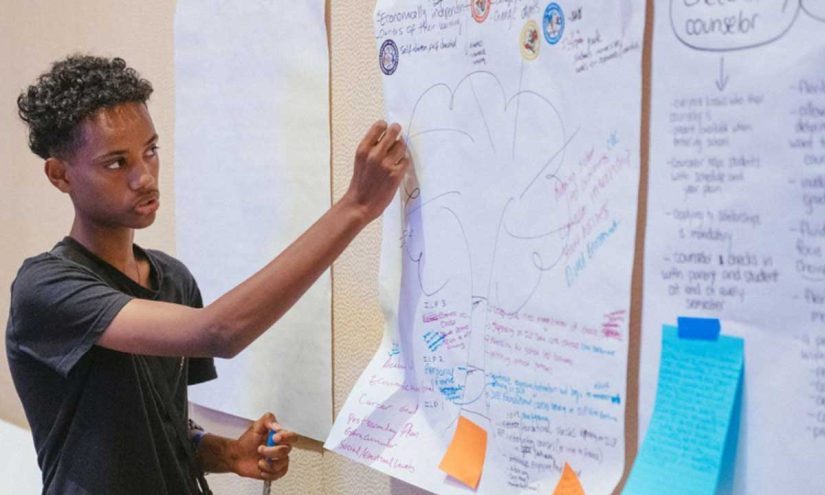
While students don’t typically attend these meetings, this one was different: students were present and at the center of the conversation. Scholars spoke candidly about their experiences with the school’s evolving model for clubs and internships — what was working, what could be improved and what they hoped would come next. The students were reflecting on a program called “Worldview Wednesday,” which allows them to explore academic and career interests during the school day. The goal of the staff meeting was to identify implementation trends, including those raised by students, and improve structures for the following school year’s programming.
What‘s remarkable about CHEC’s approach to staff meetings is not just the clarity of the students’ insights or their sincerity in wanting to help improve programming; it‘s the way the adults lean in, quite literally. Teachers nod, take notes and ask follow-up questions, resembling a co-design session more than a traditional staff meeting.
That was the CHEC leadership team’s goal. During school year 2024-2025, Principal Maria Tukeva and her staff had set the ambitious target to engage 20% of their learners in traditional adult decision-making spaces. They exceeded that aim, with 30% of their scholars participating over the course of the school year. That also led to student sense of belonging increasing by 7%, according to a school climate survey.
I see members of the CHEC team modeling a monumental shift in power as staff members center student voice and revamp school culture. Across the country, pockets of school innovation and improvement have historically gained traction in one classroom or school, but their impact is often isolated. Innovative teachers and school leaders are busy people. Districts rarely have the resources, capacity, and system-level enablers to codify and diffuse promising school-level practice widely.
Codifying and scaling school-level practice can look like curating resource libraries, developing blueprints or playbooks, or even establishing demonstration sites and hosting visits from other school teams so they can see promising practices in action. Districts play a key role in this process, from monitoring and elevating bright spots to providing added capacity and resources to invest in codification.
To Tackle Chronic Absenteeism, This DC High School Lets Students Lead
They can also create enabling conditions for school innovation through flexible policies and infrastructure that allow promising practices to take root and grow. The DCPS Design Lab, in partnership with the XQ Institute, has implemented some of these strategies to overcome challenges that districts have faced nationwide. The district is fortunate to have dedicated Design Lab staff members who work with schools to design and evaluate programs, facilitate cohort-based development initiatives, and shape infrastructure and policy through collaboration with other district leaders.
At CHEC, the student-centered, decision-making model during the school’s meeting in their cafeteria has become an exemplar for youth voice across the district. It has shaped district guidance for key planning processes — such as how stakeholders are engaged in the development of annual comprehensive school plans. I have even heard high schoolers from across DCPS present their own solutions to address chronic absenteeism at our Student Design Days. Some of our schools adopted these student-led ideas, resulting in an increase in-seat attendance by as much as 20%.
Chancellor Lewis Ferebee listens to DCPS high schoolers present findings from the student-run pilots to tackle chronic absenteeism. (DCPS)
Not far from CHEC is Paul Laurence Dunbar High School — America’s first public high school for Black students — where every eligible senior participates in an off-campus internship with a local nonprofit, government agency or business. The school’s “City as Classroom” model has contributed to an 18% increase in students on track for promotion and graduation. Driven by Dunbar’s pioneering efforts, DCPS codified processes for off-campus learning — clarifying site approvals and attendance tracking — making it easier for other schools to replicate the model.
Just down the road at Cardozo Education Campus — every ninth grader engages in structured career exploration before selecting a pathway during a celebratory “Declaration Day.” Since launching this model, Career and Technical Education pass rates for the first course in chosen pathways have climbed to 93%. Encouraged, DCPS is expanding support for exploratory CTE opportunities districtwide.
If we want innovation to scale beyond isolated stories of success, districts can invest in the infrastructure to help support and amplify promising innovations. That can mean creating dedicated roles and teams to provide capacity for codifying and disseminating best practices or building systems to capture and share these practices across campuses.
But first, it means fundamentally recognizing school-level innovators as leaders for the future of learning. Treating local brilliance as the starting point for system-wide change unlocks the full potential of our schools and the communities they serve. The future of learning is already unfolding in our schools, and I am proud of our young people and our staff for leading the way.
Disclosure: The XQ Institute is a financial supporter of The 74.
Did you use this article in your work?
We’d love to hear how The 74’s reporting is helping educators, researchers, and policymakers. Tell us how
