

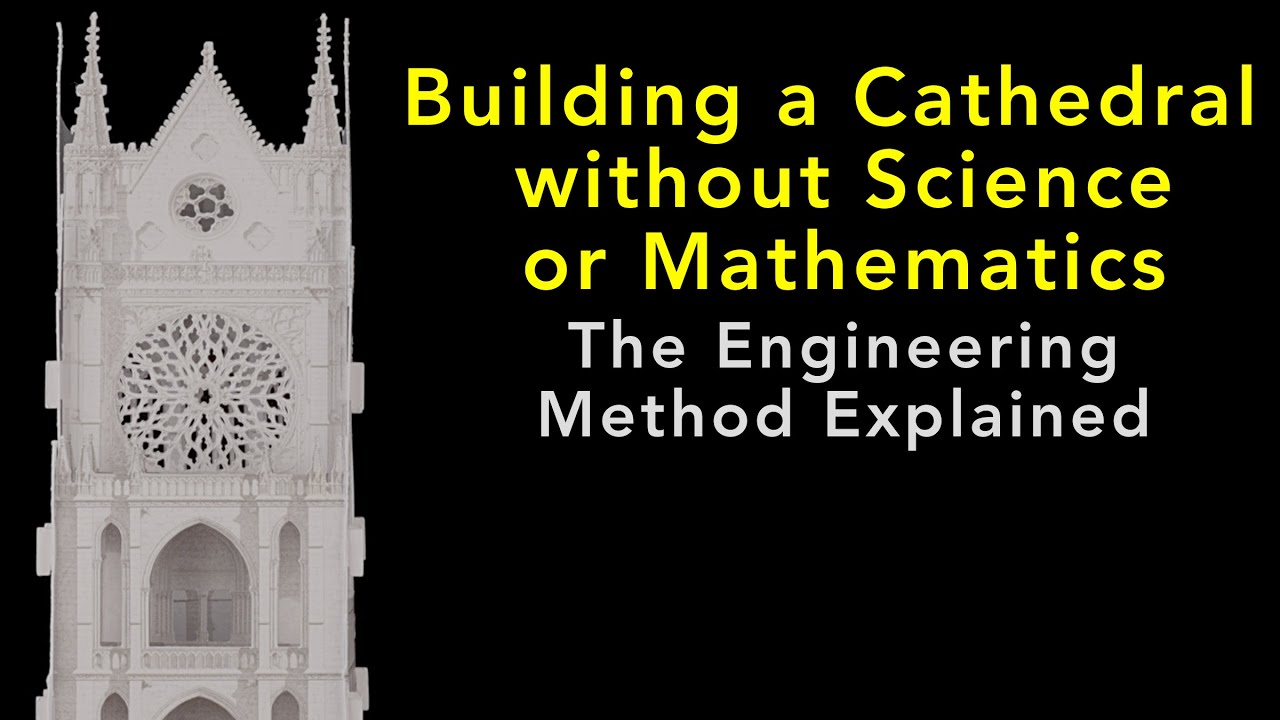
Science and engineering may be conflated to some degree in the public mind, but anyone who’s spent much time in an academic department belonging to one or the other of those branches of endeavor knows how insistently distinctions can be drawn between them. Bill Hammack, a professor of engineering at the University of Illinois Urbana-Champaign who’s been there since he was a master’s student in 1986, surely has his own thoughts on the subject. The video above from his popular YouTube channel Engineerguy explains how cathedrals were designed in the Middle Ages, using the example of Sainte-Chapelle in Paris. Specifically, it gets into how such a building’s arches and supporting walls could have been engineered without the aid of science at all, or even the use of mathematics.
Compared to today, the scope of knowledge humanity commanded back in medieval times may have been impossibly narrow — to say nothing of the knowledge possessed by any given human, especially outside the literate elite. Yet what was then known proved more than sufficient to build structures that still stand, and indeed impress, many centuries (and in some cases, more than a millennium) later.
Hammack explains that, in the place of making calculations, their builders would perform actions. For instance, a medieval mason would have made a life-size chalk drawing of the arch, laid a rope along its form, and cut the rope’s length to match that of the arch. He could then use the rope to determine just how thick the wall would need to be, between a fourth and a fifth of the arch’s span, without a number ever being involved.
Hammack notes that the Romans, too, understood this necessary proportion for arch construction. “The proportional rule doesn’t come from some scientific analysis of stone and its properties,” he says. “It comes from centuries of experience, from trial and error.” Such heuristics, or rules of thumb, constitute “an imprecise method used as a shortcut to find a solution to a problem, often by narrowing the range of possible solutions.” They’re also employed in the engineering method to “cause the best change in a poorly understood situation using available resources.” Its thoroughgoing practicality would seem to have little to do with the different sort of rigors that apply in science, where establishing truth, or at least the absence of falseness, is all. Belief in the engineering approach to problems like this doesn’t require faith in the religious sense, but if you like, you can find proof of its effectiveness in houses of worship from Sainte-Chapelle to the Pantheon to Hagia Sophia — or at least in their arches.
Related Content:
Göbekli Tepe: The 12,000-Year-Old Ruins That Rewrite the Story of Civilization
The Creation & Restoration of Notre-Dame Cathedral, Animated
An Animated Video Shows the Building of a Medieval Bridge: 45 Years of Construction in 3 Minutes
Behold a 21st-Century Medieval Castle Being Built with Only Tools & Materials from the Middle Ages
How Designing Buildings Upside-Down Revolutionized Architecture, Making Possible St. Paul’s Cathedral, Sagrada Família & More
The Longest Construction Projects in History: Why Sagrada Família, the Milan Duomo, Greek Temples & Other Famous Structures Took Generations to Complete
Based in Seoul, Colin Marshall writes and broadcasts on cities, language, and culture. He’s the author of the newsletter Books on Cities as well as the books 한국 요약 금지 (No Summarizing Korea) and Korean Newtro. Follow him on the social network formerly known as Twitter at @colinmarshall.
