

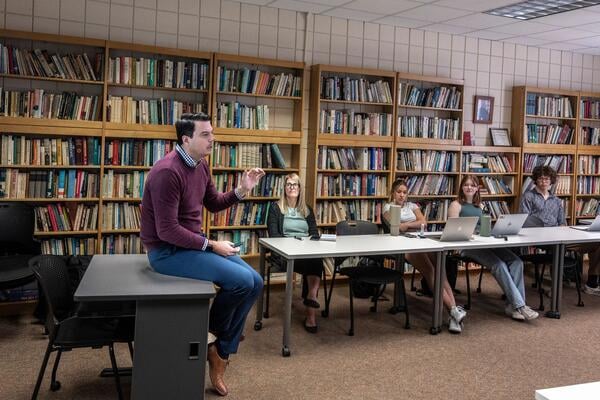
Cris Tietsort was invited into a political science course at the University of Denver to talk to students about compassion at a time when political polarization and social isolation are reshaping campus life. He began with a simple question: What are your values in a calm moment?
“It’s really important for people to clarify their values in a good moment, instead of a heated moment, because that’s when we get really hot, we get emotional, and our brain goes to a different place,” said Tietsort, an assistant professor of organizational communication at the University of Denver.
The lesson is one of many Tietsort developed through the Compassion Lab, which he launched as a one-time course in fall 2023 to help students respond thoughtfully to disagreement.
The following year, the lab became a mobile classroom—an opt-in program for faculty and staff who want to bring its lessons into their courses, from political science and business classes to residential assistant training—with the goal of equipping students with skills they can carry into their future professions.
More than 600 students have participated in the lab, Tietsort said, and over 90 percent reported that they better understood how to put compassion into practice.
“A lot of undergraduates feel alone and they feel like it’s vulnerable to reach out,” Tietsort said. “How do we help support students having meaningful connections with others? I see compassion as the heart of that.”
The Compassion Lab is part of the University of Denver’s 4D Experience, a universitywide initiative launched in fall 2022 that aims to help students develop intellectually, socially and emotionally. The 4D Experience includes the lab, peer mentors and immersive experiences such as retreats at the Kennedy Mountain Campus.
Laura Perille, executive director of the 4D Experience, said the initiative responds directly to what employers say they want in graduates, including strong interpersonal skills, empathy and the ability to navigate conflict.
“The goal is to really think about how we embed this in both the curriculum and co-curriculum in ways that are better preparing our students for life and workplace success,” Perille said.
Erin Anderson-Camenzind, a professor and the 4D Experience’s director of faculty innovation, said the foundation Tietsort created through the lab makes that broader integration possible.
“If we can provide [students] with multiple touch points for building compassion over their time at the University of Denver, then that’s when it becomes part of that identity that we really want for them,” Anderson-Camenzind said.
Fostering compassion on campus: Tietsort said there are two versions of the Compassion Lab: one more skills-focused and one more knowledge-focused.
The skills-focused version is typically used when faculty want students to build tangible tools that apply directly to their major or a course they’re taking.
“If I go into, say, a business class and we’re talking about compassion—not among friends but in the business world—it may need to be more of a motivational conversation,” Tietsort said. “It may need to be ‘How can we help you understand that compassion is actually essential for leadership, and what are the organizational outcomes?’”
The knowledge-focused version, by contrast, goes deeper into what effective support looks like and the research behind compassion.
“I had one student who said they leaned too far toward compassion, which resonates with how sometimes we’re overly compassionate and miss an opportunity to challenge someone,” Tietsort said. “They really appreciated talking about the nuts and bolts of that.”
Ultimately, Tietsort said, the lab’s flexibility is what makes it effective across disciplines.
“I always adapt to the faculty in the class because I want it to feel personalized to what they’re doing,” Tietsort said. “Some faculty want more engagement; some faculty want it to just be something that’s dropped in.”
More than 600 students have participated in Tietsort’s Compassion Lab.
Why compassion matters: Perille said students are entering a world marked by polarization, loneliness and fractured connections—realities she said make the lab and the broader 4D Experience all the more important.
“It’s really building out a network of curricular and co-curricular strategies, faculty and staff professional development, to make sure that we are collectively creating a culture and an ethos that prioritizes these things,” Perille said. “That’s really critical to how we think about this approach.”
Anderson-Camenzind echoed that sentiment, noting that cultivating compassion among students requires institutional support.
“We need to have structures in place that provide faculty and staff with the compassion and support they need, or else they may have a really hard time doing it for our students,” Anderson-Camenzind said.
For Tietsort, the goal is ultimately to help students see compassion as central to leadership.
“If you become a better empathic listener, that’s not just going to have a deep impact in your own life and building relationships, but that’s going to impact you in the workplace,” Tietsort said.
Get more content like this directly to your inbox. Subscribe here.
