

Starting this summer, most college programs will have to show that their students earn more than someone with only a high school diploma to avoid being cut off from federal funding, as part of a new accountability measure.
Congress created the earnings test known as Do No Harm when it passed the One Big Beautiful Bill Act last summer. The Education Department is still working to finalize the regulations that outline how it will work.
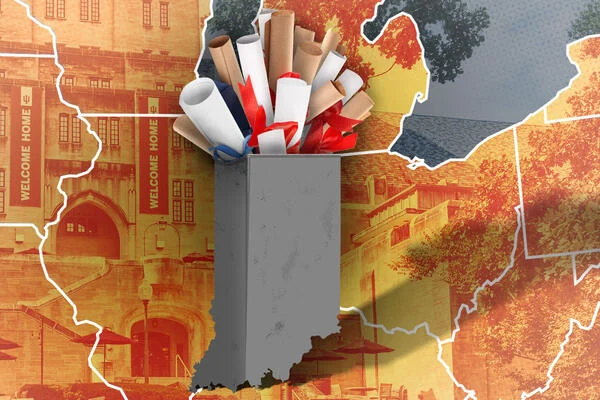
But one state is close to passing legislation that would directly import the federal test into state law—and take it further. While the federal law will cut off students attending failing programs from receiving federal student loans, Indiana’s Senate Bill 199 would end such programs entirely at public universities and Ivy Tech Community College.
In Indiana, the average salary for a high school graduate is just over $35,000, and about a dozen public institution programs would fail based on recent federal data—though the state Commission for Higher Education, a group of gubernatorial appointees, could grant exemptions. So far, the state’s flagship university and Ivy Tech haven’t publicly taken a position against it, but the state commission supports the bill.
In an email, a commission spokesperson said the bill “supports a stronger guarantee that the important higher education investment being made by Hoosier students and their families leads to meaningful career opportunities and financial stability,” adding that there will be “thorough evaluation” of all programs up for elimination, rather than automatic discontinuance.
Both chambers of the Indiana General Assembly have passed the bill, but not the same version. Republican leadership has appointed conference committee members to work out differences between the House and Senate iterations. The public disagreements have not been about this provision, but instead surround unrelated restrictions that the bill would place on minors’ social media usage.
While Indiana’s bill may be closest to passage, higher ed analyst Phil Hill has pointed out that bills were filed in Nebraska and New Hampshire that would also expand the penalty for failing the federal test. New Hampshire’s House Bill 1774, which hasn’t progressed, would cut off state funding for programs that fail the test at any public or private institution in the state. Nebraska’s Legislative Bill 1196, which also hasn’t moved forward, would do the same thing, plus cut off local funds.
The trend, if it picks up steam, could represent a new tool in how Republican states hold universities accountable for—and increasingly define the value of academic disciplines by—how much money they can earn students. Some faculty and Democrats have spoken out against Indiana’s bill.
“This is a form of academic Stalinism,” said Rep. Ed DeLaney, a member of Indiana’s House Education Committee. He said, “Every breathing human being knows that borrowing for college has risks” and that nuclear scientists make more than piano teachers. Yet the bill would end programs entirely, even for people who know the risks or have enough money to not care, he said.
“They’re going to command us to do that which is best for us,” DeLaney said, adding that “it is command and control over our universities.”
Jordan Matsudaira, an American University public administration and policy professor who co-directs AU’s Postsecondary Education and Economics Research Center, said in an email that a few states are moving toward tying state funding eligibility to student earnings or debt levels.
“Indiana is the only one I’m aware of that a) mimics the federal earnings test exactly and b) requires a program be shut entirely if it fails that test,” Matsudaira said. He noted, “That’s substantially harsher than even the federal law it references.”
“Broadly, I do think that increased accountability of this nature is a good thing: Research shows that when low-performing programs close, students tend to choose more valuable programs to attend,” he said, adding that “the argument is especially strong for shorter-term certificate programs, which appropriately are focused on employment and earnings.”
But for higher-level degrees, “More nuance may be warranted,” Matsudaira said.
“Closing a program entirely is an aggressive choice—I think states should take a close look at whether these programs have value that’s not fully reflected in their graduates’ (modest, not woefully low) earnings before fully pulling the plug,” he said. It’s also unclear which programs will fail the test because the U.S. Education Department only released estimates “based on broader classifications of fields of study than will be used in the law,” he said.
The department’s analysis was also based on previous data that won’t be used to implement the final rule. But it suggests that a range of programs at multiple institutions would be on the chopping block. (The department’s analysis uses fields of study rather than exact program titles.)
The programs projected to fail, if the federal test were to take effect today instead of this summer, include Ball State University’s bachelor’s degree in dance, Indiana University at Bloomington’s bachelor’s in music, Ivy Tech Community College’s associate degree in library and archives assisting, IU Northwest and Purdue University Northwest’s bachelor’s degrees in English language and literature—general, Purdue Northwest’s bachelor’s in computer software and media applications, the University of Southern Indiana’s master’s degree in mental and social health services and allied professions, and Ivy Tech’s associate in teacher education and professional development–specific levels and methods.
Heather Akou, president-elect of the IU Bloomington Faculty Council and a tenured fashion design professor, said, “Anything that threatens further [program] eliminations is very concerning.”
Déjà Vu
If the Indiana General Assembly pushing universities to cancel degrees sounds familiar, it may be because Republicans passed a law last year requiring programs at the public universities and Ivy Tech to produce minimum numbers of graduates.
Institutions can ask the state commission for approval to keep offering degrees that don’t meet the threshold of average annual graduates, but if the commission doesn’t grant the exemption, those programs can’t continue. Under the law, House Bill 1001, associate programs must graduate an average of at least 10 students annually over three years, while the threshold is 15 students for bachelor’s programs, seven for master’s programs and three each for education specialist programs and doctorate programs.
Even before the law took effect, the commission said universities planned to eliminate or consolidate more than 400 programs—roughly one-fifth of their degree offerings statewide. The list of disappearing programs included K–12 teacher training programs plus foreign languages; Africana, religious and women’s and gender studies degrees; and electrical, mechanical and computer engineering.
This year’s SB 199 would simply add the requirement that programs pass the federal earnings test to the end of last year’s law.
The federal earnings test broadly works like this: The education secretary will determine the median earnings for students who completed a program four years ago, and those who aren’t enrolled in higher ed anymore and are working. The program fails the test if their earnings are—in at least two of the last three years—less than the earnings of 25- to 34-year-old workers who only have high school diplomas (when comparing bachelor’s programs or lower credentials), or only have a bachelor’s (when comparing graduate or professional programs).
Akou, of the Bloomington Faculty Council, said it’s unclear how the provision will be measured and enforced. Noor O’Neill, president of the Indiana Conference of the American Association of University Professors and a tenured anthropology professor at Purdue–Fort Wayne, called the bill dismaying.
“It goes against AAUP’s values that give faculty primary control over curriculum and trusts faculty to know what’s best for students and institutions in terms of curriculum,” said O’Neill, who stressed that she was speaking for herself and the AAUP conference and not Purdue.
She called the bill “reductionist,” saying it’s “reducing the dreams that students have to enter different fields, judging those dreams and ambitions based on dollars and cents.” Connecting it to last year’s bill, she said lawmakers “want to use numbers to determine” the future of “three-dimensional students.”
She also blamed lawmakers for the low pay coming out of some of the programs on the chopping block, such as education.
“This Legislature, in three years, is single-handedly dismantling what Hoosiers have invested in for generations,” she said.
DeLaney, the Democratic representative, said the bill is a way for Republicans to attack universities without saying they’re doing so openly. (The two lead Republican sponsors of the legislation didn’t return Inside Higher Ed’s requests for comment.) And Delaney said universities aren’t speaking out against the bill.
“This is a power grab by the state administration, which is willingly given in to by the university administrators,” he said. “So we’re in a very difficult moment.”
