

Get stories like this delivered straight to your inbox. Sign up for The 74 Newsletter
Each day, hundreds of rural south Texas high schoolers wake before sunrise to board vans that bump for miles over back roads, crossing ranch land and thickets of brush. Their destinations aren’t their local schools, but distant districts where specialized academies offer them training in nursing, teaching and welding, along with associate degrees.
The students’ home districts — Agua Dulce, Premont, Brooks County, Freer and Benavides — used to operate separately. They had a shrinking student population, were unable to provide much career and technical education, and struggled with low achievement. But seven years ago, a handshake between the superintendents of the Premont and Freer independent school districts gave rise to what would become the Rural Schools Innovation Zone.
Today, the consortium, created to stave off consolidation threats and improve student outcomes, is being lauded as a model of rural collaboration. And the Texas legislature has encouraged other districts to follow its lead.
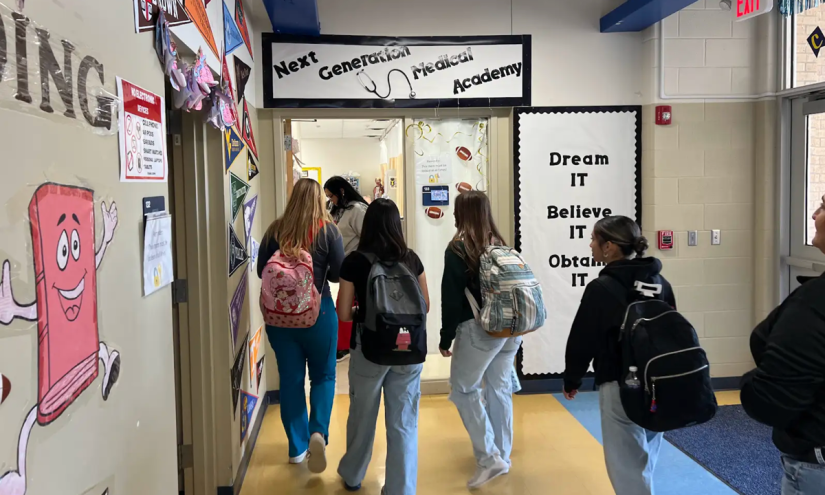
The five districts, located 45 to 90 minutes southwest of Corpus Christi and serving a student population that is at least 75% Hispanic, share six academies: Early College, for credit toward an associate degree; Grow Your Own, for future teachers; Ignite Technical Institute, focusing on welding; Next Generation Medical Academy, offering nursing and pharmacy education; Willa Zelaya STEM Discovery Zone, featuring computer technology, drone aviation and robotics; and Trade Winds Academy, for HVAC, construction and electrical.
Students wishing to participate in an academy choose the program they want in eighth grade. They take traditional core classes at their home high school and travel to the academies twice a week and every other Friday — about 10 times a month.
Sophomore Juliana Farias catches a 6:45 a.m. van, driven by school staff and internet-equipped, at her high school in Agua Dulce for the 45-minute trip to the Grow Your Own Academy. Her friend Emmerson Perez, also a sophomore, does the same in the small town of Freer, nearly an hour west.
They meet up at Premont Collegiate High School around 7:30 a.m. and walk to a nearby elementary to begin their day as teacher interns. The two won’t be in Premont long. They’ll return to their respective high schools by midday to continue their regular classes.
Mylan Pena, a junior at Falfurrias High School in Brooks County Independent School District, chose the welding academy because it offers the chance to earn a free associate degree as well as industry credentials. When Pena was a child, his uncle and grandfather worked as oil pipeline welders, leaving home for weeks at a time. It’s a job he wants to pursue after he graduates.
“I’m blessed to even have this opportunity,” he said. “My mom is a single mother. I know she wouldn’t have the funds to provide this for me. Getting the opportunity to take college (classes) for free and learning to weld for free means a lot.”
Pathways like these are more commonly found in larger, wealthier metropolitan school districts. Texas has more schools in rural areas than any other state — about 20% of its campuses. As families flock to more densely populated communities, rural schools are left with scarce resources and sometimes merge as they struggle to serve isolated towns.
That was the situation in 2019, when the Rural Schools Innovation Zone officially launched.
The districts had to find something innovative to keep the doors open, said Michael Gonzalez, Rural Schools Innovation Zone director. “We had no opportunities for kids,” he said. “We needed to do something about it.”
Career Pathway Initiatives: A Bipartisan Solution for Rural Education?
The Premont and Freer districts obtained grant funding and partnered with Brooks County Independent School District to form the consortium. It expanded to include the Agua Dulce and Benavides districts in 2023. The five districts together have about 3,250 students.
Last year, 424 students were enrolled in the academies. Now, there are nearly 600. Gonzalez said 680 are projected to participate in the 2026-27 school year.
It “was phenomenal” how the Rural Schools Innovation Zone turned trends around for the communities in south Texas, Gonzalez said. He’s been the consortium’s director since it was created and was the sole employee for five years, before recently hiring a liaison to help coordinate between the districts and their college partners.
Premont, which had the worst enrollment struggles of the partner school districts, increased its student population from students in 2012 to nearly 800 in 2024. From 2018-19 to 2023-24, the school districts improved the percentage of their graduating students who pass the state’s college-ready exam in both math and reading from 30% to 51%. The percentage of seniors with dual credit jumped from 16% to 50%, while those with industry certifications increased from 8% to 38%.
Based on the program’s success, Texas legislators passed a bill in 2023 to create a statewide program that funds similar collaborations among rural districts. The Rural Schools Innovation Zone is now one of 10 such partnerships across Texas. Last year, lawmakers expanded funding for career technical and education programs, including the rural collaborations, and promoted them as a key strategy for economic growth in the state.
Here’s a look inside some of the academies, and what their students have to say about their experiences.
Grow Your Own Educator Academy
Farias chose the Grow Your Own Educator Academy at Premont Collegiate High School to fulfill dreams she’s had since she was a little girl.
“My mom was an aide for special education students and some of my best friends are autistic, and as a little kid, you don’t realize the differences until you grow up,” she said. “I get a lot of, ‘You don’t want to do special education. It’s a hard place to be and it’s a lot of work.’ But that’s what I want to do, so looking into the program, I was like, ‘I need to be in this. It’s something I want to do and I get to start early on in my life.’”
It was initially intimidating for Farias to travel to Premont, because she was the only Agua Dulce High School student in the teaching academy. But soon she met Perez, from Freer High School, and Ava Gutierrez, a Premont senior.
Left to right: Michael Gonzalez, sophomore Emmerson Perez and other students at the Grow Your Own Educator Academy in Premont Collegiate High School in Texas. (Lauren Wagner)
“They’ve made it so much more than just the program, and I think that’s what keeps our programs going — because we all have relationships within the program that make it so much more than just college hours,” Perez said. “It’s cool because we’re from different districts, but we’re still friends.”
The trio assist classes at Premont’s elementary school and day care before taking college courses at the high school. Premont High School staff teach some of the classes, while others are in person at colleges closer to Corpus Christi, like Texas A&M University’s campus in Kingsville, about 30 miles away.
Phoenix Teens Build Their Own High School Program From 500 Class, Career Options
“On Tuesdays and Thursdays, I was traveling to Kingsville, and then on Monday, Wednesdays and every other Friday, I was in the classroom in Premont,” Gutierrez said. “It was pretty overwhelming for a while, having to travel back and forth, but you get used to it. After a while, it just kind of starts becoming part of your routine.”
Will Zelaya STEM Discovery Zone
Andrew Herrera, 16, is a junior firefighter for a Brooks County volunteer fire department. He has been known to stay up until 5 a.m. at the station fixing equipment and changing the oil in the fire trucks.
His dad, the department chief, encouraged the Premont sophomore to enroll in the school’s science, technology, engineering and mathematics academy because of his passion for drones and fire truck mechanics. The program offers instruction in computer technology, engineering, oil and gas drilling, robotics and drone aviation.
Herrera is pursuing a drone pilot license to assist with fire department calls.
Sophomore Andrew Herrera operates a heat-sensitive drone at Premont Collegiate High School. (Lauren Wagner)
“I want to do it because nowadays it’s been getting a lot more difficult for ranch (owners), since they’re building so many houses and stuff like that,” he said. “If there’s ever a fire, I’ll be able to fly (the drone) up and I can do 3D mapping or I can find better routes for the trucks to take.”
Haven Farias, a Premont senior, earned his drone pilot license this year. He said he’s also proud of his work building a life-size robot in one of his academy classes. The two passions are something he wants to continue to follow when he pursues a mechanical engineering degree in the fall at Schreiner University in Kerrville, Texas.
“I’m licensed to fly, so I’ll have more opportunities with jobs and everything for the drone side,” Farias said. “I think it’s a great opportunity. Even though I’m in, like, 10,000 sports, and I’m doing five college classes, and then I have to do all my high school classes, it’s not really difficult. It’s all about time management.”
Ignite Technical Institute
For Amber Garcia, a commitment to achieving an associate degree is what’s kept her going at Ignite Technical Institute, the welding pathway at Falfurrias High School in Brooks County Independent School District.
Amber Garcia
The Premont senior works two part-time jobs — sometimes overnight until 6 a.m. — while taking her regular classes, pursuing pathway courses and gaining college credit. Garcia was in the foster system when she was introduced to the Rural Schools Innovation Zone. Now she’s one of the best welders in the program, Gonzalez said, and one of the few female students.
“In my eighth grade year, my older brothers were doing it, and I was kind of inspired by it, but they didn’t like it,” she said. “I wanted to do it. I fell in love with it.”
Garcia said it’s sometimes hard to get up in the mornings and make it to school, but she always attends her welding classes. Gonzalez said he calls her on days she doesn’t travel to Falfurrias to make sure she’s still going to Premont High School. The work has paid off, she said, because soon she’ll go straight into the workforce as a welder.
Commentary: How a New Innovation Zone Will Bring Big-World Opportunities to Students in 3 Rural Texas Districts
“A lot of kids are lazy, and our generation is horrible, but you just have to want it,” she said. “You’ve got to push yourself. You have to say, ‘I’m going to do it.’ And no matter how frustrated you get, you just have to keep going. It’s just the growth mindset, but a lot of people don’t have that.”
Next Generation Medical Academy
Mary Alice Cantu was admiring neighborhood Christmas lights with her children and Freer High School’s curriculum director in 2016 when she heard the school had landed a grant to build a health science pathway. She was the school nurse at the time.
“I said, ‘I really would love to do that,’ ” Cantu said. “(My co-worker) turns around and goes, ‘You’re running it.’ And I’m like, ‘I’m what?’ So I went from the school nurse to this, which was a totally different hat that I wasn’t expecting, but I’ve loved it ever since.”
Cantu began teaching classes at what would become the Next Generation Academy without an education degree. She soon pursued a master’s program to have the credentials under her belt and entered her district’s new teacher academy.
“I realized it’s one thing to be a teacher and another to be a nurse,” she said. “There’s behavior management, pedagogy — all these terms. I was like, ‘You want me to do a lesson plan?’ It’s like a patient care plan, but it’s for your class.”
The nearest college program and hospital is close to an hour away, so it’s important that the medical academy be equipped as closely to a professional setting as possible, Cantu said. The high school’s home economics kitchen was transformed into a model hospital, complete with a reception desk, patient beds, drug administration carts, IV stands and dummy patients.
Mary Alice Cantu, director of the Next Generation Medical Academy, shows a model hospital bed that students use in class at Freer High School. (Lauren Wagner)
Students wear blue scrubs, clock into class with timecards and poke needles into silicone arms to draw synthetic blood before they practice on each other. There are multiple 7-foot-long touchscreen tables with digital replicas of bodies donated to science. Cantu can peel back layers of the cadavers and simulate health conditions for her anatomy or physiology classes.
Students can earn certifications in phlebotomy, electrocardiogram testing, patient care and medical assistance that can be used in the workplace. The academy got so popular that Freer’s next school nurse was hired as a second educator.
“It’s a good problem to have that we’re going to have so many students with certifications, and I don’t mind it, the numbers are growing, and we’ll just figure it out,” Cantu said. “There’s just so much opportunity for these students, whether they decide to go into nursing or not, they’re going to have the confidence and the people skills to be able to step into any setting and succeed.”
This growing enrollment is a double-edged sword, Gonzalez said. As more students join academies like Next Generation, teachers have to play a game of Tetris with class schedules and schools have to consider hiring more staff in a remote area that’s hard to recruit for.
Student attendance can also be tricky. Gonzalez said some teachers and coaches value athletics or extracurriculars over their academy programs, and students may miss a class they get only twice a week if their team has to travel for a game or conference.
The number of educators who were present during the zone’s creation is also dwindling. The partner districts have gone through five superintendents in the past three years together, meaning more people are coming in who are unfamiliar with the model and how it works, Gonzalez said.
A couple of districts have the traditional eight class periods, while the others have block schedules, making it difficult to coordinate transportation between schools. And then there are the students who switch academies or decide to leave a program altogether. The STEM academy has the lowest retention rate, at 86%. Next Generation Medical Academy retains more than 96% of its students.
“It’s crucial that we have ‘kid magnets,’ or teachers who have a relationship with these youngsters,” Gonzalez said. “They keep them in there, right? I’m not going to lie — we lose kids all the time.”
Gonzalez’s own job keeps him working all hours of the day. That dedication earned him a national community service award from South by Southwest last year.
“I didn’t realize the magnitude of it,” he said. “It’s pretty neat. You know, I just try to stay the course, try to stay on it. I use the word ‘grinder’ a lot because that’s just the way I was raised.”
Gonzalez said the Rural Schools Innovation Zone allows the remote, small districts of south Texas to remain operating and, in turn, keep their communities alive.
Each town can still gather under bright stadium lights on autumn Fridays to cheer on its football team. Students can continue to walk to their neighborhood school. And families stay because their children can still get big-city opportunities, he said.
“Why do kids pick schools? Usually for programs. They don’t go because they have the best English teacher, right?” he said. “They have the best nursing program, the best baseball program, the best football program. They go for programming and then the ‘kid magnet’ teachers running the program. So if I can allow you to be involved with the best program in the world and you don’t have to leave your school district, it’s a no-brainer. That’s what we did.”
Did you use this article in your work?
We’d love to hear how The 74’s reporting is helping educators, researchers, and policymakers. Tell us how
