

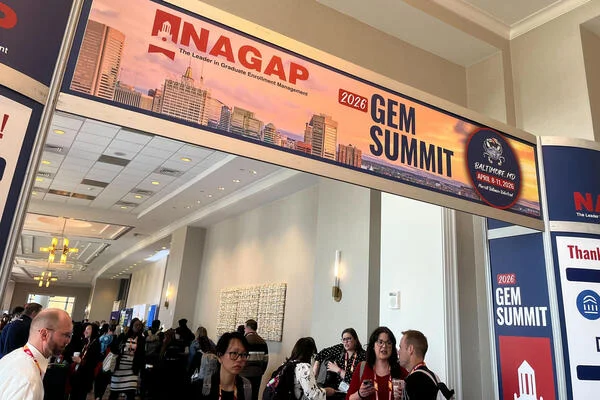
BALTIMORE—Amid a large decline in international graduate student enrollment in fall 2025, enrollment professionals are hoping to make their admissions processes more accessible to students from abroad, who often face unique challenges when applying to U.S. graduate programs.
Art Munin, a former dean of students and the senior associate vice president for enrollment management solutions at the ed-tech company Liaison, outlined those challenges at a graduate enrollment event here Thursday, presenting results from recent focus groups of international graduate students. In videos shared with the audience, the students outlined the hurdles they and their peers faced when applying to graduate school in the U.S.
One participant said the process was unaffordable, from the cost of entrance and language exams to application fees, noting that some students do not even have internet access. Another bemoaned the fact that their emails to faculty members or department offices went unanswered; in at least one case, they said they did not apply to an institution because no one responded to their email. Yet another said she had to take an English proficiency exam—even though she’d graduated from an English-language master’s program.
The research, which was presented at NAGAP’s 2026 Graduate Enrollment Management summit at the Marriott Waterfront, grew out of a partnership between Liaison and NAGAP and featured interviews with 15 current international graduate students. It’s a follow-up to a similar focus group the company did of mostly domestic graduate students several years ago. But with international students facing heightened scrutiny by the Trump administration, the results are especially important, Munin told listeners.
“These students are literally taking a leap of faith and moving their entire lives,” he said, and now they’re carrying with them fear that they could be detained or discriminated against in the U.S.
The National Student Clearinghouse Research Center’s fall enrollment report showed that the number of international graduate students dropped by over 10,000, or about 6 percent, from 2024 to 2025. International undergraduate enrollment, on the other hand, increased.
When asked what was positive about their experience coming to graduate school in the U.S., the focus group participants overwhelmingly mentioned individuals at their institution who were responsive and supportive, like their advisers and international services offices.
A number of the graduate admissions and enrollment professionals attending the session said they had recently implemented changes to make the application process smoother for international students. One person said their university had begun communicating with international students via WhatsApp, a messaging service owned by Meta that is popular abroad; about 10 other attendees raised their hands to indicate that their offices use the app, as well.
Farnaz Habib, a graduate recruiter at Florida International University, said that her office uses templates for different types of questions—sometimes edited or adjusted by artificial intelligence—to ensure they can respond quickly to every student inquiry and don’t leave anyone in the lurch. She noted that she never plugs personal information into her AI of choice, Microsoft Copilot, and she edits every email she sends. The office’s inbox is now consistently clear, she said.
Some international recruitment firms are hoping to help institutions improve their application processes for international students. Lindsay Hillcoat, executive director of North American client partnerships for SEED Global Education, which focuses on recruitment from emerging markets, said the company employs in-country representatives, who support students through the application process.
Those representatives “actually go through the school’s website, learn how to do their application … and walk them through the hurdles that they [encounter],” she said.
Because they are local to the prospective students’ country or region, their time zones align better than if a university employee were helping them. They also tend to have a better understanding of the applicant’s culture, making it easier to communicate and solve problems.
Munin said he’s excited to be participating in conversations about how to improve inefficient and confusing application processes, including through Liaison’s GradCAS tool, a Common App–like platform that allows students to apply to multiple graduate programs at once.
“It can’t be just the same old tired way—that how I applied to graduate school in the late ’90s is so similar to what’s happening today,” he told Inside Higher Ed after the panel. “These processes could be made so much easier through direct integrations, though streamlined processes, through technology.”
