

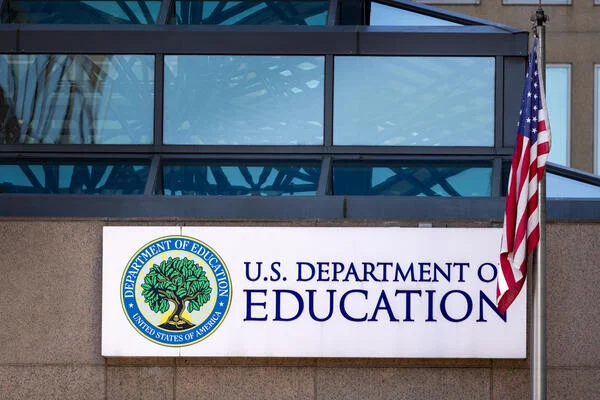
As we start the new year, my leadership team, like many others across the country, is confronting the financial fallout from the Department of Education’s decision to end grant programs for certain minority-serving institutions, including ours. The department has framed its September shift of funds away from MSIs and toward historically Black colleges and universities and tribal colleges and universities (TCUs) as an expansion of opportunity. Yet as an Indigenous education scholar and a college president, I see it creating new barriers for Indigenous learners. This decision is complex and requires deeper analysis to understand its lasting impacts.
Federal support for Native education is a part of the federal trust responsibility, codified by at least 150 treaties, as well as various statutes and court decisions. Those treaties provide explicit provisions for various services, including education, that were guaranteed to Tribal Nations and their citizens by the United States government in exchange for land. This trust responsibility follows both Tribal Nations and individual tribal citizens. Ultimately, the federal trust responsibility is both a legal and moral obligation.
In 2008, Congress created Native American–serving nontribal institutions (NASNTIs), a new category of MSI, to ensure federal grant support for institutions educating Native students outside of tribal colleges and universities. Only about 12 percent of Native students attend TCUs. Stripping more than $54 million away from the other institutions that serve large numbers of Native students effectively undermines the federal government’s trust responsibility. Furthermore, this funding, which went not to just NASNTIs, but also but to Asian American and Native American Pacific Islander–serving institutions (AANAPISIs) and Alaska Native and Native Hawaiian–serving institutions (ANNHs)—typically supported programs open to all students at these institutions who qualified, not just Native learners.
This loss is not abstract. At Fort Lewis College in Durango, Colo., where I am president, 37 percent of our students are Native American, representing more than 128 Tribal Nations and Alaska Native villages. We are the only NASNTI in the state. Recent federal cuts will mean a $2.27 million loss in critical grant support—dollars that have historically funded things like our peer educator tutoring, peer mentoring and summer bridge programs, all essential academic supports aimed at increasing student retention and graduation.
In my role, I meet students every week who tell me that the support they received through these programs gave them the academic confidence to formally enroll or stay in school and a community to belong to on campus. For many students, these programs are the difference between continuing on the track toward graduation or leaving higher education altogether. Cutting this funding pulls away the very safety nets that level the playing field.
Funding the institutions that support these students is also critical for boosting graduation rates, preparing a strong workforce and overall Tribal Nation building. Higher education access and success is a long-standing issue for Native communities, where only 42 percent of Native students graduate within six years, compared to 64 percent nationally, and only 17 percent of Native adults hold a bachelor’s degree. At a time when many communities are facing shortages of teachers, health-care providers and public servants, undermining critical pathways to higher education hurts our economy. Investing in these institutions is not only moral but profoundly practical.
Finally, the decision to reallocate funding away from NASNTIs is especially damaging because it frames Native-serving institutions as competitors with TCUs, instead of partners in the shared mission of educating historically underserved students. There is no question that TCUs and HBCUs have both been woefully underfunded for decades. These institutions serve critical historical and present-day roles, providing access to higher education and meeting community and tribal needs. They deserve robust, sustained federal investment. TCUs, in particular, play an essential role in rural areas and tribal communities. That said, needed investments in these institutions should not come at the expense of the NASNTIs and other MSIs that educate vast numbers of Native students.
By shifting this money, the Department of Education forces communities that are deeply aligned in our commitment to serving Native students and communities to fight for scarce resources, all while the department fails to meet its federal trust responsibility. NASNTIs and TCUs do not succeed at the expense of one another; we succeed together when federal policy recognizes the full breadth of our contributions.
The Department of Education has an opportunity to reaffirm, not retreat from, its responsibility to Native students. That means sustaining investment in TCUs and HBCUs and restoring support for the NASNTIs that educate large numbers of Indigenous learners. When we fund the full ecosystem of Native-serving colleges and universities, we strengthen Native communities and the nation as a whole. True recognition of Native heritage lies in a commitment that honors the promises made and ensures that every Native student has the educational resources to thrive.
Heather J. Shotton is president of Fort Lewis College.
