

Get stories like this delivered straight to your inbox. Sign up for The 74 Newsletter
A year ago, the prospect of landing a job in a corporate office instead of in fast food or retail seemed like a dream to Minnesota high school senior Najaax Sheikh Ali.
“In high school, a lot of students will be like, ‘Oh, what happens if they don’t like this aspect of me?” said Sheikh Ali, 17, a student at Fridley High School just north of Minneapolis. “What happens if I’m not intelligent enough for this role? What happens if I can’t communicate enough?”
On a whim, Sheikh Ali applied to Genesys Works, one of the country’s largest high school internship programs, and was accepted. Her confidence grew as she learned communication and technical skills at the national organization’s summer training sessions.
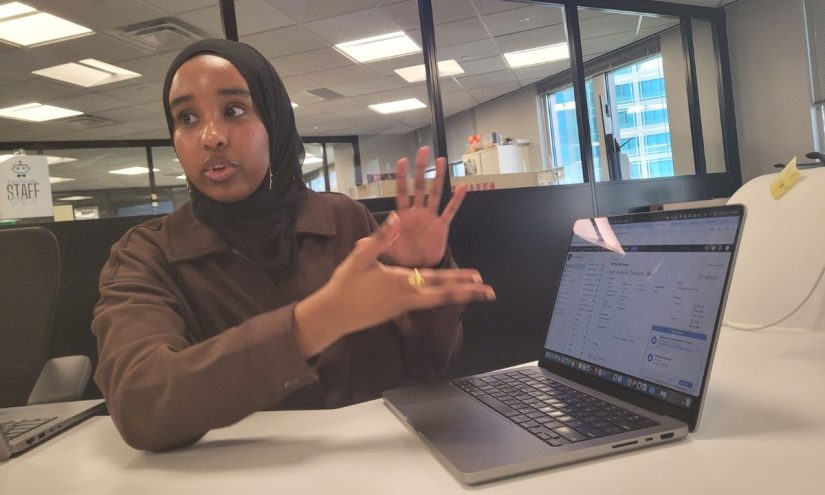
Now, just a few months later, she’s thriving as an intern at headquarters of the SPS Commerce software company in downtown Minneapolis, working on the technology helpdesk aiding employees with computer and other device issues.
“When I saw the fruits of my labor, I was stunned,” she said.
The Genesys Works non-profit has been working with students like Sheikh Ali since launching in Houston in 2002 with a goal of connecting high school students to paid internships that go beyond typical afterschool jobs and can start them on paths to fulfilling careers, often in the white collar world.
Such internships are rare despite all the lofty talk nationwide about creating more work-based learning opportunities for students that let them try out different fields and can lead to good-paying careers. Fewer than five percent of high schoolers have a chance to do an internship or apprenticeship before graduating, according to federal data and surveys by the American Student Assistance nonprofit.
But Genesys Works has found a formula that gives companies — not just nervous teens — the structure and confidence to succeed with internships. Genesys Works has placed nearly 1,100 students in internships at 202 companies in eight metropolitan areas this school year: Chicago, Houston, Jacksonville, Minneapolis-St. Paul, New York, San Francisco, Tulsa and Washington, D.C.
While many work in small, local companies, interns are also landing spots at corporate giants like Target, Accenture, 3M and Medtronic, often in the information technology, marketing or human resources departments. Students typically work 15 to 20 hours a week their senior year for $14 to $18 an hour, depending on the market.
“We’re focused on building careers and building pathways for students and giving them access to what it looks like to work in a corporate environment and to be part of a team,” said Mandy Hildenbrand, Genesys Works chief services officer.
Helping students find out if a career is right for them or what skills and certifications they should pursue in college is incredibly meaningful to success.
Future of High School: Engaging Students & Careers Via Modern Apprenticeships
“We want to make sure that we’re putting students in those types of roles,” Hildenbrand said.
Genesys Works’ model, in which the non-profit acts like a hiring and staffing agency, is key in clearing a major block to high school internships nationally — coaxing companies wary of hiring high school students to take the leap.
Genesys Works takes on duties that companies often don’t want to bother with, removing administrative burdens that scare many employers away. These include recruiting students and reviewing applications, pairing students with mentors, working with schools so students have time to work and acting as students’ employer of record so interns are on Genesys Works’ payroll and covered by the nonprofit’s insurance.
Genesys Works also adds another step that only a few internship programs do well — training students before sending them to companies. Genesys Works has each student complete an eight-week summer training program of professional conduct and some technical skills, including use of Microsoft Office applications.
In return, companies pay Genesys Works about twice the students’ hourly wages.
“Everybody wants work-based learning, but it’s very difficult to figure out how to do it,” said Hildenbrand. “We take the heavy lifting off of the schools and off of the corporate partners.”
Allison Barmann, executive director of Genesys Works in Minneapolis, the city with the most interns in the program, said the support structure makes a big difference to employers.
“Sometimes we’ll talk to corporate partners who are like, ‘Oh, well, we’ve never had a high school internship before. Like, that’s too much work’,” Barmann said. “No, no, we’re doing the hard part for you. You just have to find some work for these young people to do and find a good supervisor to help challenge them.”
Peggy Krendl, a senior managing partner of the Fortune 500 company Accenture, agreed that Genesys Works’ model makes it much easier for a company that doesn’t have youth training programs or staff to hire younger, short-term employees. Companies also rarely have relationships with school districts that allow students to miss class to work.
Accenture has taken on the second-most interns through Genesys Works nationally, behind only medical technology giant Medtronic.
“We don’t have to worry about that at all, so it’s an entire infrastructure and onboarding support network that we get working with Genesys Works,” said Krendl.
Shut Out: High School Students Learn About Careers — But Can’t Try One That Pays
The summer training is a big part of that support, especially for teenagers who have never held a professional job. Students spend eight weeks in the summer between junior and senior year learning six bundles of skills — communication, time and project management, work ethic and professionalism, problem solving and critical thinking, collaboration and teamwork, and initiative and independent work.
Students are then evaluated three times over the summer on their progress to determine their “workforce readiness.” Students are rated as to how well and often they show traits including punctuality, taking feedback well, willingness to learn and for setting plans with timelines for completing tasks.
Students are even rated on how well they stay attentive and participate in online sessions.
“We have to keep you guys engaged and focused,” instructor Ravin Boihr told students at a training session last summer. “During your internships, you may be on screen four hours a day, the same way you are here, and your supervisor is counting on you to remain active and engaged in getting your work completed.”
She stressed: “We have to make sure that we confidently are placing you guys to them.”
Lauren Loeffler, who manages interns for SPS, said students may come without specific skills, but those that make it through Genesys Works hiring process always view the job as part of building a career and want to do well. She said she sees few of the problems — behavior, tardiness, lack of work ethic — some employers might imagine in hiring students this young.
“The earlier they can kind of be exposed to the workforce, the farther ahead they’re going to be when it comes time to find that full time job,” Loeffler said. “To answer some questions that might scare future employers — like they kind of make this story up in their head — I have never seen a behavior issue. I have never seen students blatantly doing a bad job because they don’t care, they don’t like it. They are extremely motivated to do a good job.”
Land O’ Lakes, the dairy and agricultural products company based just outside Minneapolis, is so invested in the program that it takes about a dozen interns from Genesys Works each year. The interns, as at most companies, don’t work directly with the core products and services — they don’t actually make the butter at your local grocery store — but in information technology, security or other support services.
Luke Kocon, telecommunications manager for Land O’ Lakes, has two interns a year in his department, typically helping manage distribution of computers and phones to employees.
Kocon said the first few weeks are a big adjustment as students acclimate to a new culture and expectations, but they learn quickly.
“It’s mutually beneficial,” he said. “There’s definitely a ramp up period, right? But my two interns that are with us right now are delivering just as any member of my team.”
“They usually surprise me with how much they can get done and how quickly they adjust to the workflows,” he added.
Salim Kadi, a senior at Blaine High School north of the city, said his internship at Land O’ Lakes is an adjustment from a previous job he had as a cashier at Target, which was more focused on rapid-fire work with customers than handling several projects on a deadline. While his tasks are not an exact match for his hopes of working in computer science after college, he is excited for the rest of this year.
“It helps me gain experience and (understand) how the corporate world works,” Kadi said. “Even if I don’t get a position that’s like my career, I still learn how to be more professional in a corporate setting. I can also learn how to network and talk to other people too. And I can still ask about things that I want to learn about, that’s going to align with my future career.”
Land O’ Lakes, like many other companies in the program, often keeps interns even after their senior year as they move on to college. Yareni Flores, now pursuing an associates degree at Century College, remains with Land O’ Lakes’ information technology department two years after finishing her senior year in the internship.
Flores, 18, said the internship taught her a lot of professional skills.
“Back in high school, you wouldn’t really see me being here because I did not like talking to people,” Flores said. “It was my first ever job too, so I learned how to manage my time more, and how to be more responsible.”
Sheikh Ali, like Flores, said the internship can really help students grow. So she urged students to overcome their hesitancy and make the leap.
“It’s something that you really have to push for,” she said. “You really have to just try hard.I feel like having courage to pursue Genesys works is something that’s really needed.”
Did you use this article in your work?
We’d love to hear how The 74’s reporting is helping educators, researchers, and policymakers. Tell us how
