

Join our zero2eight Substack community for more discussion about the latest news in early care and education. Sign up now.
This piece was published with The 19th, a nonprofit newsroom covering gender, politics and policy.
Sarah Newberry Moore had long believed that motherhood would mark the end of her career sailing at the world championship level. A five-time national champion, she didn’t know of many women who had made it to the Olympics as mothers, even as many of her male peers competed at the highest level while raising children.
But then COVID hit, and her sailing competitions — and the 2020 Olympic Games — were postponed. As the months went on, she realized she didn’t want to stop sailing, even though she wanted to have a baby. The widespread lockdowns had presented a rare window in which she didn’t have to choose. She recalled thinking: “Who made this rule? I’m going to do both.” In 2021, her son Iren was born. And then, three years later, he was at the 2024 Summer Olympics in Paris to cheer his mom on as she competed with the U.S. Sailing Team.
Women have been competing in the Olympics since 1900 when they were first granted access to participate, but it’s taken decades for pregnancy and parenthood to be acknowledged as a natural part of an elite athlete’s path — and policy still hasn’t caught up.
Though Newberry Moore said it’s becoming more common to bring children to the Olympics — and she is in touch with several athlete-mothers competing in this year’s Milano Cortina Games who are doing so — she described how hard it was to bring Iren to the Olympics in 2024.
Sarah Newberry Moore with her son. (Instagram)
The children and families of athletes have historically not been allowed in the Olympic Village. Athletes who stay in the Olympic Village typically have their room and board covered; those who want to bring their kids along need to make — and pay for — other arrangements for housing accommodations and child care.
During the 2024 Summer Olympics in Paris, for the first time in history, a nursery arrangement was set up where parent athletes could visit with their children in the “nappy/diaper-wearing age.” There was also dedicated private space for breastfeeding. But Newberry Moore’s sailing competition was in Marseilles, not Paris, and the satellite Olympic Village where she was staying didn’t have a nursery. So Newberry Moore could only see Iren when her husband could bring him to visit; she would leave the hotel and give him a hug, and then return. He couldn’t go to her room and it was incredibly hot, so their visits were brief.
Gymnast Hillary Heron of Team Panama (R) with her coach Yareimi Vazquez (L) and her daughter Aitana Vazquez inside a nursery room in the Olympic Village at the Paris Olympic Games in 2024. (Getty Images)
“If my husband had been allowed to bring my kid into the room of the hotel, I could have spent actual recovery time with him,” she said. Newbery Moore finished 16th in the Olympics, but skipped the closing ceremony — which the rest of her teammates attended — to reunite with her family. Out of the 13 athletes on the U.S. Sailing Team, she was the only mother.
For the 2026 Winter Olympics, there will be even fewer options for athlete parents. There will be no designated family space during The Games. A spokesperson from the International Olympic Committee confirmed that there will also be no permanent breastfeeding facilities within the Olympic Villages, but “a certain number of bookable spaces will be made available in each Village, which may be used for breastfeeding, among other purposes.”
Training for Gold While Raising a Baby: Olympic Moms Through the Decades
These spaces matter a great deal for Olympic athletes because many are inclined to bring children along, rather than be separated for weeks, or in some cases, months. For breastfeeding mothers in particular, these spaces are not a luxury but a necessity.
As an Olympic medalist and mother of three, Alysia Montaño has been a vocal advocate for women in sports for years. She founded For All Mothers+ (formerly &Mothers), a nonprofit focused on dismantling the motherhood penalty that women face in all industries, including sports, and adopted better standards to help address it.
Her organization provides financial support for athlete moms — including the “Bring the Babies Changemaker Grant” — a $5,000 grant intended to help cover “essential family travel costs” which can include airfare, lodging and child care. Newberry Moore was a grantee in 2024, and this year, five athletes competing in the Milano Cortina Games have received funds from the grant.
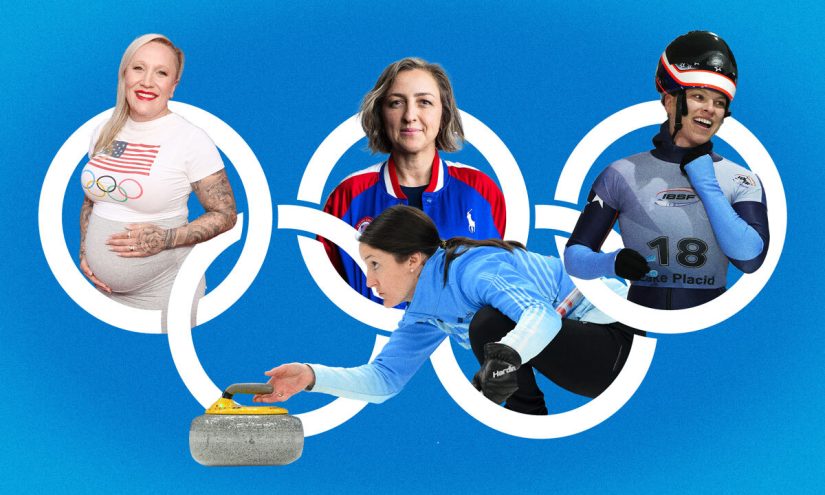
Olympian and mother Kelly Curtis of Team USA finishes the Women’s Skeleton Race Heat four at the IBSF World Championships in Lake Placid, New York, in 2025. (Getty Images)
The grants are “a crutch for a broken system,” Montaño said. While interviewing some of the grantees gearing up to compete in Italy to learn more about their experiences, she said, it became clear that the funding plays an important role “in alleviating maternal and child stress. Reflecting on her conversations with athlete moms, she said, that “being able to stay with their children is the very best support system so that our athletes can go out and be the very best they can be.”
Kelly Curtis, a skeleton athlete competing in this year’s Winter Olympics with the USA Bobsled & Skeleton (USABS) Team, is one of the grant recipients. In an interview with Montaño, Curtis explained that she regularly brings her daughter, Maeve, to competitions. “She comes with me wherever I go,” she said. For the 2026 Winter Games, Curtis will forgo staying in the Olympic Village, because she doesn’t want to be separated from her daughter. Instead, she will be staying off-site at a hotel. The cost is 700 euros a night, for 17 nights, she told Montaño, noting that she has to pay fully out of pocket.
Tabitha Peterson Lovick, a member of the U.S. Olympic Curling Team and another grant recipient, told Montaño that having a “little bit of baby time” will be good for her mental health during her competitions. She is staying in the Olympic Village, but her daughter, who is traveling with her husband and in-laws, is staying off-site. “I really want to have that time with my baby, even if it’s just 30 minutes.”
Kaillie Humphries Armbruster, an Olympic bobsledder, and another member of the USABS Team, called the grant “a huge relief,” in an interview with Montaño, and explained why it’s so important for her to have her baby there. “When I go to race, it will have been hours since I’ve seen him,” she said. “He could care less how I do every single time, but he’s just so excited. He like runs over and he just — he wants Mom. And I’m excited to end an Olympics and have that.”
Olympic bobsledder Kaillie Humphries Armbruster with her baby. (Rian Voyles)
For mom Olympians, challenges go beyond child care
Women’s participation in the Olympics has been steadily increasing over the decades, but it wasn’t until the 2024 Paris Olympics that The Games achieved gender parity among athletes.
While it’s not uncommon for men to have both professional athletic careers and children, it is a much harder road for women who must pause their training and competition schedule to have children. According to an ongoing survey about the motherhood penalty in sports, conducted by For All Mothers+ and Carleton University’s Health & Wellness Equity Research Group, 73% of mom athletes experienced a decrease, termination or pause in funding related to pregnancy or motherhood, and 72% of respondents reported needing additional income or employment outside of their sport to support their family.
The key goal for gathering this data, Montaño said, is “to influence policy changes more broadly across the sports industry. There are biases with the motherhood penalty that we are looking to shift.” It’s bigger than sports though, she explained. She’d like to see the narrative change for all mothers in all industries. “The podium moments for athlete mothers are podium moments for all mothers.”
Kaillie Armbruster Humphries holds her new baby following the Women’s Monobob Race Heat 4 at the IBSF World Championships in Lake Placid, New York, in 2025. (Getty Images)
Montaño has publicly shared about her own experience losing sponsorships and health care when she was pregnant in 2014.
In 2022, after several high-profile Olympic athletes, including Montaño, Allyson Felix, Kara Goucher and Elana Meyers Taylor spoke out about the disparity, the U.S. Olympic and Paralympic Committee (USOPC) directed the National Governing Bodies (NGB) of each sport to include provisions for pregnancy and postpartum time periods, allowing athletes who announce they are pregnant to have their stipends and health coverage continue for up to a year after the birth of a child.
Newberry Moore said these provisions are game changers. “It makes it possible for you to imagine returning, and it creates the climate needed for retaining female athletes.”
Alysia Montaño after she ran an 800m-heat at the US World Championship trials while five months pregnant in 2017. (Getty Images)
A number of athletes have continued pushing for change beyond those provisions.
In 2022, Felix and Montaño, two world-class American track and field Olympians, started an initiative to provide free child care to athlete moms in the U.S. Track and Field Championships in Eugene, Oregon. Felix, who went on to be a leading voice in the Olympic nursery program, has said that the burden of child care costs is “the biggest barrier” to women continuing to compete at a high level.
Kristine David, a spokesperson for For All Mothers+ explained that the recent attention on athlete moms isn’t because there weren’t mothers who could compete before, but because “they just got forced out too early because they didn’t see a path forward with the infrastructure in place for them, such as getting their health care cut off, or not being able to bring nursing babies to competitions.” She added: “We are making headway with the USOPC and other NGBs, but there’s still a long way to go to making maternal support standard at The Games. Our hope is that by the Summer 2028 Games, we will see ourselves as obsolete, and all provisions become standard.”
Montaño underscored that point and expressed the disappointment that there will be no nursery this year. “We are looking for consistent and reliable change that parents can rely on,” she said.
After the 2024 Olympic Games, Newberry Moore found out she was pregnant, this time with baby boy Rocky. She had a contract to continue with the U.S. National Sailing Team so she called her performance director and asked if she could defer by a year. But there was no specific language in her contract to protect her decision; a deferral would be at the discretion of the performance director. “I really think you guys should put this in writing,” she recalled saying to her director. “If she hadn’t had agreed to defer the contract, the idea of coming back is insane to me. It would have been a year of resources I couldn’t have used because I was growing a baby in my body.”
Did you use this article in your work?
We’d love to hear how The 74’s reporting is helping educators, researchers, and policymakers. Tell us how
