

Get stories like this delivered straight to your inbox. Sign up for The 74 Newsletter
As Winter Storm Hernando was blanketing New York City with 20 inches of snow two weeks ago, Mayor Zohran Mamdani broke with seven years of precedent and declared Monday, Feb. 23 a snow day for public school students — with no remote instruction. The following day, he declared all schools open, also with no remote option. Nearly 40% of students, and 12,000 teachers, didn’t show up.
When I asked the subscribers to my 4,240 member mailing list how they felt snow days should be approached, I received a variety of answers, ranging from approval to frustration to constructive criticism.
For some, a snow day was greeted simply as a welcome break.
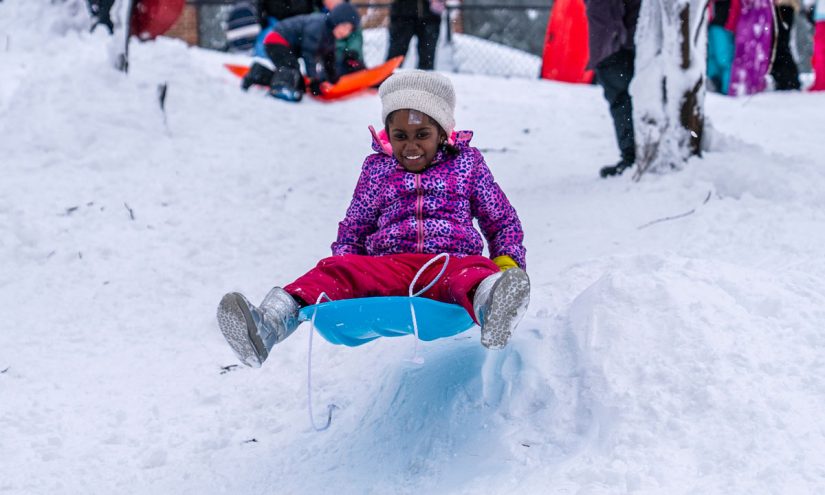
“Kids need to be kids,” wrote Jessica Feinstein, an Upper West Side mom of elementary and middle school children. “Many in politics have forgotten this. Playing in the snow with family and friends is more than just a childhood pastime. It’s important for social-emotional health.”
The majority were relieved that they didn’t have to navigate remote learning while working from home.
“A real snow day should be with no remote instruction,” Greenwich Village mother of three Kaya Heitman said. “Parents are still required to work remotely on a snow day, and assisting multiple children with remote instruction is awful for parents also juggling their own meetings.”
“It is particularly unreasonable to ask children under the age of 6 to participate in synchronized remote learning,” said Harlem mom Maria McCune. “During the January storm, the school expected my 4-year-old to participate in two Zoom meetings. It was necessary for me or my husband to participate, given that she wasn’t capable of navigating on her own. Despite the school’s best effort to make these sessions educational, they were an absolute disaster. I am confident my child learned nothing essential during that time.”
Remote Learning Was Supposed to Make Snow Days Obsolete. But Did It Really?
“If I have to take time off my own work because staff and/or kids can’t get safely into school, which is understandable,” added Amanda, “don’t make me try to be a teacher, hovering over my kid, fighting with them to do work in an environment that is not conducive to the effort. This is miserable for all and does not result in meaningful strides forward in their education.”
On the other hand, some parents said remote learning made their lives easier.
“My husband and I both needed to work from home on Monday,” said Amber, mom of a second grader. “It would have really helped if remote school had been in place. It allows us to focus on work while our daughter stays in her normal routine and logs in virtually.”
Marie D. agreed. “If closure becomes necessary, there should be remote classes available, along with learning packets that each child can complete independently.”
Nearly everyone who responded to my query was sympathetic to the needs of those who rely on public schools for child care and meals. They offered a variety of solutions.
SW suggested, “All grades should be given an option to drop in to any school location in-person if child care, a warm location or a meal is needed. Before the start of each school year, schools need to take a poll of staff willing to come in on snow days at bonus pay. If there is not enough staff that volunteer to be available, then that school is physically closed on snow days. If there is enough staff to open the location on a snow day, then that school gets listed as a Snow Day Location where students can go regardless if that is their regular school location. DOE should publish a list of Snow Day Locations on their website by the end of November so people, staff and meals can be planned for such an emergency.”
Regardless of how they are handled, all agreed that snow days must be built into the school calendar so as not to lose class time NYC students cannot afford to go without.
“My 10-year-old self would hate to hear me say this,” Brooklyn’s Melinda LaRose admitted, “but I think the February vacation should be eliminated. It’s too close to the winter break. If Presidents’ Day was kept as a long weekend, that would give four snow days to play with and/or end school a little earlier in June.”
How Zohran Mamdani Bucked the Establishment and Won Election — in Middle School
McCune concurred: “I would be willing to lose the midwinter break so the schools can have more flexibility for a return to traditional snow days in the future. Navigating precarious sidewalks and streets is not worth it if it ultimately puts people in danger or in unsafe situations. Perhaps giving the city and property owners an additional 24 hours after a snowstorm for cleanup (without school) can help. There is the consideration of children who need a hot meal and can only access these through school resources, but I think this can be resolved in a way that does not involve the nonsense of navigating crosswalks that are not appropriately cleared, or walking on the street instead of a sidewalk because the sidewalk is not appropriately shoveled.”
As with anything, it is impossible to please all of the people all of the time. School closures and free play will always be preferable for some, while others would rather their children be engaged in remote learning, and still others will need in-person child care no matter how brutal the commuting conditions.
Just as I advocate for school choice in selecting the optimal learning environment for every family, snow days should also be a matter of personal preference, with schools offering a variety of options, depending on a given family’s needs, and no penalties for whichever choices they end up making.
Did you use this article in your work?
We’d love to hear how The 74’s reporting is helping educators, researchers, and policymakers. Tell us how
