

Get stories like this delivered straight to your inbox. Sign up for The 74 Newsletter
An incident where schoolchildren were hit with pepper spray at an Oʻahu school has added momentum to calls for counselors, not cops, on campus.
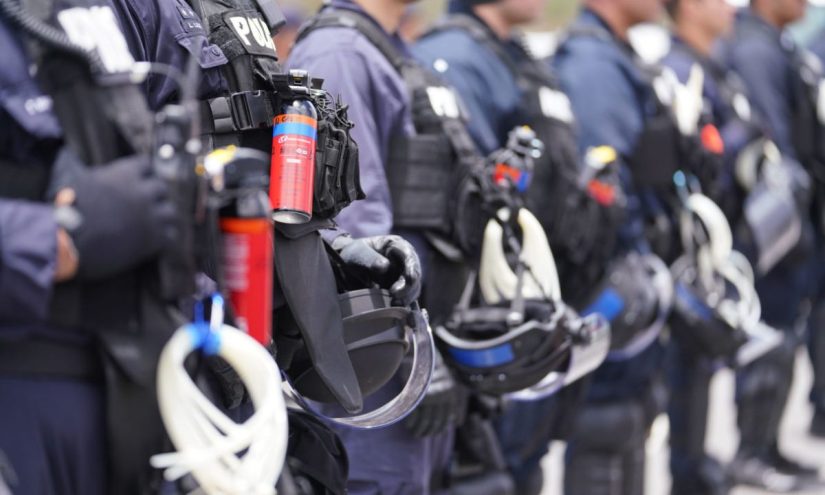
In late February, a Honolulu police officer deployed pepper spray against Kapolei Middle School students while trying to break up a fight, a rare use of force against Hawaiʻi minors in an educational setting.
Emily Hills, senior attorney with the ACLU of Hawaiʻi, said she would like to see more counselors and mental health professionals addressing issues on campus rather than police, who can sometimes escalate tensions.
“We are talking about kids in school and concerns about criminalizing behavior that really should be better dealt with through school officials or authorities,” she said. “Aside from whether or not this is constitutionally excessive force, was this really necessary?”
A police officer told attendees at a neighborhood board meeting that the officer used the pepper spray because he was outnumbered.
School safety is an ever-present concern and high-profile fights in recent years led parents and politicians to petition for armed school resource officers in some Oʻahu schools. School resource officers were placed at high schools in Kaimukī, Kapolei and Waiʻanae in January.
There was no SRO present during the February middle school incident but some advocates, say is was nonetheless a sign there should be less police presence in schools, not more. They want to instead see a focus on getting more counselors and therapists in schools to help address student mental health and behavioral issues to prevent problems such as fights and bullying.
“It’s shocking to think of pepper spray being used with children that age,” said Deborah Bond-Upson, president of the organization Parents for Public Schools. “I just think we need to do everything we can to make the atmosphere in our schools more peaceful and positive.”
Bond-Upson was pushing this session for passage of House Bill 1889, which would be a first step toward requiring licensure for school psychologists in Hawaiʻi. Hawaiʻi is the only state that doesn’t require its school psychologists to be licensed by the state board of psychology.
The Education Committee deferred the bill last week, which generally kills a bill’s chances of making it through session. Committee Chair Donna Kim did not respond to a request for comment on why.
An officer deployed pepper spray as he tried to break up a fight at Kapolei Middle School in late February. (Kevin Fujii/Civil Beat)
The Department of Education is also asking the Legislature for $1.8 million for 20 mental health interventionists, who are school psychologists assigned to work with students with the highest levels of mental health needs.
The interventionists would focus on assessing a student’s risk of self-harm or harming their peers and also help with transitions if the student is referred to an educational placement outside of a traditional classroom setting.
Bond-Upson said she wishes more mental health support could help prevent fights and serious bullying from happening in the first place. She fears the use of pepper spray in response to the fight at Kapolei Middle School will lead to more negative consequences for students.
“I’m afraid it alienates them from the police. I’m afraid it makes them less comfortable being in school,” she said. “So I would just want to see that we do everything we can to avoid that kind of situation, and one of the biggest things we need to do is to really fund psychological support in our schools.”
Three Students Arrested
The fight at Kapolei Middle School broke out around 2:30 p.m. on Feb. 24. A group of girls had attacked another girl, Honolulu police Cpl. Roland Pagan shared at a public meeting.
A responding officer, who would be the only officer on scene, grabbed one of the girls who was assaulting the victim and attempted to arrest her. A group of girls then grabbed the officer and other kids grabbed ahold of the girl he was trying to arrest, Pagan said. At that point, the officer used pepper spray.
The incident occurred after school near the back entrance of campus, according to a statement from Department of Education spokeswoman Nanea Ching. School officials didn’t know how many students were involved, but she said no serious injuries were reported and those who were affected by the pepper spray were near the officer.
Police arrested three girls after the incident at Kapolei Middle School. Prosecutors could not say whether the girls were charged because information about juvenile cases is sealed. (Craig Fujii/Civil Beat)
One girl was arrested on a charge of third-degree assault, and two others were arrested for resisting arrest. Police declined to provide the ages of the girls and said they would not release further information.
Christine Denton, spokeswoman for the Honolulu Prosecutor’s Office, said the office is prohibited from discussing juvenile cases. Criminal justice records involving minors in Hawaiʻi are shielded by law from public view.
In a letter sent home to parents, Kapolei Middle School Principal Daryl Agena said the pepper spray was deployed to “disperse the crowd and restore order.”
Leslie Keating, the parent of an eighth grader at Kapolei Middle School, brought up her concerns about the incident at a Makakilo-Kapolei-Honokai Hale Neighborhood Board meeting in February. She said her son was not present during the fight, but she was worried about the use of pepper spray on young students. Kapolei Middle School includes grades 6-8, and students could be anywhere from 11 to 14 years old.
“These are chemical weapons that have chemicals that we don’t know the long-term effects of,” she said. “I’m not okay with it.”
Pagan said he is unaware of any long-term effects of pepper spray.
“Pepper spray is one of our lowest-level uses of force,” Pagan told the neighborhood board, “and he used it because he was outnumbered.”
‘Extreme Force’
Keating told Civil Beat she doesn’t agree with the use of pepper spray on students or adults, but she is especially concerned about its use at a middle school where some children may have asthma or other breathing issues that make them particularly sensitive.
“I mean, some of these kids weigh 80 pounds, they don’t have adult bodies yet,” she said in an interview. “So using pepper spray on them, I don’t know, it very much irked me.”
Jannet Lee-Jayaram, an emergency pediatrician and clinical associate professor with the University of Hawaiʻi’s John A. Burns School of Medicine, said pepper spray isn’t known to have long-term effects, but it can cause injuries to the lungs and eyes, including corneal abrasions from people rubbing their eyes too hard after exposure.
Wookie Kim, legal director with the ACLU of Hawaiʻi, said he considered the use of pepper spray on middle schoolers extreme. (Cory Lum/Civil Beat)
In the short term, pepper spray can cause intense pain in the eyes, irritation in the nose and lungs and burning of the skin.
The use of chemical agents, like pepper spray, sits in the middle of the spectrum in HPD’s use of force policy. The policy ranges from techniques with the lowest risk of injury to those with the highest risk of serious injury or death.
The first three options are officer presence, verbal directions and physical contact. Chemical agents, including pepper spray, are listed as the fourth option. The options escalate from there, including using physical strikes, canines or even firearms.
The policy states that the use of chemical agents on a crowd should be directed by an incident commander on scene unless an officer believes someone is in immediate danger of serious injury or death.
Wookie Kim, legal director of the ACLU of Hawaiʻi, said it’s difficult to determine whether the officer’s use of pepper spray in this scenario was justified without knowing more of the details. But, he noted of chemical agents should be reserved for the most threatening scenarios.
In an instance like this one, which involved young people at school, other deescalation methods should have been considered first.
“We should be very concerned about the use of such extreme force with middle schoolers,” he said.
‘Counselors Not Cops’
Pepper spray has been used at schools before in Hawaiʻi — and around the country.
In 2023, Honolulu police officers deployed pepper spray to break up a fight at Kapolei High School. Paramedics treated multiple students for exposure but no serious injuries were reported, according to an HNN article from the time.
In other parts of the country, however, children have been hospitalized from pepper spray exposure at school.
In February, a 12-year-old in Tulsa, Oklahoma, went to the hospital after campus police sprayed students participating in an ICE protest outside their school. In September, 32 students and faculty members at a Florida high school were hospitalized after school police and administrators deployed pepper spray to break up a large fight.
The incident at Kapolei Middle School brings up the question of whether police officers should be the ones addressing student behavioral problems on campus, Kim, of the ACLU, said.
“Our whole position is that we shouldn’t have substantial police presence on school campuses,” he said. “We want counselors, not cops.”
The focus, many advocates and parents say, should shift to getting more mental health support for students.
During the last Education Committee, committee members and testifiers discussed HB1889 and debated whether creating a license structure would help or hinder the Department of Education’s ability to recruit more psychologists and fill its vacancies.
Currently, a psychologist does not have to be licensed to work as a school psychologist in Hawaiʻi.
While advocates say creating a license structure would create training and ethical standards for the position, Sen. Donna Kim questioned whether adding the requirement would create more bureaucratic hoops for school psychologists to jump through.
But Bond-Upson, of the Parents for Public Schools group, said requiring licences would allow eligible services in schools to be reimbursed by Medicaid.
Overall, she said she hopes the pepper spray incident can lead to change in how behavioral issues are handled at schools.
“I am heartbroken that the police had to enter the situation,” she said. “And that’s why my first responses are, ‘What is it we can do to make the atmosphere of the school such that this kind of alarming behavior does not happen to kids and with kids?’”
Did you use this article in your work?
We’d love to hear how The 74’s reporting is helping educators, researchers, and policymakers. Tell us how
