

Get stories like this delivered straight to your inbox. Sign up for The 74 Newsletter
All 8th graders in the San Francisco Unified School District will soon be able to enroll in Algebra I now that board members voted earlier this week to fully restore the course at the middle school level.
The 50,000-student system made headlines in 2014 when it eliminated the curriculum for eighth graders in an effort to bolster struggling kids’ performance by allowing them more time on foundational classes — and to address inequities in which students got fast-tracked for advanced high school math.
Board members did not respond to emails seeking comment, but the superintendent, Maria Su, in a statement on the district’s website said she welcomes the change.
“We’re excited to offer Algebra I to our eighth grade students as part of our goal to help more students succeed in math, working to increase the number of students meeting grade-level standards from 42% in 2022 to 65% by 2027,” she said.
Critics say eliminating 8th-grade algebra robbed capable students of that early, first step in a math sequence that allowed them to take calculus their senior year — a prerequisite for some top colleges and, arguably, for careers in lucrative STEM fields.
A Stanford study backed up these claims, showing participation in Advanced Placement math initially fell 15% while “large ethnoracial gaps in advanced math course-taking remained.”
San Francisco Voters Overwhelmingly Support Algebra’s Return to 8th Grade
Residents in 2024 supported a ballot initiative to bring back the course and it became available to some students through a pilot program: The district served 3,827 8th graders in 2024-25 and 1,030 of them took Algebra I that school year.
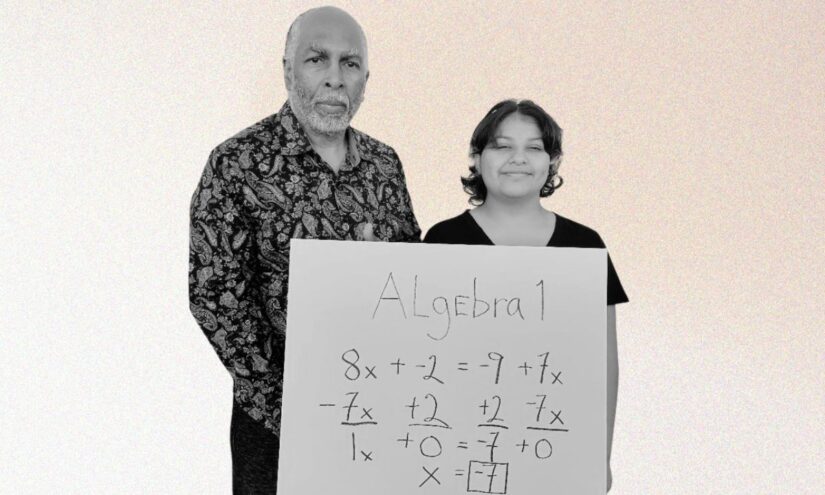
Rex Ridgeway, along with several others, filed a lawsuit against the school district to restore the course in 2023. He told The 74 this week the change was overdue. He said it will prevent students like his granddaughter, Joselyn Marroquin, who was deprived of the course in her middle school years, from having to take it elsewhere.
“During this period of time, students, like my granddaughter, had to either take a summer algebra accredited course or double up in the 9th grade and take both Algebra I and geometry in order to be on track to take calculus in the 12th grade,” he said.
A retired stockbroker, Ridgeway tutored his granddaughter from first to ninth grade, filling in what he considered deficiencies in the district’s math, English and science instruction. Marroquin is now a freshman at San Jose State University, her grandfather said, majoring in business administration, corporate accounting and finance — and minoring in economics.
The Board of Education narrowly approved the algebra measure Wednesday night in a 4-3 vote. According to the school district, Algebra I will be offered in eighth grade as an expanded math course at 19 of its middle and K-8 schools.
Students who meet the academic criteria will be automatically enrolled in both Math 8 and Algebra I — but can opt out of Algebra I if they choose.
Those who don’t test into the course can still enroll in it as an elective and students’ whose test scores reflect strong ability in the subject can take only Algebra I.
Thomas S. Dee, Ph.D., is the Barnett Family Professor at Stanford University’s Graduate School of Education
(Stanford University)
Thomas S. Dee, a professor at Stanford’s Graduate School of Education and an author of the earlier Stanford study, said he celebrates the board’s move: He and co-author Elizabeth Huffaker, as part of a second study currently in the works, found that 8th graders who took Algebra I along with Common Core Math 8 as part of the pilot program experienced substantial learning gains.
Dee said, too, he supports the automatic enrollment of already proficient students, saying the tactic should “ensure that those gains will be broadly realized among all the students ready to take algebra — regardless of their other circumstances and background.”
But Dee’s enthusiasm is tempered: He said his research reveals the need for the district to improve math curriculum for students prior to 8th grade so they are better prepared for algebra.
“Broadening algebra access without addressing the uneven patterns in algebra readiness will increase achievement gaps,” he said.
And, allowing parents of students taking Algebra I to opt out of Common Core Math 8 will deprive them of a chance to advance, he said.
“Our results indicate that families that make this choice will leave truly substantial learning gains on the table and increase their child’s risk of having to retake algebra in 9th grade,” Dee said. “I viewed the board’s insistence on this issue partly as a reflection of a legacy of distrust that was created through the community’s experience with earlier generations of district leadership.”
Is the Hardest Job in Education Selling Parents on San Francisco Public Schools?
Huffaker, an assistant professor of educational leadership and policy at the University of Florida, said automatic enrollment “nudges students who are likely to succeed in algebra into the course” and notes that the district’s plan will also increase math instructional time at most campuses.
But she, too, has concerns about families opting out of one of the two simultaneous courses.
“We completely understand why a family might value an additional elective that allows their child to take art, for instance,” she said. “But the learning gains from the expanded math option are really worth taking seriously, especially because they extend even to the most high-achieving students. There wasn’t really a cap on who benefited.”
Melodie Baker, executive director at ImpactSTATs Inc., and a Women in AI Fellow at EDSAFE Alliance, said the real question isn’t when students take algebra, but whether the pathway makes sense at all.
“A sequence designed as a pipeline to calculus was built for a different era,” she said. “Meanwhile, students need data fluency, computational thinking and applied math for an AI-driven economy.”
Is Calculus Necessary? As Caltech Drops Requirement, Other Colleges Stay Course
Automatic enrollment policies are valuable, she added.
“But expanding access to an outdated curriculum only gets us partway there,” she said. “True progress means rethinking what we teach, not just who gets access. Math should be a foundation for the future, not a relic that sorts students into winners and losers.”
Did you use this article in your work?
We’d love to hear how The 74’s reporting is helping educators, researchers, and policymakers. Tell us how
