

Listen to the article
This audio is auto-generated. Please let us know if you have feedback.
Dive Brief:
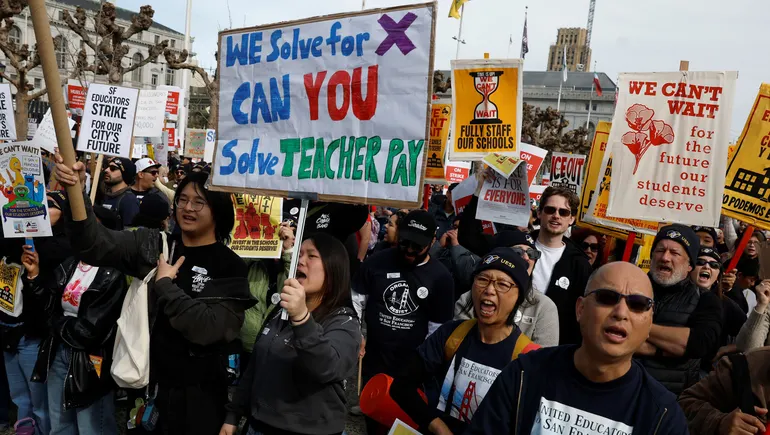
- San Francisco educators went on strike Monday for the first time since 1979. As of Tuesday, the strike has forced the 50,000-student San Francisco Unified School District to close all of its schools for two days.
- United Educators of San Francisco and California’s seventh largest school district are still negotiating a contract for teachers and paraprofessionals. The union said it has yet to reach an agreement with San Francisco USD over salary raises, fully funded family health benefits and special educators’ workload models.
- The contract negotiations over the past 11 months come as the district faces a $102 million budget gap for the 2026-27 school year. Additionally, San Francisco USD is under state oversight for its finances as the district says it is making progress to exit state control, part of which includes continuing to make budget cuts.
Dive Insight:
As of Monday, the union proposed in its negotiations a 10% salary increase over two years for paraprofessionals and teachers after the district proposed a 6% raise over three years.
The union also proposed Monday that San Francisco USD provide medical coverage for employees and their dependents at 100% of the cost for Kaiser insurance. The district previously proposed covering 75% of Kaiser family healthcare or have an annual health benefits allowance of $24,000 per full-time educator.
United Educators of San Francisco said in a Monday update that the union is willing to stay at the negotiating table with the district “as long as it takes, but we have not received anything to indicate that we will reach an agreement that provides for fully funded family health benefits, a workload model, and raises.”
In a press conference on Monday, San Francisco USD Superintendent Maria Su said the district “does not have unlimited funds.”
Su added that she remained committed to reaching a full agreement with the union, and that students and families cannot afford for the strike to go on.
“Every day this strike continues has real consequences. Students are losing instructional time. Families are scrambling to take care of their children,” Su said. “Many of our most vulnerable students are losing access to food, mental health supports and connections to their school community.”
Meanwhile, an independent report issued as part of ongoing negotiations in February said that a 9% wage increase alongside full dependent health benefits, as has been requested by the union, would likely be rejected by the state. The report was part of the collective bargaining process to help both parties reach an agreement and came after an impasse between the district and union.
Given the district’s financial circumstances, the report recommended a 6% wage increase over a two-year period. Full dependent health benefits are currently unfeasible due to the district’s financial status, the report said. But the independent panel did suggest a temporary solution that could use existing parcel tax funds to cover the union’s request on this issue.
San Francisco USD’s budget constraints are not unique to the district. School systems across the U.S. are grappling with significant financial deficits as declines in enrollment and, consequently, per-pupil funding continue.
For example, Texas’ Corpus Christi Independent School District approved a plan in January to close seven elementary and middle schools as it faces a $27.6 million budget deficit and aging school buildings.
