

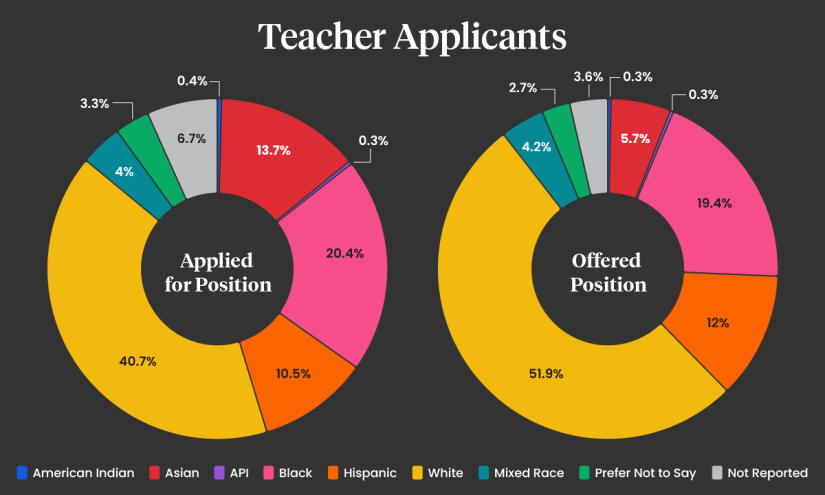
School hiring processes play a crucial role in determining the racial demographics of the American teacher workforce — including by putting non-white teaching candidates at an apparent disadvantage — according to a study released in February. In dozens of school organizations around the country, Asian American applicants to teaching jobs were significantly less likely than those of other groups to advance at each stage of the hiring process.
Black and Asian candidates both struggled to clear early hurdles, such as being classified as minimally eligible for a position by a district screening protocol. But Asians faced the biggest obstacles to hiring, ultimately receiving job offers at half the rate of their counterparts.
Study author Dan Goldhaber, an economist and director of the Center for Analysis of Longitudinal Data in Education Research, said the disparities for Asian applicants were particularly striking once he and his coauthors accounted for factors that should have made them more competitive, including greater teaching experience and a higher likelihood of earning an advanced degree.
“Once you control for those differences, then it looks like they’re doing even worse because they look like better candidates on paper,” Goldhaber said.
Why Diversity Matters: Five Things We Know About How Black Students Benefit From Having Black Teachers
The research takes up the key question of how schools can achieve greater racial diversity within their teaching ranks. Education leaders have worked toward that goal for decades, citing a need for minority students to have access to role models of their own background. A series of influential research findings from the last few decades shows that children see higher levels of academic achievement after being assigned to a same-race teacher.
School districts have rolled out a huge variety of initiatives designed to attract and retain more teachers of color, hoping that the result will be a teacher group that more closely resembles their student demographics. But these reforms to the teacher “pipeline,” including sizable investments in alternative teaching pathways and “grow-your-own” programs, don’t address the individual hiring decisions of districts and schools.
To put a spotlight on those choices, Goldhaber and his collaborators gathered data from Nimble Hiring, a company that provides applicant tracking software to schools. The service supplies hiring teams with information on the gender, race, and ethnicity of their applicant pools, along with detailed work histories including applicants’ prior job titles and descriptions, highest academic degrees, and reasons for separating from their former jobs.
In all, they assembled records for over 46,000 job aspirants between 2019 and 2024. Applications were drawn from 18 school districts and 24 charter school organizations across multiple states. Each application was tracked across four escalating steps, from an initial screening by a district central office to the final decision to make a job offer.
With each successive stage, the pool was narrowed further, but not all groups saw the same degree of winnowing. For example, Asian and African American candidates were somewhat less likely to make it through the primary screening (80 percent and 86 percent, respectively) than whites (92 percent). But the next step showed a huge divergence between groups: Black candidates had their applications passed to school-level hiring managers at a rate of 63 percent, measurably less than the 80 percent chance for whites; Asian candidates saw the lowest rate of all, just 46 percent.
By the final phase, they were substantially under-represented relative to other job seekers. Between 15 and 18 percent of white, Hispanic, and African American applicants received job offers, compared with 7 percent of Asians. Even that proportion shrank to just 5 percent when controlling for professional qualifications that should have made Asians particularly attractive: Sixty-four percent reported holding an advanced degree, while just 38 percent of white applicants said the same.
Evidence of bias?
Goldhaber warned that the paper’s findings should be interpreted with care. Such a large difference in hiring rates between racial categories certainly “lends itself to concerns” about bias, he acknowledged, especially given the research team’s efforts to directly compare candidates with similar credentials applying for similar roles.
Yet even the broad dataset they assembled differed from that used by school administrators.
For instance, the authors knew more than hiring managers about the race of individual applicants; that information was not directly reported to district and school officials, though they could develop intuitions based on factors like candidates’ names. On the other hand, the researchers knew less about what facts came out in the course of the hiring process, such as applicants’ self-described teaching styles or the perceived quality of their colleges or graduate programs.
“‘Discrimination,’ to me, is that if all else is equal, there are still differences in hiring rates by demographics,” Goldhaber said. “We did our best, given the data we had, to make all else equal, but we’re not looking at quite as much information as the school systems are looking at.”
Still, he added, a hypothesis of either conscious or unconscious discrimination would be supported by evidence from other research examining racial hiring differences. Those “audit studies” have found that companies — including those that attach pro-diversity statements to their job postings — are less likely to hire individuals with evidently Asian surnames.
I Didn’t Have a Teacher Who Looked Like Me Till College — Why I’m Working to Change That for the Next Generation
Kris Chun is a private school administrator in Berkeley, California, and the treasurer of the Asian Educators Alliance, a group aimed at expanding opportunities for educators of Asian descent. In an email, he argued that the small proportion of Asian Americans working in K–12 schools may contribute to a “chicken-and-egg” problem.
“People do not have Asian teachers growing up and don’t see Asians as teachers,” Chun wrote, citing his own experience. “Then, when it comes to hiring, Asians aren’t seen as teachers because the people doing the hiring haven’t had very many Asian teachers.”
Making matters even more complicated, there is little reason to think that hiring decisions are the only, or even the primary, reason why comparatively few Asians take jobs as teachers. Melanie Rucinski, a lecturer in public policy at Harvard University, wrote in a 2023 white paper that Asian college students in Massachusetts were less likely than those of other racial extractions to pursue education at the undergraduate level. They were also less likely to gain a teaching license after passing their licensure test — and less likely to be hired at a school after receiving their license.
Rucinski cautioned that her studies of teacher labor markets focused on applicants’ behavior rather than that of employers. Yet she added that it was possible that a dearth of Asian educators could be somewhat self-perpetuating, and that that theory “would track with what we know about discrimination in employment in other settings.”
“Asian teachers are just less represented, even compared with African American or Hispanic teachers,” Rucinski said in an interview. “So it’s very easy for me to imagine, based on broader literature on discrimination in hiring, that that will generate feedback loops for who gets hired into teaching.”
Did you use this article in your work?
We’d love to hear how The 74’s reporting is helping educators, researchers, and policymakers. Tell us how
