

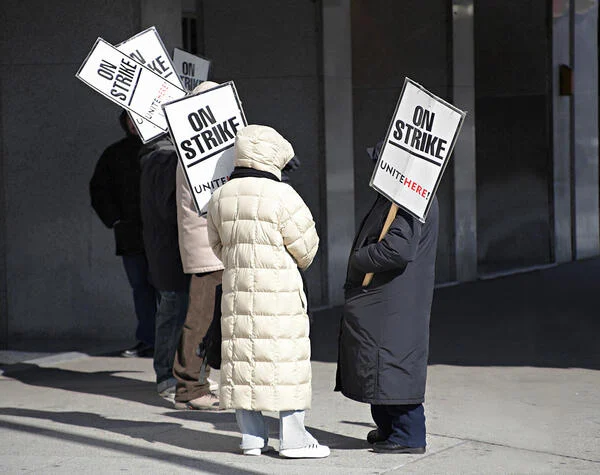
A growing number of faculty unions are including provisions about artificial intelligence in contract clauses and memoranda.
This month, Inside Higher Ed debuts Labor Watch, a monthly recap of recent higher education labor news, from strike announcements to union updates to news from the National Labor Relations Board. Check back during the first week of each month for the latest.
St. John’s Shuns Unions
On Feb. 19, St. John’s University, a Roman Catholic institution in Queens, N.Y., withdrew its recognition of two faculty unions: its American Association of University Professors chapter and the Faculty Association. Both unions had been recognized by the institution and New York State since 1970.
Photo illustration by Justin Morrison/Inside Higher Ed
President Brian Shanley announced the revocation to faculty via email on their 235th day of working without a contract. “In recent years, it has become clear that the university does not have the flexibility required to fulfill its Catholic-centered mission while its core academic decisions are entangled in a collective bargaining relationship,” Shanley wrote in the email. St. John’s is the second institution to use a religious exemption to shutter its union this academic year; in the fall, the Loyola Marymount University Board of Trustees announced it would no longer recognize its non-tenure-track faculty union and cease bargaining.
In their most recent contract proposals, St. John’s union leaders requested a 3.85 percent pay increase for full-time faculty and a 25 to 30 percent pay increase for part-time instructors, which they said would bring the university in line with peer institutions, The EduLedger reported. Faculty are rallying against the revocation and collecting signatures on a petition urging Shanley to return to the bargaining table.
All Eyes on AI
A growing number of faculty unions are including provisions about artificial intelligence in contract clauses and memoranda—a trend that is likely to accelerate this year as AI poses an increasing threat to intellectual property protections and academic and research integrity. At least five four-year institutions and one community college have reached agreements related to AI, Bill Herbert, executive director of the National Center for the Study of Collective Bargaining in Higher Education and the Professions, reported in his February newsletter.
Oregon State University established a joint labor–management committee to discuss how generative AI impacts faculty working conditions and its existing labor contract. In its first contract, the Brown University Postdoc Labor Organization included an article that states the university will notify and discuss with the union “any artificial intelligence–related policies impacting working conditions.” At the University of Michigan, the bargaining unit for librarians, archivists and curators entered into a memorandum of understanding with management about AI, which states that employees may use AI to perform work responsibilities “based on their independent professional judgement” and prohibits the university from using AI to reproduce the voice or likeness of an employee without their written consent.
Better Bargaining in Colorado?
University of Colorado system regent Elliott Hood presented a policy to the board last month that would expand collective bargaining rights for faculty, staff and student workers, according to Boulder Reporting Lab. Currently, only staff designated as state employees are granted collective bargaining rights through the statewide union Colorado WINS. Hood has support from fellow regent Ilana Spiegel but will need support from at least two other regents for the policy to pass. The board is expected to vote in June.
Strike Alert
Members of California State University’s Teamsters Local 2010, a union that represents 1,100 skilled trade workers across the university’s 22 campuses, struck for four days between Feb. 17 and Feb. 20. In a March 2 news release, union leaders framed the strike as a success. On the first day of the strike, CSU chancellor Mildred García committed to providing “much deserved compensation increases” to faculty and staff, should Gov. Gavin Newsom’s budget proposal—which contains a 5 percent base funding increase for the system—pass the State Legislature, union leaders reported.
New York University’s full-time, non-tenure-track faculty union will strike on March 23 if the university “does not bargain in good faith and settle a fair first contract,” union leaders announced last month. They claim the university has “repeatedly broken the law” by refusing to negotiate over housing and retiree medical benefits and by “unilaterally changing the terms and conditions of employment” while negotiations are ongoing.
Contract Wins
The graduate student union at the University of Pennsylvania, which represents more than 3,400 graduate workers, ratified its first contract on Feb. 27. The contract includes a $49,000 minimum annual stipend in year one and a $50,470 minimum stipend in year two; expanded health care, dental and vision coverage; paid parental leave; and guaranteed vacation time. It took effect immediately and will run through June 1, 2028.
Harvard University’s custodians’ union reached tentative agreements with the university on Tuesday, three and a half months after the previous contracts expired. The new contract includes a $4-an-hour wage increase over the life of the four-year contract, as well as “improved language defending the job security of immigrant union members” and a $500 bonus for every custodian.
Grad Student Wants Out
Cornell Ph.D. student Russell Burgett is asking National Labor Relations Board general counsel Crystal Carey to issue a complaint to “free graduate students across the country from being forced to fund and associate with union bosses,” the National Right to Work announced last month. Burgett aims to have the NLRB reconsider the 2016 Columbia decision, in which the bureau ruled that graduate students could be classified as employees and are therefore covered by the National Labor Relations Act. Burgett is not a member of the Cornell Graduate Student Union and requested to opt out of paying the portion of union dues that funds political actions by the union. Union leaders rejected this request, he says.
“A graduate student’s primary relationship with his or her school is as a customer of that school’s educational instruction and services, not as a statutory employee,” Burgett wrote in his appeal. “Universities forcing graduate students to pay union dues to act as teaching and research assistants interferes with their ability to complete their course of studies and earn their degrees. Here, the [union contract] effectively makes financially supporting [the union] a condition of receiving a Cornell graduate degree.”
Staff Protest En Masse UMASS
Hundreds of members of the University of Massachusetts Professional Staff Union picketed in early February to protest UMass Amherst chancellor Javier Reyes’s demand that employees give up part of their cost-of-living adjustment in favor of merit-based pay increases, Amherst Indy reported. Employees have been negotiating a new contract with UMass since July 2024, and Gov. Maura Healey has approved a 12.5 percent adjustment over the three-year period the new contract would cover—from July 2024 to January 2027.
