

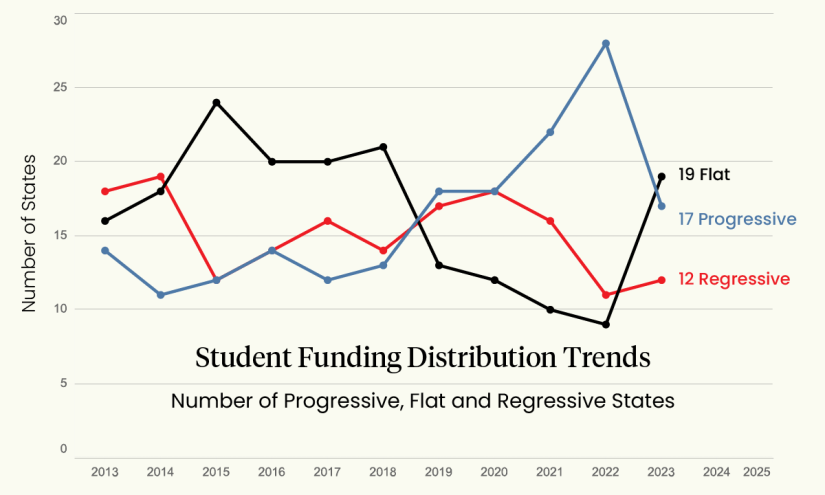
Most states maintained or slightly increased school funding levels from 2022 to 2023, but more than 10 reduced the percentage of money allocated to high-poverty districts — reversing a decade-long trend, according to an Education Law Center analysis of the most recent data available.
The national nonprofit broke down the results of its latest report, which describes trends in state funding to schools in all 50 states and Washington, D.C. in a recent webinar.
“In order to be fair, school funding must be both adequate and equitable,” said Danielle Farrie, Education Law Center research director. “So this means that states provide an overall level of funding that’s sufficient to provide all students with the resources that they need to meet state standards, and that the funding should be distributed so that students in poverty receive more.”
One of the most concerning report findings is the decline in funding to schools with high rates of children from low-income families, compared to schools with more affluent populations, Farrie said. States are progressive if high-poverty schools receive at least 5% more funding in state money than those in more affluent areas. States that do the opposite are labeled regressive. States have a flat distribution of funding if the amount is similar on both sides.
In 2023, 17 states were labeled progressive, reversing a decade-long increase of progressive states that peaked at 28 in 2022.
Utah was the most progressive state, funneling 60% more funding per-pupil to high-poverty districts than others The most regressive state was Connecticut, which provided 19% less money to high-poverty districts.
Education Law Center
The analysis, which focused on state dollars amid an influx of federal COVID-relief funding, also found that most states maintained or at least slightly increased per-pupil funding levels from 2022 after adjusting for inflation.
“This is a dramatic departure from the previous year, when high inflation rates basically wiped out most of the nominal per-pupil funding increases in most states,” Farrie said.
Some states experienced significant funding boosts. From 2022 to 2023, California increased its per-pupil funding by 19%. Washington, D.C., and Hawaii jumped 15% while Michigan moved up by 13%.
Los Angeles, San Francisco Teachers Unions OK Strikes Over Pay, Staffing Demands
The Education Law Center credited California’s positive gains to its revision to the state funding formula more than a decade ago. Even so, school districts have recently called for more state funding as teachers unions have demanded better pay and working conditions. Seven superintendents signed an open letter in February to advocate for “more stable, adequate and predictable funding from the state.”
“Rising housing costs, inflation and everyday living costs are affecting educators and classified staff across California,” the letter says. “Many are making difficult personal choices simply to remain in the profession or continue serving their communities.”
The largest funding loss from 2022 to 2023 was in Louisiana, which declined by 8%, moving its ranking in how well schools are funded from 25th in the nation to 38th.
Overall, 22 states fund their schools above the national average of $17,853 per student. New York is the top state at $29,440, followed by Vermont, Washington, D.C., New Jersey and Connecticut. The lowest state funding level comes in Idaho, which provides $11,085 per student. North Carolina, Utah, Arizona and Nevada fund at similar levels.
How Do Kids in Top-Spending States Perform on NAEP? Not as Well as You’d Think
“In North Carolina, our funding is grossly inadequate, and it’s been the subject of lawsuits,” said Kris Nordstrom, senior policy analyst at the North Carolina Justice Center, in the webinar. “It’s inequitable for all student groups and it’s been that way, sadly, for a long time.”
North Carolina has been under fire for more than 30 years because of inadequate school funding. Lawsuits filed in 1994 eventually led to the creation of a remedial plan in 2022 for the state to better fund public schools, but it was halted in 2024 after appeals were filed to stop payments to districts. The case has since been under the advisement of the North Carolina Supreme Court, which has yet to issue a ruling.
“I think our anticipation is that if we ever do get a ruling that it won’t be a good one,” Nordstrom said. “Our school funding continues to be flat or decreasing once you account for the additional costs facing schools. So it’s pretty bleak.”
The Education Law Center also ranked states based on their funding efforts, which compares funding levels against each state’s gross domestic product. North Carolina is at the bottom of the ranking, providing $12,193 when its GDP per capita is $58,639. The top state is Vermont, which gives schools $27,067 per-pupil while its GDP per capita is $54,318.
“Obviously in North Carolina, you’ve seen our school funding effort plummet,” Nordstrom said. “But in almost every state, school funding has decreased since before the Great Recession. So the money exists in our economy to provide much more robust funding for schools than we currently are.”
Did you use this article in your work?
We’d love to hear how The 74’s reporting is helping educators, researchers, and policymakers. Tell us how
