

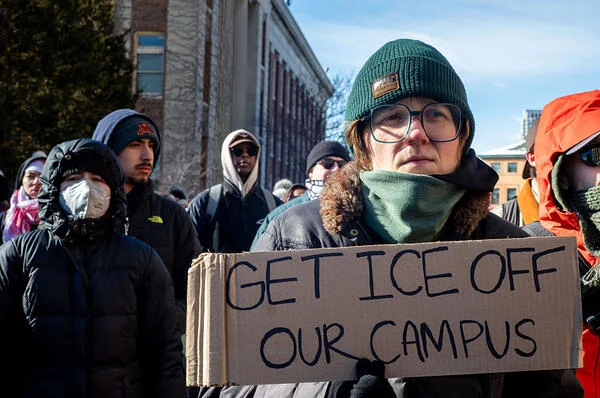
Students and community members at the University of Minnesota on Jan. 26 protest the ongoing immigration raids in Minneapolis.
Brandon Bell/Getty Images
Students at colleges and universities nationwide are protesting the presence of Customs and Border Protection recruiters at campus career fairs in the wake of massive immigration raids and the high-profile killings of two U.S. citizens by immigration officials. Some have asked institutional leaders to disinvite the agency.
The student backlash comes amid national outrage over the Trump administration’s ongoing immigration crackdown, which has been criticized for its use of violent tactics and racial profiling. Though the Immigration and Customs Enforcement agency has led most of the deportation efforts, CBP, which is a larger agency and recruits more heavily than ICE on college campuses, has been involved in the campaign as well. CBP officers shot and killed Minneapolis nurse Alex Pretti after he attempted to help a woman whom officers had just pushed to the ground.
In many cases, universities have declined to disinvite the agency, arguing that they welcome a wide variety of employers to recruitment events and noting that CBP has attended similar events in the past. But in a handful of cases, CBP appears to have pulled out in advance of the event, including at Saint Louis, Villanova and Western Michigan Universities, as well as at the University of Maine.
Student activists argue that allowing CBP to recruit on campus makes members of the community, particularly immigrants, feel unwelcome and condones the violence perpetrated by immigration officers.
“So many of our community members live every day in immense fear, trying at every cost to avoid interaction with agents of this violent regime,” reads a petition opposing CBP’s participation in a job fair at Rowan University in New Jersey. “Everyday [sic], we are seeing ICE conduct violent abductions of our neighbors and peers. To bring in an office upholding this violence administratively and encouraging students to use their degrees to increase this harm is incredibly disappointing and certainly antithetical to the mission of Rowan University (and truly, any higher education institution).”
CBP’s reasons for dropping out of some job fairs remain unclear; neither the agency nor the Department of Homeland Security responded to Inside Higher Ed’s request for comment. However, according to Clayton Berry, assistant vice president for communications at Saint Louis University, CBP withdrew from an upcoming March 4 job fair after speaking with university leaders about the pushback from students.
“We listened and considered the varied perspectives and needs of our community. We shared relevant considerations with our contact at CBP and discussed that we would expect disruptions at the event,” Berry wrote in an email. “As a result of that conversation, CBP withdrew and requested a refund. We continue to connect students with CBP and other employers through our online portal.”
(A local news article reported that SLU disinvited CBP, which Berry said was not accurate.)
Student media at the University of Maine reported that CBP had been included in a list of employers recruiting at the career center’s annual All Majors Career Fair, but, days later, the agency was no longer listed. Samantha Warren, chief external and governmental affairs officer for the university, did not answer a question from Inside Higher Ed about why the agency was no longer listed.
“If you have questions for employers about why they are participating or not in this professional networking event, I encourage you to speak with them directly,” she wrote in an email.
At other institutions, CBP appeared at job fairs as scheduled. Some college leaders defended the choice to allow the agency to participate, arguing that they welcome a wide range of employers and noting that students are not obligated to attend the event. Several also said that CBP has been attending their career fairs for many years.
“All the employers fill out paperwork, they’re vetted, and as long as they’re within our guidelines, we allow them to come. We respect free speech; that applies to both the employers at the fair and the students,” said Sharon Turner, senior director of communications at Utah Valley University, which held a career fair last week that CBP attended.
Students at several universities have staged demonstrations during job fairs in recent weeks to protest CBP’s presence, including at UVU, where members of the Civil Disobedience Club staged a sit-in outside the ballroom where the event was being held, according to The Deseret News.
“We hoped there would be a chance that Customs and Border Protection wouldn’t come if there was enough friction with it,” one of the club’s co-founders told the paper.
In contrast, a leader of university’s College Republicans chapter told The Deseret News that the group was happy CBP was on campus and that they “would love to see them on campus again at all of UVU’s job recruitment events.”
Students held similar protests at Brigham Young University, the University of Georgia and Ohio State University—the latter of which ended in the arrests of two student protesters and one staff member for “criminal trespass,” according to The Ohio Capital Journal. CBP recruiters ended up leaving OSU’s career fair 30 minutes into the four-hour event.
Students have also protested or spoken out against CBP’s participation in online events. At Cornell University, over 100 students and community members held a rally opposing ICE and CBP’s deportation campaign. Students spoke out against virtual recruitment events and webinars being promoted through Handshake, a job board and career-development platform for college students.
This isn’t the first time recruitment by immigration officials has sparked backlash on college campuses. Over the past decade, especially during periods of heightened tension around immigration, student activists have often called for universities to disallow CBP and ICE from coming to campus. In some cases, institutions agreed to do so; in 2019, San Jose City College asked the company that was organizing its job fair to rescind its invitation to CBP.
“We serve a very diverse student population, a large percentage of whom have immigrated to the US from other nations, and an even larger percentage of our students have family members who are immigrants,” the college’s then–acting president Elizabeth Pratt wrote in an email to campus. “For many in this population, the presence of US Customs and Border Protection representatives on campus—regardless of their intentions or reasons for being there—can cause undue distress and concern.”
