

Get stories like this delivered straight to your inbox. Sign up for The 74 Newsletter
The spread of broadband internet over the 2010s was linked with a spike in the amount of time children spent online, along with reports of worsened self-image and increased bullying among girls, according to a recently released study. Boys and girls were both more likely to contemplate or attempt suicide after broadband became more available in their communities, the research found.
Circulated in January through the National Bureau of Economic Research, the paper used survey data from a nationally representative sample of thousands of teenagers to investigate one of the more controversial questions in American life: How much is young people’s engagement with the internet contributing to the persistent fraying of their mental health?
With youth exposure to technology reaching saturation levels — a 2025 report showed that over half of all children eight years old or younger now have their own mobile device — prominent scholars have spent the last few years pointing to the clear relationship between kids’ use of screens and social media and their mounting rates of depression. Skeptics counter that the theory mistakes correlation for causation, and that troubled adolescents likely spend more time plugged in to escape the stress or loneliness they are already feeling.
Kids, Screen Time & Despair: An Expert in Economics & Happiness Sounds the Alarm
Brandyn Churchill, the paper’s lead author and an economist at American University, said that he sought to overcome the “ambiguity” of cause and effect by exploiting the uneven pace of broadband’s expansion across the country.
“This avoids the correlation-versus-causation issue because it’s a natural experiment with a control group and a treatment group,” Churchill said. “In states where they gained greater access to broadband, mental health among kids got worse compared to states where they did not.”
Complicating somewhat the broadly observed trend that girls experience worse consequences from time spent online, the study also shows that suicidal thoughts also intensify among male students in proportion to internet access. But its findings generally dovetail with other research from around the world that has tied high-speed internet with psychological problems.
Brandyn Churchill (American University)
Relying on figures from the Federal Communications Commission, Churchill and co-author Kathryn Johnson tracked the deployment of broadband across American counties between 2009 and 2019, a period during which the U.S. moved from just under 70 percent coverage to approximately 90 percent. Sizable variation existed between states, with broadband reaching less than 50 percent of Mississippi counties and almost 90 percent of Massachusetts counties as the 2010s began.
As each new community mothballed its dial-up internet, the adolescents living in them responded by logging on more frequently. Responses to the National Youth Risk Behavior Survey, a school-based poll administered by the Centers for Disease Control to thousands of high schoolers, showed that heightened access to high-speed connections predictably led to teenagers devoting more hours of each day to online activity.
The switch “enabled new types of technologies that we didn’t have when dial-up was more common,” Churchill said, including streaming and video-based social media. “You gained the ability to move to photo- and video-based social media like Instagram, Snapchat, and obviously TikTok nowadays.”
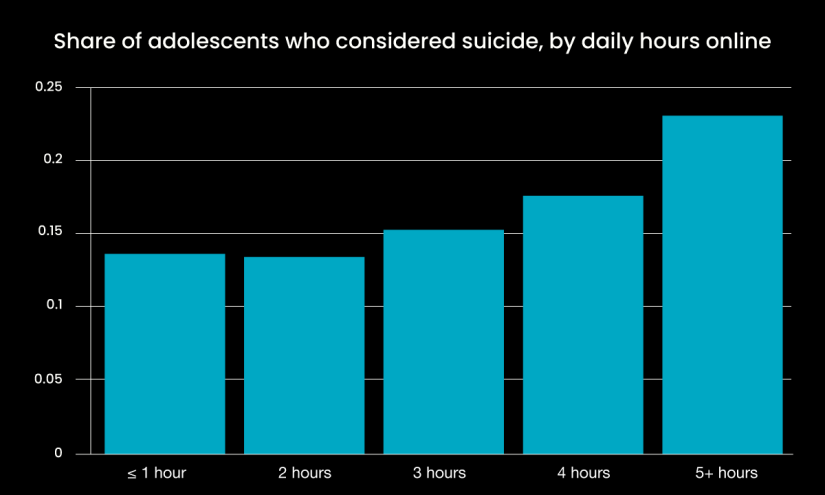
But with the increased internet usage came a more disturbing increase in children’s attitudes. According to the CDC survey, those who spent more than five hours online each day were 68 percent more likely to have considered suicide in a given year than those spending at most one hour online. Heavy users were 64 percent more likely to have actually attempted suicide.
Growing body of evidence
By digging further into the survey responses, the authors discovered possible channels for the negative emotion, each familiar to many parents and educators working with young adults.
For example, with each increase of broadband access by one standard deviation (a common statistical term measuring difference from a statistical average), adolescent girls were 9 percent more likely to complain that they were being cyberbullied. They were also 8 percent more likely to describe themselves as overweight, though broadband availability was not associated with changes to youth body-mass index during the time under study. Boys became almost 10 percent more likely to report that they were getting insufficient sleep each night.
While girls absorbed a larger impact than boys, each group saw significantly higher levels of suicidal thoughts as they took part in more high-speed internet.
Esther Arenas-Arroyo
Esther Arenas-Arroyo, an associate professor at the Vienna University of Economics who has conducted similar studies within Europe, said that there are some drawbacks to focusing on internet usage rather than the penetration of specific technologies, such as smartphones or social media apps. Still, she added, access to broadband represents “a necessary condition for the types of online behaviors most plausibly linked to deteriorations in youth mental health.”
“Existing evidence shows that adolescents are far more likely to engage with social media, entertainment, and video platforms when they are at home with high-quality connectivity,” Arenas-Arroyo wrote in an email.
Last year, the economist published her own paper on youth mental health and its interactions with digital activity. Rather than simple access to broadband, that work examines the rollout of ultra-high-speed fiber optics that have increasingly replaced slower forms of broadband in her native Spain. Like Churchill, she and her collaborators concluded that the acceleration of internet connectivity led to more “addictive” internet usage; additionally, however, she combined that data with hospital records, finding that fiber deployment contributed to a documented jump in mental health diagnoses and suicide attempts.
Arenas-Arroyo argued that the body of research around the topic has become too large for education leaders and the political class to ignore.
“A growing body of causal evidence, including my findings, shows that as internet access becomes faster and more ubiquitous, its potential risks to adolescent mental health may intensify,” she observed. “This shifts the policy debate away from whether there is a problem and toward how to mitigate its negative effects.”
Study: 98% of Teens Attend Schools Limiting Cellphones, but Most Still Use Them
Policy changes across multiple countries have already begun to alter the way that students interact with the internet. A survey released last month by the University of Southern California found that 98 percent of America’s K–12 students attend a school with some form of limitation on cell phone use, with over three-quarters of teenaged respondents saying they supported the restrictions.
Even blunter tools have been embraced internationally, with Australia making news last year by banning all use of social media for children under 16. On Tuesday, Spain became the first European country to do the same, with the country’s prime minister decrying social media as “a failed state.”
Churchill conceded that it would be impossible, and probably undesirable, for countries across the West to attempt to push back the adoption of broadband. But with the research consensus around the potential downsides of the technology growing louder, he added, governments will likely find themselves charged with the task of addressing them.
“Our work is built on national estimates of adolescents across the entire United States — and yes, our results line up with a lot of the other results that existed,” he said. “That should increase our confidence in making policy recommendations based on these findings.”
Did you use this article in your work?
We’d love to hear how The 74’s reporting is helping educators, researchers, and policymakers. Tell us how
