

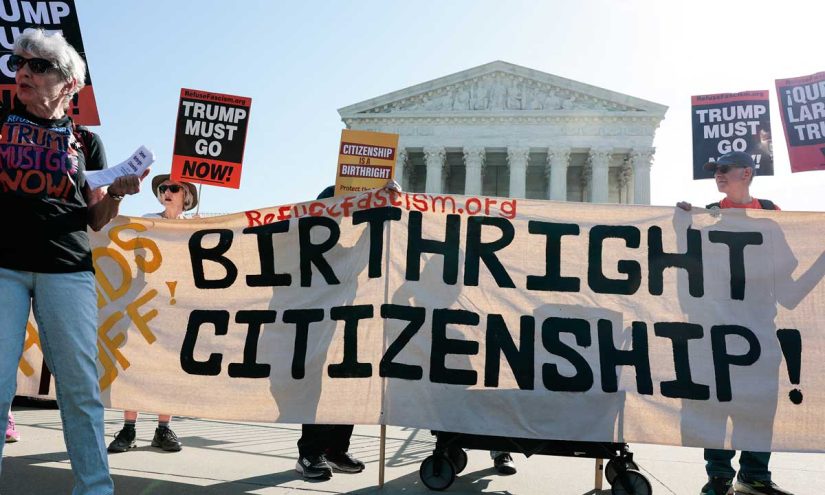
The Supreme Court heard oral arguments Wednesday morning in a birthright citizenship case that, if decided in the government’s favor, could render thousands more children undocumented — and stateless — at the same moment conservative forces are trying to undo those students’ right to a free public education.
President Donald J. Trump, who watched from the gallery Wednesday in unprecedented fashion while the government made its case, signed an executive order on his first day back in office last year banning birthright citizenship for the children of undocumented immigrants. His plan would also exclude babies born here whose parents are temporary residents.
Birthright citizenship was enshrined in the Constitution in 1868 by the 14th Amendment, which states: “All persons born or naturalized in the United States, and subject to the jurisdiction thereof, are citizens of the United States and of the State wherein they reside.”
22 States, Civil Rights Groups Sue to Block Trump’s Birthright Order
Solicitor General D. John Sauer, arguing for the government, told the court he recognized the amendment was adopted just after the Civil War to grant citizenship to those newly freed from enslavement and their children, “whose allegiance to the United States had been established by generations of domicile here.”
It did not, however, grant citizenship to the children of temporary visitors or illegal aliens, he said. And, Sauer maintained, unlike newly freed people, “those visitors lack direct and immediate allegiance to the United States.”
Solicitor General D. John Sauer (Tom Williams/CQ-Roll Call, Inc via Getty Images)
“For aliens, lawful domicile is the status that creates the requisite allegiance,” he said. “For decades following the clause’s adoption, commentators recognized that the children of temporary visitors are not citizens, and illegal aliens lack the legal capacity to establish domicile here. Unrestricted birthright citizenship contradicts the practice of the overwhelming majority of modern nations. It demeans the priceless and profound gift of American citizenship.”
Several of the justices, including Chief Justice John Roberts, appeared skeptical of Sauer’s reasoning, peppering him with pointed questions and casting doubt on key elements of his argument.
President Donald Trump rides in his motorcade as he arrives at the U.S. Supreme Court in Washington, D.C., on April 1, 2026. (Kent Nishimura/Getty)
Many believe Trump is likely to lose this constitutional battle, though he has triumphed in prior cases before the court that hinged on presidential powers. Conservatives hold a 6-3 majority, with three of the justices in that bloc — Neil Gorsuch, Brett Kavanaugh and Amy Coney Barrett — Trump appointees from his first term.
Mysterious Recusal Could Upend Pivotal Supreme Court Charter School Case
Cecilla Wang, the ACLU’s national legal director and lead attorney in the case that involves several statewide ACLUs and other legal advocacy groups, argued on behalf of the mothers and babies who would be affected by Trump’s order. In a less than three-minute opening statement, she said the 14th amendment is critical to our nation’s understanding of itself.
Cecilla Wang, ACLU national legal director. (ACLU)
“Ask any American what our citizenship rule is, and they’ll tell you: Everyone born here is a citizen alike,” said Wang, herself a birthright citizen whose Taiwanese parents came to the U.S. as graduate students. “That rule was enshrined in the 14th Amendment to put it out of the reach of any government official to destroy.”
Birthright citizenship was codified and protected by the Immigration and Nationality Act of 1952, which provided that “person[s] born in the United States, and subject to the jurisdiction thereof shall be nationals and citizens of the United States at birth.”
This came decades after another critically related ruling, the 1898 Supreme Court case United States v. Wong Kim Ark, which challenged the citizenship of a Chinese-American San Francisco resident. Ark, who was denied re-entry into the U.S. after visiting his parents in China, was found to be protected by the 14th amendment.
Wang believes that case bolsters her argument. She said, too, Trump’s executive order would throw the country into chaos. The president left the court minutes into her remarks.
“The 14th Amendment’s fixed, bright-line rule has contributed to the growth and thriving of our nation,” she said. “It comes from text and history. It is workable, and it prevents manipulation. The executive order fails on all those counts. Swathes of Americans would be rendered stateless. Thousands of American babies will immediately lose their citizenship. And if you credit the government’s theory, the citizenship of millions of Americans — past, present and future — could be called into question.”
While some members seemed more amenable to her arguments, conservative Justice Samuel Alito asked her about babies born in the United States who do not automatically become citizens, including the children of ambassadors, for example.
“If those who framed and adopted the 14th Amendment had wanted to limit the citizenship test to just those specific groups that you concede fall outside the birthright rule, why didn’t they refer to those groups?” he asked.
Wang said the answer was baked into the 14th amendment by the language that guarantees citizenship outside a few rare exceptions of those not “subject to the jurisdiction of the United States.”
Gorsuch said Wang had “good stuff on her side.” She, in turn, said the Trump administration’s proposed approach to citizenship contradicts what earlier leaders sought to achieve.
“We can’t take the current administration’s policy considerations into account … to radically reinterpret the 14th amendment,” Wang said, adding she believed those who ratified it did, in fact, consider future immigration. “Contrary to the government’s arguments now, they wanted to grow this country, make sure we had a citizenry, populate the military and settle the country.”
But Sauer, the solicitor general, said birthright citizenship, as it stands, is “a powerful pull factor for illegal immigration and rewards illegal aliens who not only violate the immigration laws, but also jump in front of those who follow the rules.”
And, he said, there is another problem.
“It has spawned a sprawling industry of birth tourism as unaccounted thousands of foreigners from potentially hostile nations have fought to give birth in the United States in recent decades, creating a whole generation of American citizens abroad with no meaningful ties to the United States,” he said.
When asked whether the government knew how many women came to the U.S. specifically to give birth, Sauer could not provide a solid figure.
Several of the justices also questioned Sauer about his key argument that established legal domicile must exist to qualify for birthright citizenship, asking whether it referred to the domicile of parents or their offspring.
“Under the minimum definition of domicile,” Alito said, “a person’s domicile is the place where he or she intends to make a permanent home.”
Normally, Alito said, one would think a person who is subject to arrest and removal could not establish domicile. But, he said, we have a unique situation in the United States where people may live here for years and be subject to deportation yet, “have in their minds made a permanent home here and have established roots — and that raises a humanitarian problem.”
Lower courts on numerous occasions have found Trump’s order unconstitutional and blocked its implementation. Since it was issued, Trump has launched a massive deportation campaign that has harmed students and schools and become increasingly unpopular with the American people — particularly after federal agents shot and killed two U.S. citizens in Minneapolis in January.
U.S.-Born Students Tell Congress About Lasting Toll of Harrowing ICE Encounters
“This is potentially the most important civics lesson of a generation,” said Adam Strom, co-founder and executive director of Re-Imagining Migration. “Ultimately, birthright citizenship is about who gets to claim their place in this country … stripping that in a moment of aggressive immigration enforcement could render (children) stateless.”
Such a person is not recognized as a citizen of any nation and therefore has very limited protection. The U.N. estimated in 2019 that there were more than 4.2 million stateless people around the world but the actual number is believed to be more than twice as high.
Alejandra Vázquez Baur, a fellow at The Century Foundation, a progressive think tank, and director of the National Newcomer Network, said undoing birthright citizenship would be a “disaster” for hospitals and a “nightmare for families” — regardless of their status — as they would have to prove citizenship for their newborn child to have basic human rights.
“It’s no coincidence that they’re seeking to strip birthright citizenship protections for U.S.-born children of immigrants while simultaneously attacking the foundational right to education for all granted by Plyler v. Doe,” she said, referring to the 1982 Supreme Court ruling that a child cannot be denied a public education based on their immigration status.
“Together, these attacks undermine our democracy and threaten to create an underclass of millions of children with uncertain futures and no rights in this country,” she said. “It is fundamentally immoral, unconstitutional, anti-child and un-American.”
The court is expected to render a decision in late June or early July.
Did you use this article in your work?
We’d love to hear how The 74’s reporting is helping educators, researchers, and policymakers. Tell us how
