

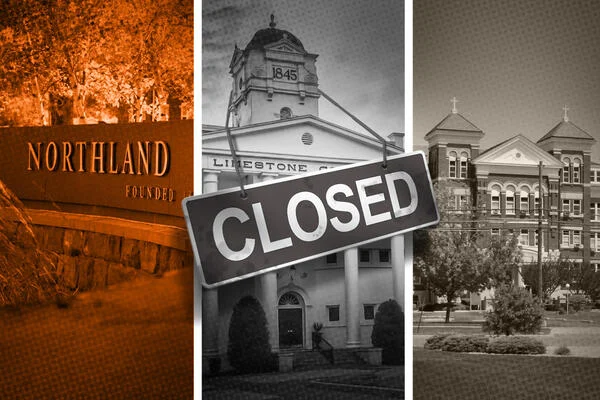
At least 15 nonprofit institutions announced closures amid a difficult year for higher education as the sector navigated rising operating costs and political minefields amid a presidential transition.
That number is down from last year when Inside Higher Ed tracked 16 closure announcements but up from 2023 when 14 nonprofit colleges announced plans to shutter their operations. That count does not include colleges that closed this year but had previously announced plans to do so.
Colleges planning to close are a mix of public and private institutions, though all seven of those in the public sector were part of Pennsylvania State University. Pennsylvania was the only state that had more than one college announce closure plans in 2025. Of the other eight colleges that announced closures, five were religiously affiliated. Enrollment at colleges that announced closures ran from a high of nearly 2,000 students to a low of less than 100. Most had seen enrollment tanking for years while operating costs continued to rise, creating untenable deficits.
Next year is also likely to be challenging for higher education; three credit rating agencies issued unfavorable outlooks for 2026. Anticipated pressures on the sector including concerns about declining enrollment, new caps on federal student loan programs, obstacles for international students seeking to study at U.S. institutions, and possible drops in state funding, among other issues. Small, tuition-dependent colleges are expected to be the most vulnerable institutions.
Here are nonprofit colleges that announced closures this year:
The above list does not include Martin University, which paused operations earlier this month and appears on the brink of closure. While the private college—which is the only predominantly Black institution in Indiana—terminated staffers en masse because it couldn’t make payroll and encouraged students to transfer, it has not yet announced plans to close.
To jump to the list of mergers, click here.
College Closures
Northland College
The small private college in Wisconsin was the first to announce a closure this year. Northland officials said in February that the college would close at the end of the 2024–25 academic year due to insurmountable financial challenges and declining enrollment. Northland officials attempted to raise $12 million to keep the college alive but that effort failed.
St. Andrews University
The private North Carolina campus, which was a branch of Florida-based Webber International University, abruptly closed in May due to what officials called insurmountable financial challenges. The move came despite a growth in enrollment, which had climbed from 715 students in fall 2013 to 930 in fall 2023.
Limestone University
Officials at the private, Christian university in South Carolina left its roughly 1,600 students in the lurch when they announced a sudden closure in May after a last-ditch $6 million fundraising effort failed. Limestone, which had struggled for years and showed clear signs of financial distress and persistent enrollment declines, owed 281 students nearly $400,000 in the aftermath.
Bacone College
The private institution in rural Oklahoma officially shut down over the summer when it was forced to liquidate its assets after declaring bankruptcy the prior year. Bankruptcy had been an effort to restructure as the university grappled with several financial woes including lawsuits from unpaid vendors and crumbling facilities. Bacone, which historically served a majority Native American student body but did not have Tribal College status, saw its enrollment collapse over a decade; in fall 2013, the college had nearly 1,000 students and enrolled just over 100 in fall 2023.
Penn State Commonwealth Campuses
Penn State’s Board of Trustees signed off on a controversial plan in May to close seven of 19 Commonwealth Campuses due to enrollment and financial pressures—a process that will play out over two years. Campuses in Dubois, Fayette, Mont Alto, New Kensington, Shenango, Wilkes-Barre and York will shutter in spring 2027. Collectively, they enrolled almost 3,200 students, a number that has been dwindling for years. Despite enrollment challenges, the plan prompted pushback from trustees and community members because it comes at a time the university is investing hundreds of millions into athletics at the flagship campus, including a $700 million stadium renovation and a $9 million coaching buyout.
Siena Heights University
Officials at the private, heavily indebted Catholic institution in Michigan cited untenable financial challenges when they announced a closure this summer, which will become official at the end of the 2025–26 academic year. Enrollment at Siena Heights had been trending down for years, falling from a recent high of 2,707 students in fall 2015 to just 1,832 students in fall 2023.
The King’s College
Although The King’s College formally announced a closure this year, it wasn’t open to begin with. The Evangelical college in New York City shut down in 2023 due to severe financial issues and was stripped of accreditation but avoided formalizing the closure. Earlier this year, trustees announced plans to revive the institution but pulled the plug in July after that effort failed.
Trinity Christian College
Squeezed by declining enrollment, persistent operating deficit, an over-reliance on a small donor pool and lasting effects from the coronavirus pandemic, the private college outside of Chicago announced in November that it would close. Trinity Christian College will formally shut down at the end of the current academic year. The closure comes after the college operated at a loss in eight of its last 10 fiscal years and enrollment shrank from 1,068 in fall 2019 to 872 last year.
Sterling College
The tiny work college in Vermont, which intentionally capped enrollment at 125 students but only enrolled 78 as of fall 2023, announced in November that it will close after the spring semester. Officials cited “persistent financial and enrollment challenges” in the closure announcement. Sterling’s looming closure means that only eight federally-recognized work colleges remain.
Mergers & Acquisitions
As some colleges closed, others merged with or were absorbed by larger institutions. Inside Higher Ed tracked seven college mergers and acquisitions announced this year—down from 12 in 2024.
This year also saw some mergers fall apart.
For instance, the University of Findlay and Bluffton University called off a planned merger in March after Findlay’s board voted against moving forward with the proposal. The University of Idaho also scrapped plans to buy the for-profit University of Phoenix for $685 million after lawmakers objected to the deal, citing financial risks and other concerns. (Except for Phoenix, all colleges referenced here are nonprofit institutions.)
Rosemont College // Villanova University
Villanova, a significantly larger institution, will absorb Rosemont, which is located less than a mile away. The deal looks more like an acquisition versus a merger and comes as Rosemont has struggled financially and with enrollment, leaning heavily in its endowment to stay afloat.
East Georgia State College // Georgia Southern University
The University System Board of Regents approved a merger between two of its members in April, an arrangement that will see East Georgia become part of the larger Georgia Southern.
Russell Sage College // Albany College of Pharmacy and Health Sciences
The two private institutions in New York announced a merger in April. The merger, which is set to finalize by fall 2027, aims to create one of the largest private, health-focused colleges in the region. Officials project an enrollment 4,000 students in Albany, Troy and online.
Kean University // New Jersey City University
The two public universities in New Jersey struck an agreement to begin merger negotiations in March. That deal, which will merge the minority- and Hispanic-serving institutions, comes after NJCU faced significant struggles in recent years. The university declared a financial emergency in 2022, which necessitated a $10 million state bailout and led to an administrative shake up.
Morningside University // St. Luke’s College
The two Iowa institutions announced in July that they were coming together as one, with Morningside set to absorb St, Luke’s. The latter institution is currently part of Unity Point Health, a hospital system spread across Illinois, Iowa and Wisconsin. While the two institutions have collaborated in the past, the merger will allow Morningside, the larger of the two, to expand health-related degree offerings.
Elon University // Queens University of Charlotte
Located about two hours apart, the two private universities in North Carolina announced in September that they plan to merge, with the deal expected to conclude in summer 2026. On paper, the merger looks more like an acquisition for Elon, which has a stronger financial position.
Pacific University // Willamette University
Pacific and Willamette officials announced earlier this month that they are exploring a merger, which would create the largest private institution in Oregon. Collectively, the two universities, located an hour apart, enroll about 6,000 students. The plan is for each institution to maintain their respective campuses, admissions requirements, academic programs and athletic teams but operate under a shared administrative structure known as the University of the Northwest.
