

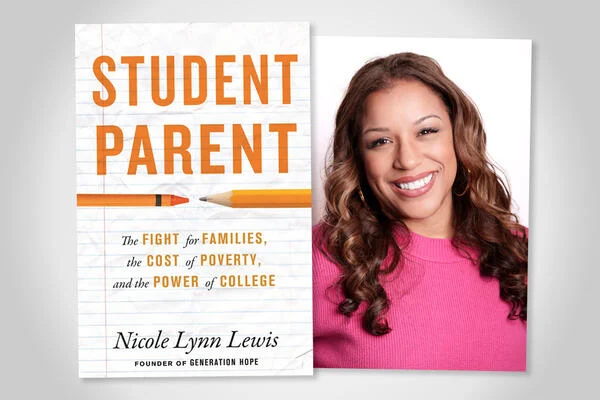
When Nicole Lynn Lewis graduated from William & Mary, she crossed the stage with her 5-year-old daughter.
Seven years later, she founded Generation Hope, an organization dedicated to helping parents get to and through college, motivated by her own experiences as a teen parent and student.
In her most recent book, Student Parent: The Fight for Families, the Cost of Poverty, and the Power of College (Beacon Press, 2026), Lewis delves into the obstacles facing students with children, from skyrocketing childcare costs to food insecurity and limited public transportation to campuses. She also weaves in students’ and her own personal stories and concrete recommendations for how college leaders and policymakers can improve parents’ college access and completion.
Inside Higher Ed spoke with Lewis about her approach to understanding and alleviating the challenges confronting student parents. The conversation has been edited for length and clarity.
Q: In your first chapter, you describe how workforce development and employment are frequently cited as a solution for low-income parents who are struggling, but higher education is too often overlooked as an option for them. Where have you seen that dynamic play out? And why do you think that is?
A: I think it plays out in so many spaces, whether it’s in philanthropy—where you have funders that want to solely focus on workforce development as a solution to dismantling poverty—or you have community groups who are focusing on getting folks into jobs, as opposed to really finding pathways to college and higher education.
[It’s] just a general sentiment about what is possible for people who are navigating poverty, what their potential is. Rather than [viewing them as] being fully capable of earning a postsecondary credential, the focus is really on getting them into jobs that may not even allow them to put food on the table and really don’t have opportunities for promotion. So, it comes from a sentiment of really limiting folks who are navigating scarcity and also this belief that higher-resourced people know better how to help these people thrive than the actual folks who are living this every day.
Q: You also emphasize in the book that race has to be a critical part of the conversation about parenting students. You also note that race-conscious practices in higher ed are under fire right now. What has it been like for you to talk about race and the way it plays into the experiences of parenting students in this current political climate?
A: Well, there’s no doubt that we’re in a season and a moment in this country that is definitely making it difficult to name race as having a critical role in whether or not people are able to actually achieve the American dream. That is certain. But when I sat down to write this book, I really wanted to provide people with true solutions and wanted people to have a real understanding of the challenges and the barriers for student parents when it comes to them earning a college degree. And in order to do that, I have to talk about race.
There is no way to really unpack the childcare challenges, the tuition affordability, the housing insecurity, food insecurity, without naming that race, racism and systemic oppression have shaped the way that people are able to either access these things or not in this country. So, it is challenging, but the only way that we’re going to get to true solutions and true action is by being honest about how we got here and what we need to do going forward.
I think there are very obvious things, like the Supreme Court ruling that banned race-based decision-making [in admissions] and really dismantled affirmative action efforts. Student parents are more likely to be students of color, so a decision like that obviously is going to impact the student parent population.
But there are also things that people may not connect to the student parent experience, like students of color growing up in communities that have been choked of resources. And so, you’re not able to have high-quality schools in many communities that are predominantly Black and brown. If you are a Black mother, you are less likely to get adequate health care and attention when you are pregnant, and that has huge implications for your child and their own academic career years later. And so it happens even before birth where we see these disparities, and those disparities have real implications for whether or not you, as a student, and certainly as a student parent, are going to be able to have the preparation, the resources, the support that you deserve to make it to the graduation stage.
Q: In addition to race, you talk about gender. You mention that when we talk about parenting students, we’re not always thinking about fathers, who are also an important part of the picture. How do you think gender plays into the resources that parenting students need?
A: I wanted to explore all the different angles of gender as it relates to the student parent experience. So, I talk about the fact that the majority of student parents are mothers, and single mothers, and that single mothers in this country are disproportionately shouldering poverty and all of the challenges that come with that. I talk about the pay equity gap and so many of the things that make it incredibly difficult for mothers to be able to just put food on the table every day, never mind pursue higher ed experience.
And then at the same time, I wanted to talk about the erasure of fathers and student fathers. In our larger society, fathers have really been removed from the caregiving and caretaking conversations in this country, and really that has been pushed to moms to shoulder caregiving. And the damage that does to fathers is it really discounts the critical role that they play. [At Generation Hope], we will make sure that student fathers are acknowledged, they’re named, they’re prioritized. Your programming for your student mothers might look different from what it looks like for the student father population.
We’ve done a barbershop campaign, for example, where we had children’s books that we placed in barbershops with a QR code on the back that if you scan the QR code, you’re able to learn more about Generation Hope and the supports that we offer to go to college. The thinking there is, let’s go to where fathers are, and fathers are going into barbershops, they’re going to get their hair cut, and they’re getting their children’s hair cut. To be able to have resources right there in their community that provide more information about college as a viable option for them, that is a strategy in terms of recruitment.
But we also see some of our college partners doing things like Super Bowl watch parties for student fathers, trying to engage them in the ways that they want to be engaged. And I think the critical thing for student parent work across the board is really having student parents themselves help to guide the programming. We believe so strongly in the impact of having student parents around the table and designing the supports and the programming.
Q: In the book, you say that “a focus on shame” is central to your work with colleges to help them better support parenting students. Can you tell me more about that approach?
A: The teen parent population and the student parent population and the single mother and single father population—and even if we think about, more broadly, folks who are navigating the university and are low income in this country—have been made to feel ashamed. They have been made to feel like they are not worthy or deserving of a college degree, of economic mobility, of opportunities, of fulfilling careers … The list goes on and on.
In order for us to really reach them and serve them, we’ve got to create spaces that are nonjudgmental. We have to create spaces that really combat that shame that they face out in the world. We have intentionally built that environment at Generation Hope—that’s been critically important for us—and now we work with college partners to help them create campus environments that are all about embracing parenting students, celebrating family, inclusion and really making sure that student parents feel seen and that they feel like they belong. And that flies in the face of— when we think about what traditionally has been celebrated and prioritized in higher education. But we know that when you’re able to create those campus environments, that’s when student parents really thrive.
Q: What can colleges and policymakers do to create those campus environments and to respond to the many struggles of student parents detailed in your book, including poverty, food and housing insecurity, childcare costs, and transportation? What role can institutions and policy play in relieving some of those challenges?
A: These are big challenges and big issues. They’re not just being faced by college campuses and student parents; they’re being faced by millions of people across the country. We always tell colleges, you’re not expected to solve all the issues and the challenges, but what we want you to be is a place where student parents feel like they can succeed and where they can thrive and where they are seen.
That can be things like making sure that you’re collecting data on the parenting status of your students. Most colleges and universities across the country are not doing that. And that’s a good starting point so that then you start to understand who your student parent population is. If you learn that, say, 15 to 20 percent of your students are parenting and most of their childcare needs happen after hours, and there’s really a drop-in care need so that they can go to class, that helps you think about what kind of solution you could stand up on campus. Could you create a drop-in childcare room on campus? Could you partner with a YMCA or a community group to be able to provide services? So, it really begins with data for colleges, and that can help to determine what are the unique needs that your student parents have, how are you able to put some supports in place as an institution to meet those needs and then how can you partner out in the community to do that.
And then for policymakers, what I really try to drive home in the book is the importance of thinking of college as a poverty solution for moms and dads. Much of the focus is on workforce, but we really want policymakers to be thinking about, how do we create policies that pave a path to college for mothers and fathers and making sure that is a part of the conversation. Something like universal childcare—policymakers thinking about that, not just as it relates to keeping parents employed but keeping parents enrolled in school. That’s not happening at scale, and we want policymakers to really begin to insert that into the conversation and prioritize this.
