

Get stories like this delivered straight to your inbox. Sign up for The 74 Newsletter
Kids. Zoomers. Whippersnappers.
You know, those bipedal mysteries who are bopping around with a simultaneous look of disdain and indifference. They’re listening to music with wired headphones and seem to levitate underneath the baggy, acid washed jeans and windbreakers of the late nineties. There’s probably bubble tea involved.
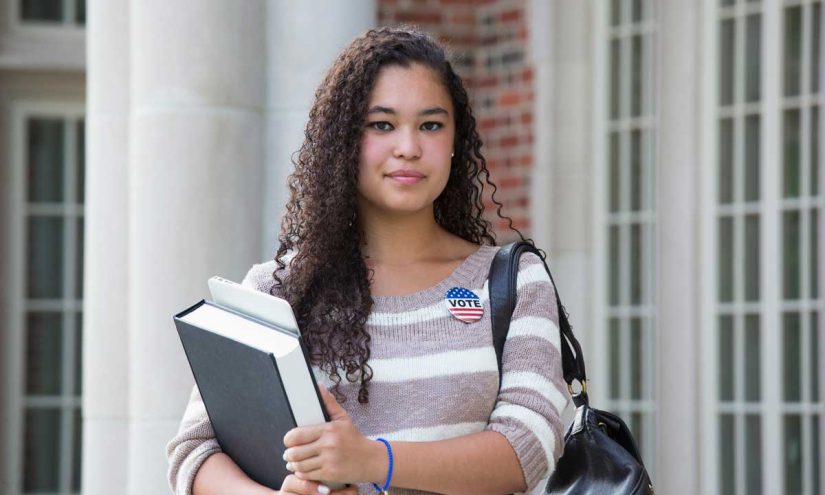
In 2028, these kids are voting. In two years, these nine million 16 and17 year olds, zits and all, may be all that stand between us and a failed state.
The ramifications of the 2028 election are looming monumental on the horizon.
Rally, organize, vote. This is the mantra champions for democracy are pushing. But they’re not pushing it to the kids — and boy, should they.
In its latest World Report, Human Rights Watch warns of an “authoritarian wave” that has come into power across the globe, including in the United States. “Authoritarian leaders have exploited public mistrust and anger to win elections and then dismantled the very institutions that brought them to power,” the report states.
Throughout history authoritarian playbooks have hinged on capturing the hearts and minds of young people. The idea is simple: You capture the youth early enough and you capture the future.
This was a key pillar in the Soviet strategy to flip eastern Europe after World War II: simultaneously cripple the education system and funnel state sponsored messaging to a swath of vulnerable teens eager to form a collective identity.
The far right in America has internalized this playbook and are committed to realizing it. What does the targeting of these young people look like?
It’s the ‘manosphere’. It’s the podcasters and YouTubers and influencers who are modeling a misogynist and toxic ‘masculine’ grind culture that appeals to marginalized teen boys looking for inclusion and identity in a world working to deprioritize the patriarchy. The content and community is the bait, the white noise of far right ideologies consumed through osmosis is the hook.
The manosphere is beginning to tap into the cohort of young Latinos, a marginalized bloc desperate to assimilate and be seen as American. They don’t want to accept they’re latching onto a movement intent on their further disenfranchisement.
This scheme transcends class and gender. It’s the likes of Erika Kirk, Nick Fuentes, and leaders within Turning Point USA who are flooding teen spaces and media to eloquently rail against a diversifying America and progressive and empathetic principals in ways that are overtly racist and laced with nationalistic rhetoric.
This prong of the movement doesn’t rely solely on social media; it’s in schools, too. In the last year, the number of Club America chapters in US schools — Turning Point’s high school program — has doubled to 3,000.
Lawmakers are entwined with these groups, receiving donations and funneling money toward youth recruitment. They also appear in podcasts and rub shoulders with influencers because they need them to convert young, future voters.
Young People Have Something to Say. We Should Be Listening
Why? Because they are desperate to maintain minority rule and squash opportunities for America to become a democracy that is representative and elected of its population and their ideals, that is: a youthful generation of progressive people of color.
As America grows ever more diverse, these power brokers are fervent to recruit a new generation that will maintain their minority rule.
The problem is that it’s working.
The other problem is that champions of democracy aren’t doing the same thing to cultivate the next generation of civically engaged young people who might be able to thwart this movement.
It’s difficult to understand why pro-democratic movements haven’t leaned into cultivating the democratic agency of the 16- and 17-year-old population prior to the voting age. They just don’t.
There is obvious ageism toward young people, and a failure to get behind the science of adolescent development. I also believe it is implicit bias playing out at scale –- a manifestation of our country’s white-dominated power structure unwillingness to accept the future is racially and ethnically diverse, multilingual and much better informed than ever before.
Even when there are attempts to organize around teens, it’s done poorly and with little effect because these young people harbor a growing level of disdain for the priorities and ideologies of both political parties and organizers. They see a civic system that doesn’t look like them, doesn’t have the same priorities of them, and has proven over decades not to have their best interest in mind.
In a collaborative study led by the Center for Interdisciplinary Research, Collaboration, Learning, and Engagement, researchers found 60% of young people agree the political system doesn’t work. Black and Brown youth are the ones choosing not to vote. Why should they?
Most chilling, 31% of the Gen Z respondents in the study said they do not “buy into the value of democracy”, and are sympathetic to authoritarian governments. This population is expected to account for over half of the voting population in 2028.
So, what can be done? A lot in just two years.
One of the first priorities is to protect and reinvigorate civic education in public schools — particularly those serving the most diverse and historically marginalized populations. It is here the pipeline for future voters is restored. It’s not just teaching how a bill becomes a law, it’s teaching kids how to build democratic power. Amid systematic attacks on public education, basic and sound civic education is no longer a guarantee, and local leaders must be held accountable to ensure access to strong curricula.
The education system can’t do all the heavy lifting. Out-of-school time civic education and participatory engagement programs need to be designed and run all over the country. That’s particularly important for two distinct communities: those whose voting rights have been systematically targeted throughout history and those of privilege and access who’ve never felt a need to show up to the polls.
Beyond programs and education, conversations about why this matters should be taking place at the dinner table, on the courts, on the streets, on line, in the cafeterias and community events. Young people need to rally around the idea of representative democracy. The refrain should be simple: kids are voting in 2028 — are they prepared?
It’s important to remember that our nation is not preparing young people for politics or partisanship: We are preparing them for democracy.
Voting is not partisan, it is democratic. Civic engagement is not political, it is democratic. It’s not a matter of pushing issues or candidates. . It’s a matter of preparing them to engage and trusting in their moral and ethical fortitude. They’ve proven to always land on the right side of history.
I’ve said before, the entire youth civic ecosystem must be reformed — a project that is decades of work in the making. Still, I believe one well-prepared generation could radically alter the civic landscape and discourse, and be the catalyst to creating a pipeline of young voters that will lead increased turnout, local level engagement, more representative candidates, increased accountability, and a new age in which majority and representative rule is the status quo and not a pipe dream.
In the meantime, remember democracy is under threat. There is a movement looking to overturn our republic, and it hinges on capturing the hearts/minds of young people. Young people could have an incredible role to play over the coming years. Where anti-democratic movements recognize the power of youth, the collective good must too — and that collective must rally around young people before it’s too late.
Did you use this article in your work?
We’d love to hear how The 74’s reporting is helping educators, researchers, and policymakers. Tell us how
