

Get stories like this delivered straight to your inbox. Sign up for The 74 Newsletter
The country is in the midst of an extraordinary literacy crisis. Today, 70% of kids who are graduating aren’t reading proficiently. Let that sink in for a moment. This isn’t a small group of kids; it’s the majority.
Experts have raised a variety of factors contributing to this reality: learning loss due to the pandemic, increased screen time, the dissolution of long-form reading and teacher burnout. While each of these points are critical, there’s an even deeper, more fundamental issue facing students that a flurry of educational reforms haven’t fixed and may have worsened:
They are simply not spending enough time actually reading in school.
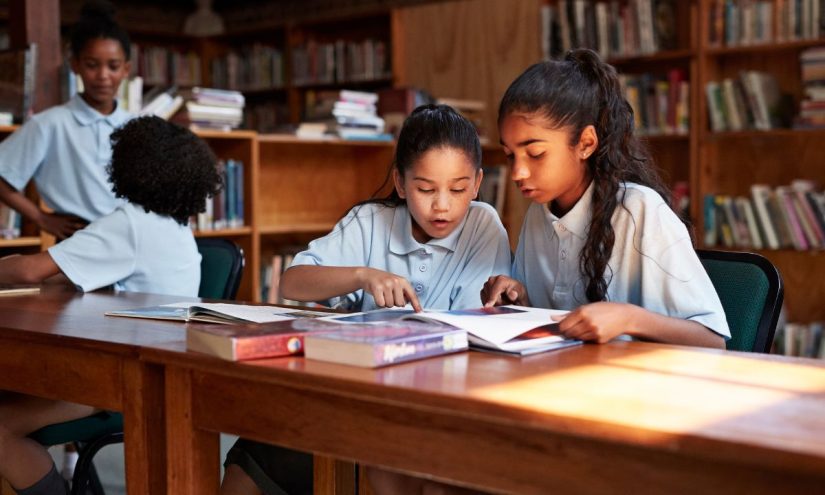
Practice makes perfect, but without the reps, there’s no room for growth. Research suggests kids should have at least 15 to 30 minutes of uninterrupted reading time a day. The reality? Much worse. On average, middle school and high school kids are getting about eight minutes, if that.
This poses an even greater challenge for students in poverty. Kids who have little to no reading opportunities at home depend on school to fill the gaps. When reading minutes are reduced, they’re hit the hardest.
So how do educators fix it?
It turns out, they already have the answers. Here’s what the research tells us.
First, schools must protect uninterrupted reading time — and make it non-negotiable.
Right now in school, kids are bombarded with interruptions: digital devices, announcements, visual distractions, visitors. In fact, a recent study of the Providence Public School District revealed that classrooms are interrupted more than 2,000 times a year, resulting in the loss of between 10 and 20 days of instructional time. What’s more, administrators often underestimate or misperceive how these interruptions might be disrupting the learning process.
Students need to be given the space to focus. If educators want to make changes, they need to get intentional about providing stronger opportunities for kids to focus in school: rethink the physical environment to reduce visual noise, streamline communications for students and build in time for cognitive processing.
That means giving students the time and space to get their reading reps in.
Second, teachers must make the time kids are spending in school worthwhile.
Giving kids the time and space they need to read, requires that they know how to do it. And there needs to be accountability and checks that tell us the practice is worthwhile. That’s where a strong curriculum comes in.
Why Are So Few Kids Reading for Pleasure?
Educators need to be asking ourselves whether the work we’re asking students to do is worthy of their time and intelligence. If our kids are spending 15,000 hours in school across K-12, it’s on us to ensure they’re getting out what they’re putting in. It starts with providing high-quality instructional materials that are comprehensive, coherent, evidence-based, knowledge-rich, and grade-appropriate.
Research shows students learning under a coherent curriculum gain an average of 1.3 months of additional learning — 1.8 months for struggling students. With the right instruction, kids who are hit the hardest finally have the opportunity to catch up.
Unfortunately, TNTP’s 2018 multi-system study, The Opportunity Myth, and its subsequent study Unlocking Acceleration revealed that students are rarely taught grade-level work, and they’ve often seen the materials that are being covered in a previous class. As a result, while kids are getting As and Bs, they’re demonstrating mastery of grade-level standards just 17% of the time.
Bottom line? Kids are doing the work, but they aren’t being appropriately challenged. They’re caught in an incoherent moshpit of disconnected academic programming. Schools are underestimating students’ potential, and it’s backfiring on their ability to learn to read.
Schools need to prioritize a curriculum that is cohesive, knowledge-rich, and grade-appropriate to support true learning. If we’re going to ask kids for their time, let’s make it count.
Finally, schools need to be clear-eyed about how they are measuring success.
Today, the domain of English Language Arts is made up of three key areas that are interconnected: reading, writing and oral language. Research shows these areas work hand in hand to help students build their skills; writing improves reading comprehension, while oral language supports both reading and writing.
The problem? Most testing tools that are used for instructional decision-making focus on a small slice of what it means to be proficient in the higher order skills of ELA. They rely on limited data sets like multiple choice questions from a single moment in time to draw conclusions around proficiency across the whole domain, sometimes with big consequences for kids and teachers and instructional programming. Often, these tests don’t measure grade-level proficiency, they measure recall. That’s why our children can get As and still not be proficient readers.
If schools want our kids to succeed in literacy — an imperative in the age of AI — there has to be a more advanced discussion about assessment. Schools need to adopt an assessment system that aligns with the domain of English Language Arts. That means moving away from single-point-in-time multiple choice testing strategies and adopting assessment practices that hold the bar for higher order reading, critical analysis, writing, speaking, communicating and collaborating.
Solving the literacy gap doesn’t require an overhaul of our education system or an innovation that is smarter than all humans combined. As educators, we can teach children to read who attend school for 15,000 hours. We need a collaborative, aligned effort to challenge the status quo. We need leaders who are willing to pull on the right levers for change: protect reading time, provide high-quality, grade-level materials and measure what actually matters
Did you use this article in your work?
We’d love to hear how The 74’s reporting is helping educators, researchers, and policymakers. Tell us how
