

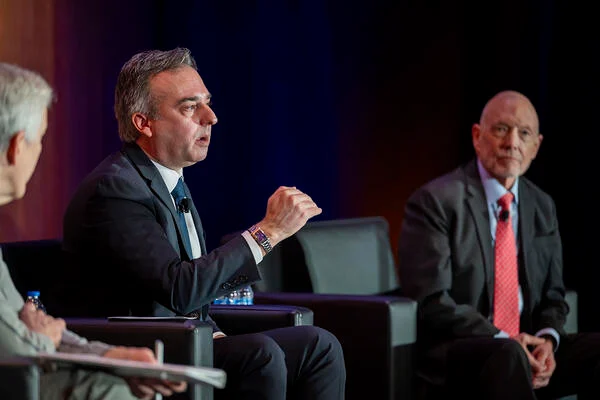
WASHINGTON, D.C.—Higher education can’t afford to back down and surrender its independence. That’s the message American Council on Education president Ted Mitchell sent at the opening plenary of ACE’s annual meeting Thursday morning, calling on college leaders to resist a “federal takeover” by the Trump administration.
At last year’s meeting, in the early days of the second Trump administration, Mitchell struck a fighting stance in his remarks, telling attendees, “We’re under attack.” Now that the extent of that attack has become clear—if not entirely successful—Mitchell argued that colleges must remain true to their mission, even under fire from a federal government willing to target those who don’t fall in line with their political priorities.
Mitchell offered his thoughts during the first part of a panel titled Truth, Trust, and Leadership: Higher Education’s Inflection Point. That was followed by a conversation between former education secretary Arne Duncan and David Pressman, who served as the U.S. ambassador to Hungary from 2022 to early 2025, when Prime Minister Viktor Orbán was further consolidating his power—including by targeting higher education.
A Sector Under Fire
Mitchell opened with the obvious: “It’s been a hard year for higher education,” he said. He argued that the sector has been insulted, demeaned and assaulted, which has “disrupted our work” and “threatened our ability to do what we do for students, for communities and for America.”
But he also pointed to bright spots, including advancements on Pell Grants for short-term programs, enhanced conversations around accountability and Congress’s role in protecting federal research funding from the Trump administration’s attacks.
“We’ve defended our institutions’ rights, We’ve defended our faculty’s rights, we’ve defended our students’ rights,” Mitchell said. “We have opposed measures that would cripple our research enterprise, and we have defended the rule of law.”
But higher education’s critics have made some fair points, Mitchell conceded, arguing that the sector must improve, innovate and increase connections with the public amid growing skepticism. Mitchell particularly noted concerns about student success and the need to improve graduation rates, “the scourge of antisemitism” on college campuses and worries about free expression.
“Free speech is under threat,” Mitchell argued. “It’s under threat from the right, and it’s under threat from the left. We need to improve tolerance and viewpoint diversity on our campuses. Let me just say—cancel culture is wrong, whether it comes from the left or the right.”
He also credited institutions that rejected the Trump administration’s proposed “Compact for Academic Excellence in Higher Education,” which promised signatories preferential treatment from the federal government in exchange for far-reaching institutional changes. While he argued the sector could “improve in some of the areas noted by the compact,” rejecting it was the right move because it represented “a step toward the federal takeover of higher education.”
‘A Lack of Imagination’
Duncan and Pressman took the stage after Mitchell, discussing the parallels between Orbán’s rule in Hungary and the way Trump has wielded power in his second term.
“I’m not saying the United States of America is Hungary, but what I think Hungary offers at this moment is a case study in what institutional and state capture looks like,” Pressman said.
He painted a picture of Hungary as a nation captured by an authoritarian promising to protect it from “marauding outside forces,” only to impose his ideological agenda on universities and rule through a system of severe punishments and lavish rewards.
Orbán launched his attacks on higher education by demonizing university leaders. He then used funding to punish or reward universities, doxed and harassed faculty members, and finally forced structural change, including by transferring assets of public universities to foundations controlled by loyalists. Pressman described similarities between his conversations with Hungarian university personnel about why they conformed and last year’s settlement between Columbia University and the Trump administration, which he saw as an example of capitulation.
(That agreement restored frozen federal research funding and ended investigations into campus antisemitism in exchange for multiple changes at Columbia, including an overhaul of disciplinary processes and a review of academic programs.)
“When I hear the president of Columbia University describe the rationale with respect to why Columbia took the decision it took, for instance … I can hear the rector of [Hungary’s] University of Szeged describing to me exactly why they made the decision that they did,” Pressman said.
He argued that while Szeged’s leaders believed “they needed to save what they could” and assumed “this was a passing blip,” the move amounted to a fundamental surrender of their independence. Like Hungarian universities, U.S. institutions have demonstrated “a lack of imagination about what is happening,” Pressman argued. Alarmingly, they also show a “lack of imagination about where it can lead,” he added.
But he noted a distinct difference between the two situations: speed. While it took Orbán nearly a decade to remake Hungary’s universities, it took mere months “for some of the most powerful, elite institutions to cave to the Trump administration’s effort to undermine” the sector, Pressman said.
While he praised university leaders for rejecting Trump’s compact, he argued there is more work to do. He also urged institutions to be careful not to confuse demands that weaken their independence with a meaningful dialogue.
“I know that there’s some of you who believe that you’re in a dialogue with the federal government about the future of education. I think when you start from that premise you have already lost,” he said. “Because the reality is, it’s not a dialogue that’s focused on solving the problems that are identified; it’s an action focused on trying to undermine your independence.”
Presidents Seek Solutions
As speakers advocated for the sector to push back on government overreach, college presidents and others questioned how they could do so, particularly at red-state institutions constrained by conservative boards and prevailing political realities.
Hofstra University president Susan Poser said during the question-and-answer portion of the session that while private boards may support pushing back on the Trump administration, presidents at public universities face possible termination for speaking up.
“Public boards are highly political, and so there are states now where the president can’t possibly do any activism or they will simply lose their job, and they’ll put somebody in who will then, you know, go with the political views of their board. And so this isn’t a question about lack of imagination, in my view. It’s a question of constraints, and they’re different in every university,” Poser said.
Ultimately, she wanted to know how ACE can help organize the sector.
“Without putting too fine a point on it, that’s one of our hopes today and going forward—that we can stand together, that we understand that people are constrained by different environments, but that we have a set of values that we can speak to,” Mitchell responded. He added that he sees ACE’s role as being able “to say things that presidents can’t, or system heads can’t” and that by bringing people together, he hopes to create an opportunity for further engagement.
