

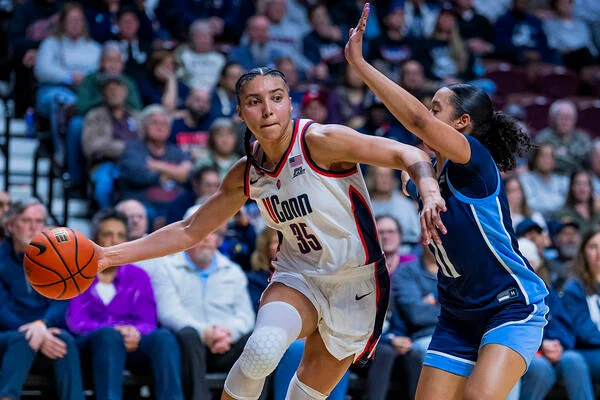
The women’s NCAA Division I basketball tournament kicks off today, marking the tail end of yet another record-setting year for the sport. Regular season viewership for women’s college basketball was up 19 percent compared to the previous season on ESPN, reaching its highest average viewership since the 2008–09 season.
Historically, fans fill out far fewer brackets for women’s March Madness than men’s; last year, about five million fans completed brackets for the women’s tournament, compared to around 34 million for the men’s. But women’s basketball fans appear to have better foresight. The most consecutive matchups predicted correctly in a single men’s tournament bracket was 42 last year. For the women’s tournament, however, nine brackets made it through 52 games, while one lucky—or perhaps gifted?—fan accurately guessed the outcomes of 57 consecutive games.
We’ll see if anyone gets a perfect bracket this year, but considering there is about a one-in-nine-quintillion chance of doing so, we at Inside Higher Ed have our doubts.
If you’re still working on your own predictions, consider using Inside Higher Ed’s academic bracket, which uses NCAA data on teams’ academic prowess to determine the winner of the women’s basketball tournament. (Our bracket for the men’s tournament is here.)
To select the winner of a given matchup, we use each team’s most recently available academic progress rate, the NCAA metric that measures athlete retention and academic eligibility. The team with the higher APR moves on.
We use graduation metrics to resolve ties, first looking at teams’ graduation success rates—the six-year graduation rate for athletes on the team. If that number is also the same, we use the most comprehensive federal graduation rate—though Ivy League institutions typically don’t have FGRs, which can make things a bit more complicated. On the rare occasion teams tie across all three categories, we turn to the overall GSR for all of the institution’s sports teams.
(We also used these metrics to compare the institutions in the First Four matchups, even though those matches will happen before this story is published Friday.)
We only had to go to that overall GSR tiebreaker once in this bracket, in the Final Four match between the Princeton Tigers and the Holy Cross Crusaders, and then again in the final. Princeton took on the Samford Bulldogs, who had fought their way to the final all the way from a First Four matchup against Southern University.
Fullscreen
But ultimately, Princeton came out on top, besting Samford’s overall GSR by just one point. Congratulations, Tigers!
