

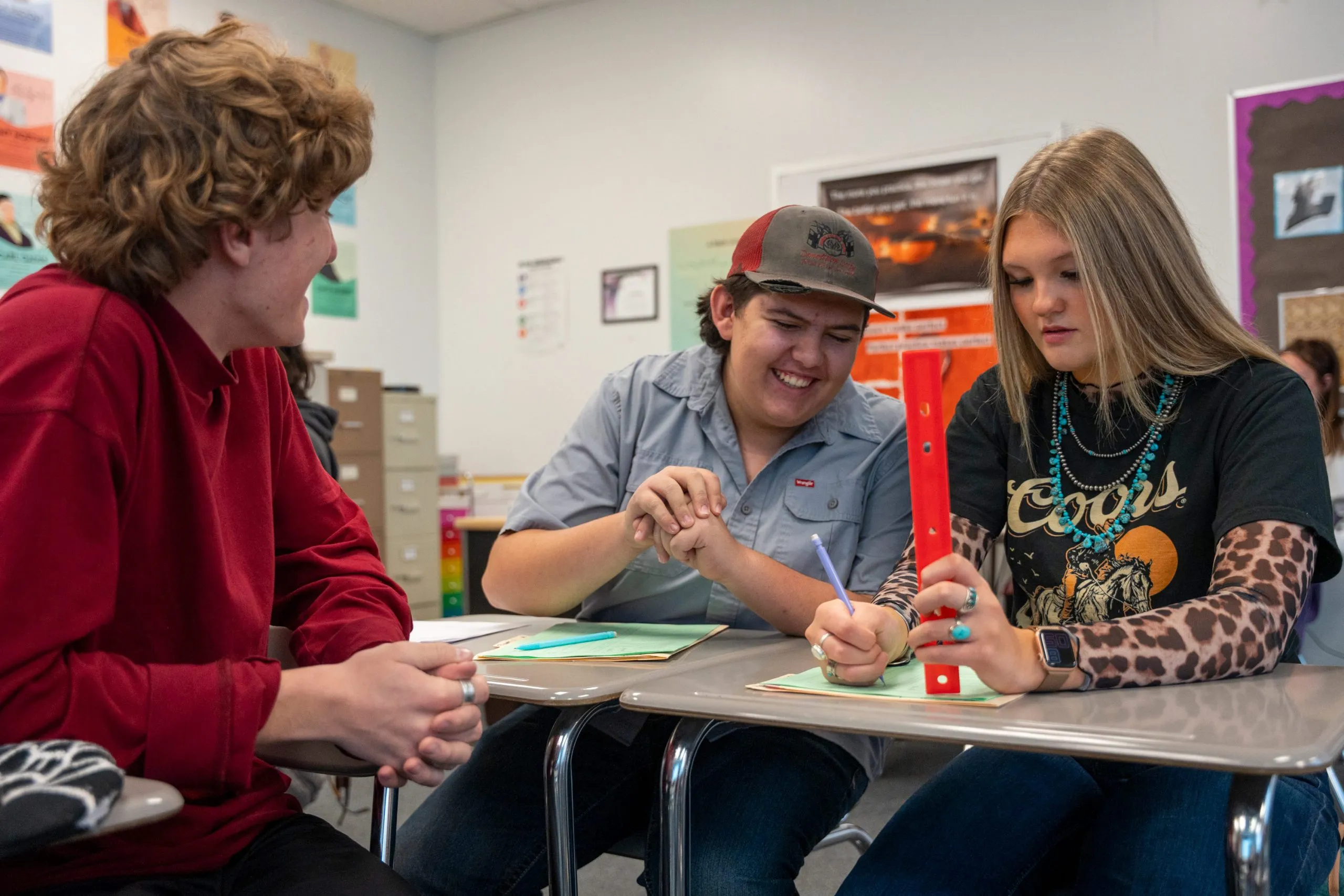
LEHI, Utah — It was the last class before Thanksgiving break, and high school math teacher Sarah Gale was dishing out more than her usual lessons on data science.
“I can smell it,” said one student, pressing her sleeve to her face, as Gale walked around the classroom with a jar and samples of Marmite. The salty spread is popular in Australia and Britain, but far less so here, in the suburbs of Salt Lake City.
“Yeast extract? Disgusting,” said another student, reading from the jar, as her peers mimicked coughs and dry heaves.
The Marmite was more than a culinary dare. Gale, who teaches at Lehi High School, brought it to help her students understand a 2017 study on whether doctors’ bedside manner influenced their patient’s compliance. In the study, researchers asked doctors to prescribe a Marmite-like spread to patients, using either condescending or respectful tones to explain the unusual treatment.
Gale’s students loaded data from the study into a coding platform on their school-issued laptops, then wrote statistical models to compare doctor delivery styles with how much “medicine” each patient consumed. “What’s the hypothesis we’re trying to prove here?” Gale asked the classroom. “What question can the data answer?”
Three years ago, Gale and 15 other math teachers in northern Utah volunteered for a pilot program to introduce data science at their high schools. They split a $20,000 state grant, each designing their own course to teach students how to gather, analyze and interpret massive streams of information that define and govern modern life. State education officials, meanwhile, hoped data science might help more graduates get work in Utah’s booming tech industry. They also wondered whether students who disengaged with traditional math might find relevance and interest in the subject again.
The Beehive State is one of a growing number of states that have expanded access to data science in schools, according to a 2025 report from Data Science 4 Everyone, a nonprofit group. Some 14 states offer pilot courses for students or train teachers in the subject, the report said, while an additional seven have formal standards that guide what students learn about data science and at what grades.
Fans of the field’s expansion into K-12 schools see data science as a stepping stone to good jobs in fields like health care, manufacturing and transportation, which may not require a college degree. Critics, however, worry the emphasis on computers and coding crowds out more traditional forms of math, like algebra and calculus, which often are necessary for admission to selective colleges and provide the building blocks for many high-paying jobs in science, engineering and mathematics fields.
Utah unwittingly opened the door to that debate last fall, when state education officials pitched an overhaul of K-12 math standards that would introduce data science to students as early as preschool. The proposed standards would also allow local school boards to offer a stand-alone course in data science — modeled after the pilots like Gale’s class — for juniors and seniors who might not be ready for or interested in taking college-level math. At the same time, state officials wanted to make it easier for students to enroll in calculus, and their proposal would have removed a requirement for two years of honors math before enrollment.
The combination of changes alarmed some parents and educators, who protested what they considered a lowering of standards for Utah graduates. State officials revised the proposal, retaining two years of honors math and adding data science as an option in the third year. But in January, at the start of an election year, the divided Utah State Board of Education voted to shelve the new math standards until the state can complete a review of the draft standards and how high schoolers in other countries learn math.
The pushback caught state officials by surprise, and it suggests that even as math scores tumble in many parts of the country, the path to developing ways to engage students remains a challenging one. Utah’s proposed approach to data science avoided the pitfalls of a much-criticized policy in California that, before a reversal, allowed students to substitute data science for Algebra II when applying to the University of California state system. Even still, Utah hit pause on any overhaul.
“We couldn’t have anticipated this delay,” said Molly Basham, a mathematics specialist at the state education agency.
Related: The building blocks of math that students need to excel — but aren’t always getting
Math scores for U.S. students have fallen for years, even before the pandemic. As of 2024, just 22 percent of high school seniors tested at or above proficient in math on the National Assessment of Educational Progress, also known as the Nation’s Report Card — the lowest math performance for seniors in nearly two decades. And while Utah students generally outrank the national average, students here still lag behind pre-pandemic levels in math.
Meanwhile in the state, roughly a quarter of all job postings require some data science skills, according to a 2024 report from the Burning Glass Institute, which collects data on credentials and the workforce, and the think tank ExcelinEd. But as in most other states, fewer than 1 percent of the state’s high schoolers sat through a single lesson on data science.
In 2023, at a September summit on artificial intelligence and data science, political and tech leaders advocated for a statewide expansion of teaching both in the classroom, as a way to keep Utah competitive in the economy. The state that fall had just launched the pilot courses, including Gale’s, at 18 schools. And earlier in the year, Utah started a top-to-bottom review of its math standards, a process that happens every seven years.
Under the proposed standards, preschoolers in Utah might collect data on classroom pets to learn basic counting and categorization; middle schoolers could track weather patterns using scatter plots and linear equations. In high school, juniors and seniors might choose a stand-alone course in data science and learn how to apply it to many fields, like nursing or psychology.
Utah requires high schoolers to complete three years of foundational math, but allows students to replace their third credit with an alternate course that parents, in writing, must acknowledge won’t prepare their children for college. High schools offer alternatives such as Accounting, Math of Personal Finance and Medical Math. A higher share of male and Native American students choose these options instead of foundational classes that emphasize more algebra and pre-calculus.
“We have some alternate math courses that some schools use as a dumping ground for kids who need a third, easy math credit,” said Kyle Peterson, a secondary math specialist for the Alpine School District, which includes Lehi High.
He and other advocates of data science said they hoped a stand-alone course in the subject would offer a more challenging, yet practical, final math class for high schoolers who had lost interest in the subject or determined algebra and calculus had no role in their future careers. The state has marketed the subject as a good option for would-be history majors, psychologists and nurses.
Related: Some schools cut paths to calculus in the name of equity. This group takes the opposite approach
That’s been Hailee Kubbe’s experience so far.
A student at Taylorsville High School in the Granite School District, located between Salt Lake City and Lehi, she entered her junior year with a D average in math. A counselor suggested Kubbe take one of the easier, alternate math courses to fulfill her graduation requirement, such as Math Decision Making for Life.
The 16-year-old, however, had already decided on data science.
Her verdict, a few months into the course: “I like this a lot more than regular math. I actually understand it. There’s a lot of visuals, and there’s no dumbing things down.”
Kubbe knows she won’t get college credit for the class. But she’s already enrolled in a training program to become a certified nursing assistant after high school and appreciated the chance to take a more challenging math class.
“I work with lots of numbers from lots of patients,” Kubbe said. “What’s in the numbers is way more interesting than you think.”
Jeff Strohl directs the Center on Education and the Workforce at Georgetown University.
He praised the proposed standards in Utah for introducing general data science skills in earlier grades before offering older students the chance to specialize. “It sounds like a thoughtful approach,” Strohl said. “Every future data scientist needs that base of knowledge.”
Still, he noted that artificial intelligence has made the job market a little less stable for some technology workers, especially computer scientists and coders: “Clearly they are getting hit by some of the disruptions brought about arguably by AI.”
Zarek Drozda, with the Data Science 4 Everyone coalition, said six other states may update their math standards soon to include data science. But it may take a while for Utah to join their ranks.
Related: A lot goes on in classrooms from kindergarten to high school. Keep up with our free weekly newsletter on K-12 education.
The state board first wants time to review how Utah teaches math, and whether it needs changing. Many other states pace students through an Algebra I, Geometry and Algebra II in high school, also known as the AGA sequence. But North Carolina, West Virginia and Utah blend the subjects together and help students build connections between them in a so-called integrated approach.
The agency, under direction of the state board, also will collect feedback from secondary school teachers on how they feel about the AGA versus integrated models. Agency leadership has estimated it will take three to five months to even bid the contract for an international review of how Utah teaches math, and up to a year before the review’s completed and data delivered to the board.
By then, after an election this year, the board will have a new set of members to vote on the math standards.
In the meantime, Gale plans to continue teaching her pilot course. She’s one of just a handful of teachers in the original pilot who still offer the class; most high schools dropped it from their course catalog after state money evaporated. It’s unclear if the board’s decision to postpone the standards decision could lead more high schools to abandon it.
“Our entire math curriculum is calculus-based, but things are kind of changing in the real world,” said Gale. “Every big company uses data to make decisions. It’s more important than ever.”
Contact staff writer Neal Morton at 212-678-8247, on Signal at nealmorton.99, or via email at morton@hechingerreport.org.
This story about data science was produced by The Hechinger Report, a nonprofit, independent news organization focused on inequality and innovation in education. Sign up for the Hechinger newsletter.
This <a target=”_blank” href=”https://hechingerreport.org/this-state-tried-to-overhaul-math-instruction-it-didnt-go-as-planned/”>article</a> first appeared on <a target=”_blank” href=”https://hechingerreport.org”>The Hechinger Report</a> and is republished here under a <a target=”_blank” href=”https://creativecommons.org/licenses/by-nc-nd/4.0/”>Creative Commons Attribution-NonCommercial-NoDerivatives 4.0 International License</a>.<img src=”https://i0.wp.com/hechingerreport.org/wp-content/uploads/2018/06/cropped-favicon.jpg?fit=150%2C150&ssl=1″ style=”width:1em;height:1em;margin-left:10px;”>
<img id=”republication-tracker-tool-source” src=”https://hechingerreport.org/?republication-pixel=true&post=114768&ga4=G-03KPHXDF3H” style=”width:1px;height:1px;”><script> PARSELY = { autotrack: false, onload: function() { PARSELY.beacon.trackPageView({ url: “https://hechingerreport.org/this-state-tried-to-overhaul-math-instruction-it-didnt-go-as-planned/”, urlref: window.location.href }); } } </script> <script id=”parsely-cfg” src=”//cdn.parsely.com/keys/hechingerreport.org/p.js”></script>
