

Many academics have opted out of traveling to the U.S. in light of immigration enforcement concerns.
Matthew Hoen/NurPhoto/Getty Images
More than 2,000 mathematicians have signed a petition calling on the International Mathematics Union to move its quadrennial conference—scheduled to take place in Philadelphia in July—outside the United States. The signatories cite a number of concerns, including the United States’ ongoing war on Iran and the risk that foreign scholars may be profiled and detained by U.S. Immigration and Customs Enforcement if they travel to the conference.
The United States’ recent military actions are “affecting all of us as humans … but in particular, there are acts of aggression that are directly affecting mathematics in various countries and we’re not hearing anything about it,” said Ila Varma, an associate professor of mathematics at the University of Toronto and a co-creator of the petition.
She cited two recent examples: On Monday, the United States bombed Sharif University of Technology in Tehran—Iran’s top science and engineering school and the alma mater of Maryam Mirzakhani, the first woman to win the prestigious Fields Medal. The attack destroyed multiple buildings that housed artificial intelligence databases, Al Jazeera reported. And in January, during the U.S. effort to capture Venezuelan president Nicolás Maduro, U.S. air strikes damaged five centers at the Venezuelan Institute for Scientific Research, Chemical & Engineering News reported. The center for mathematics bore the brunt of the assault and was “completely destroyed,” according to a statement from Venezuelan minister for science and technology Gabriela Jiménez Ramírez.
IMU leaders have not released a public statement about either event, and they did not respond to Inside Higher Ed’s questions about the petition and the conference. According to a statement issued by the IMU executive committee on March 30, the 2026 International Congress of Mathematicians will proceed as planned. The most recent in-person ICM, held in 2018 in Rio de Janeiro, drew 3,018 mathematicians and more than 10,000 total attendees.
“Promoting international exchange is at the core of the IMU’s mission. At a time when international collaboration and science face serious challenges, we strongly believe that holding the ICM in person in Philadelphia is especially important,” the committee wrote. “We understand the concerns about entering the United States, as well as about feeling safe and welcome in Philadelphia and at the Congress. The Local Organizing Committee is fully committed to providing a safe and welcoming environment for all participants and has recently made additional arrangements to help mitigate risk.”
‘We Don’t Stand for It’
The petitioners’ argument highlights what they see as a double standard by the IMU, Varma said—the 2022 ICM was scheduled to be held in St. Petersburg, but two days after Russia launched a full-scale invasion of Ukraine on Feb. 24, the IMU moved the conference online.
“The IMU condemns in the strongest possible terms the Russian invasion of Ukraine. It is a violation of international law, with the most terrible consequences for millions of innocent people affected by this aggression. Our deepest sympathy goes to our Ukrainian colleagues and the Ukrainian people in these grave circumstances,” IMU leaders wrote in a 2022 editorial.
The IMU should treat U.S. aggression in Iran and Venezuela the same way, Varma said. They created the petition “to ensure that there was a collective understanding of the discontent in large swaths of the mathematical community that could see this double standard between Russia in 2022 and the U.S. in 2026, and we don’t stand for it,” she said. She and petition co-author Tarik Aougab sent the document to the IMU executive committee on April 1 but have not yet heard anything back.
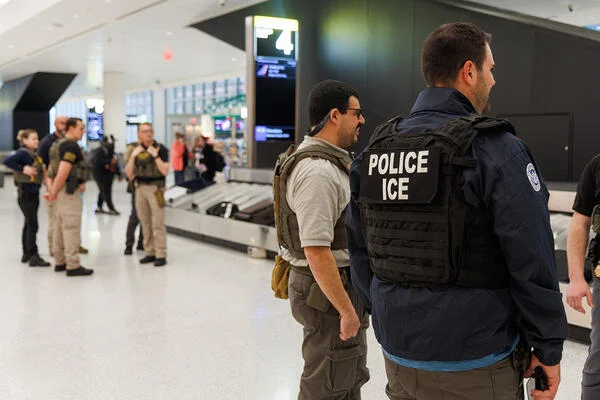
Another major concern for petition signatories is the risk of attendees being harassed or detained by ICE. Many academics have opted out of traveling to the U.S. in light of immigration enforcement concerns, and some mathematicians are doing the same, said Daniel Flores, a math Ph.D. student at Purdue University. Flores has decided to boycott the conference—which would be the first he’s attended—if it isn’t moved outside the U.S.
“There are some mathematicians I’m in contact with who, even for the past several months, have been very hesitant to travel to the U.S. because of fears that their phones might get confiscated and they might get deported by ICE,” Flores said. “If the organizers of the ICM want to be responsible to the international community, they really should consider relocating.”
Several organizations have already announced plans to boycott the ICM, including the Cuban Society of Mathematics and Computing, the Sociedade Brasileira de Matemática, and the Société Mathématique de France.
“The SMF will not have a stand at the ICM in Philadelphia. Indeed, neither the issuance of visas by the host country, nor its internal security—given that martial law is regularly invoked there—appear to be guaranteed,” leaders wrote in a public statement that Inside Higher Ed translated from French. “Furthermore, the SMF remains fundamentally committed to the legacy of Benjamin Franklin, inseparable from rational thought, and condemns the distrust of science and any attack on academic freedoms.”
More than 100 former ICM speakers have signed the petition, along with seven mathematicians scheduled to speak at this year’s conference. Emmy Murphy, a math professor at the University of Toronto, spoke at the 2018 ICM and plans to skip the conference this year.
“There are a lot of reasons why Canadians might be particularly sympathetic to [the petition],” Murphy said. “There’s been some number of Canadian academics who were detained, and even just Canadian people on short-term travel visas who have been detained, to say nothing of [Trump’s threats to annex Canada].”
In a January blog post, University of Michigan Dearborn math professor Tian An Wong wrote about the moral questions surrounding the decision to hold the ICM in Philadelphia, but stopped short of endorsing calls for the conference to be moved.
“It should have been clear early on that the USA is not a viable place for a fully international gathering of mathematicians,” Wong wrote. “Of course, it will always be safer and more accessible for some than others (think back to the days of 2020 following the murder of George Floyd in Minneapolis). But now that citizens from less than two-thirds of all countries can even apply for an entry visa, who is the conference accessible to?”
