

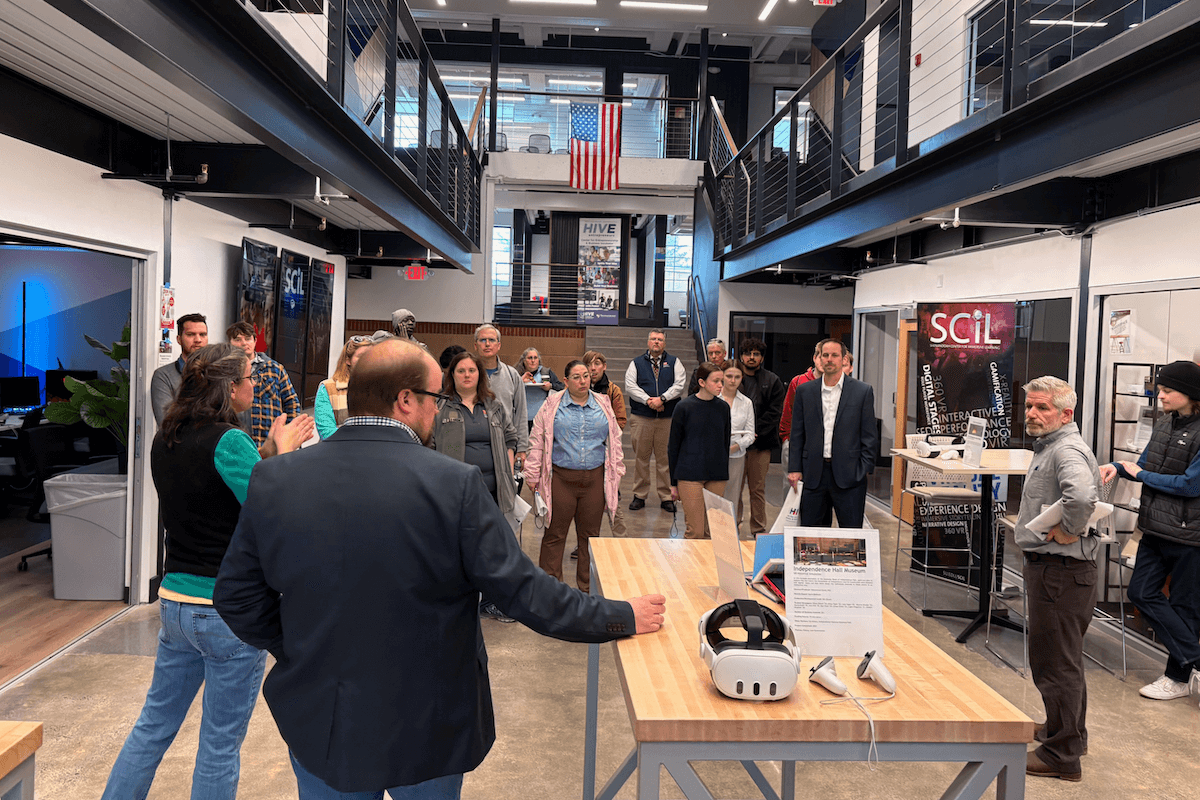
Shenandoah University hosted members of the U.S. Army Corps of Engineers (USACE) Middle East District on Feb. 25, giving its visitors a chance to learn more about the advanced technology and engineering programming in Hazel-Pruitt Armory, home of the Hub for Innovators, Veterans and Entrepreneurs (HIVE), on SU’s main campus in Winchester, Virginia.
Led by USACE Middle East District Director of Public Affairs Joe Macri, 20 individuals – including Edward “Ted” Upson, the Middle East District’s chief of engineering and construction, and engineers, technicians, architects, interior designers, and interns – toured Hazel-Pruitt Armory and witnessed Shenandoah’s commitment to innovation and experiential learning. The visit took place during National Engineers Week.
During the visit, Shenandoah’s Director of the Division of Advanced Technology Ralph Wojtowicz, Ph.D., shared details about SU’s engineering program, which debuted in 2023 and fully launched in 2024, and discussed how the professional engineers in attendance could support the program and its students. Dr. Wojtowicz also demonstrated how the engineering program encourages interdisciplinary collaboration and hands-on learning.
“Visits by technology leaders such as those from the USACE have multiple benefits,” Wojtowicz said. “By building personal connections, we establish job paths for our students who can, in turn, support the strength and growth of these organizations and our regional economy. We gain information about external projects that we can discuss in the classroom and use to formulate new course content. These visits are also an opportunity to market ourselves. The university and donors have invested in new facilities and equipment for the Cybersecurity Lab, physics laboratories, the AI and Autonomous Systems Lab, and the HIVE’s Makerspace. Faculty have invested many hours to make these great learning spaces. This is an exciting time for our science and technology programs.”
The group from the USACE Middle East District also toured the Shenandoah Center for Immersive Learning (SCiL), where co-directors Nathan Prestopnik, Ph.D., and Mohammad Obeid, Ph.D., and SCiL Operations Manager Mariah Arant showcased student-led augmented and virtual reality projects. SCiL provides students with hands-on experience in 3D design, simulation, and interactive media, and access to professional tools such as VR/AR headsets, high-performance workstations, powerful game engines such as Unreal Engine and Unity, and Adobe Creative Suite. It also includes a motion-capture studio, virtual production space, and a makerspace for 3D printing and similar projects.
The tour concluded at the Esports Arena, home to one of the nation’s first collegiate academic esports programs. Shenandoah Esports Director Alyssa Duran explained to visitors how the arena functions as both a competitive gaming hub and a research environment for studying technology, performance, and teamwork. Duran noted that SU students use advanced computing, broadcast technology, and data analytics for enhanced player performance and audience engagement.
In 2024, Shenandoah University and the USACE Middle East District, which is headquartered in Winchester, signed a memorandum of understanding that established the framework for providing more professional opportunities for SU’s students while enhancing the Middle East District’s ability to recruit and retain a highly skilled and diverse workforce. According to Patricia Young, executive director of the HIVE, opportunities for speaking engagements, internships and other opportunities for collaboration are being developed.
“The USACE Middle East District’s visit to Shenandoah University not only celebrated National Engineering Week, but it also showcased how collaboration between academia and industry can foster innovation and leadership in the next generation of engineers,” Young said. “This partnership stands as a testament to the Shenandoah’s commitment to creativity, technology, and experiential learning.”
