

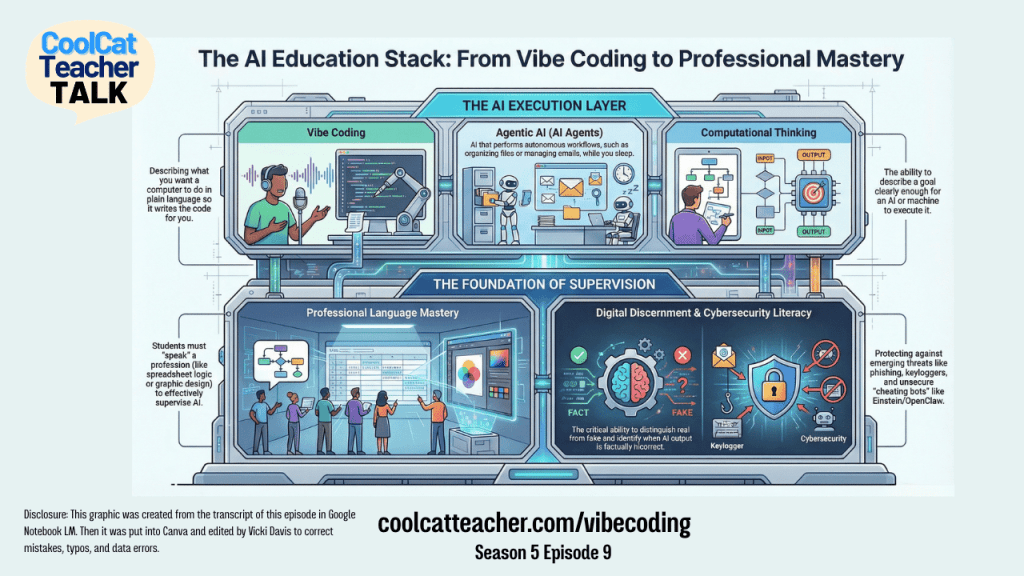
Artificial intelligence isn’t coming to education—it’s already here, reshaping how we work and what our students need to know. A friend recently asked me, “Vicki, how is vibe coding different from what we’ve always done?” It is very different but really exciting when we realize it is something all of us can do!
In this show we talk about vibe coding, how I’m using Claude Cowork (agentic AI), and safety issues for the AI age. I also prompt a conversation about what students need to know in the AI age.
As I talk to recent college grads who have lost their jobs because “entry-level jobs are being taken by AI,” I realize students need to graduate with the language of the professions they are pursuing. Just like calculators moved advanced math down decades ago, now the language of spreadsheets and many industries using AI are moving down as we learn to use the equivalent of a calculator for words in the new AI tools.
In this episode, you’ll hear from Donnie Piercey about how vibe coding empowers every teacher to build custom solutions without coding expertise. We’ll dive deep into agentic AI and why schools must teach professional fluency earlier than ever. And Rachelle Dené Poth brings critical insights on AI literacy, cybersecurity, and why students need digital discernment—not just digital literacy. Whether you’re driving to school, grading papers, or unwinding after a long day, this episode is for you.
Donnie Piercey works as a fifth grade teacher in Lexington, Kentucky. He is always trying to find new and innovative ways to incorporate technology across the curriculum in order to increase student learning and engagement. You can always check and see what his students are up to by visiting his classroom website, http://www.mrpiercey.com.
Donnie has run a 1:1 iPad, Chromebook, and Macbook classroom over the course of his thirteen year teaching career. Donnie received a B.A. in Theology from Asbury University and got his Masters in Education from Auburn University (Montgomery). Donnie is also a Google for Education Certified Innovator, a Google for Education Certified Trainer, and a lead for the Google Earth Education Experts network. He recently traveled to Antarctica with National Geographic and Lindblad Expeditions as a Grosvenor Teacher Fellow.
He currently lives in Lexington, Kentucky with his wife and two children.
Rachelle Dené Poth is an edtech consultant, presenter, attorney, author, and teacher. Rachelle teaches Spanish and STEAM: Emerging Technology at Riverview Junior Senior High School in Oakmont, PA. Rachelle has a Juris Doctor degree from Duquesne University School of Law and a Master’s in Instructional Technology.
Rachelle is an ISTE Certified Educator and a Microsoft Innovative Educator Expert. She is the past-president of the ISTE Teacher Education Network and served on the Leadership team of the Mobile Learning Network for five years. She received the ISTE Making IT Happen Award in 2019 and has received several Presidential gold and silver awards for her volunteer service to education. She was the EdTech Trendsetter Winner for 2024 from EdTech Digest, Named one of the 150 Women Thought Leaders to Follow for 2022, and one of 30 K-12 IT Influencers for 2021.
In 2017, Rachelle was selected as the 2017 Outstanding Teacher of the Year by PAECT and by the NSBA as one of the “20 to Watch” educators.
Rachelle is the author of nine books. Her newest book “How to Teach AI” published by ISTE will be available July 30, 2024. Rachelle’s books are available at https://bit.ly/booksbypoth. She has also contributed to eight other books related to education. She is currently working on two new books for educators.
She presents regularly at state, national, and international conferences and provides professional development and coaching for educators and school districts. She focuses on Artificial Intelligence, Augmented and Virtual Reality, SEL and STEM.
Rachelle is a columnist for Getting Smart, Edutopia, and Defined Learning. She has a podcast ThriveinEDU. Rachelle is also a host of ThriveinEDU Live and leads a community of educators on Facebook.
Disclosure of Material Connection: This episode includes some affiliate links. This means that if you choose to buy I will be paid a commission on the affiliate program. However, this is at no additional cost to you. Regardless, I only recommend products or services I believe will be good for my readers and are from companies I can recommend. I am disclosing this in accordance with the Federal Trade Commission’s 16 CFR, Part 255: “Guides Concerning the Use of Endorsements and Testimonials in Advertising.” This company has no impact on the editorial content of the show.
Click to read the full transcript
This transcript was generated using AI and has been reviewed by humans for accuracy. Minor errors or artifacts may remain.
COOL CAT TEACHER TALK — Season 5, Episode 9
“Vibe Coding and Agentic AI”
FINAL TRANSCRIPT
============================================================
00:00:00:01 – 00:00:22:10
Vicki Davis
Welcome back, educator, to Cool Cat Teacher Talk. I’m Vicki Davis, and today we’re talking about something that’s changing everything and I mean everything. How we work, how we live, and what we need to do to teach our students. Today’s topic how AI changes what we teach our students. Vibe. Coding. agentic AI.
00:00:22:12 – 00:00:35:03
Announcer
Ever wondered how remarkable teaching happens? Find out right now at Cool Cat Teacher Talk with award winning teacher Vicki Davis. Get insights from top educators, tech tips, and inspiration to elevate your teaching.
00:00:35:05 – 00:01:00:12
Vicki Davis
This is Vicki Davis, and today on Cool Cat Teacher Talk will start with vibe coding. That’s where you describe what you want a computer to do and it writes the program for you. My friend Donnie Piercey, a fourth grade teacher from Kentucky, is going to show you how any teacher can do this with zero coding experience, and you can make all kinds of exciting things for your classroom.
00:01:00:15 – 00:01:24:17
Vicki Davis
But then we’re going somewhere bigger. We’re going to talk about agentic AI. Now, don’t let that word to scare you. It’s just a agents artificial intelligence that doesn’t just answer your questions. It does work for you. It can open and organize your files and check your calendar and manage your email and run whole workflows while you sleep.
00:01:24:17 – 00:01:48:00
Vicki Davis
And when you say, oh, I’m not going to give it permission to do all that, you don’t have to, I haven’t. It can be a support in draft emails for you, and you can really tamp down how much you want to give it access. Even with limited access, it’s massively useful as I’ll be sharing in the show. But here’s the question I want you to sit with today.
00:01:48:02 – 00:02:16:04
Vicki Davis
If AI can now do the entry level work that used to teach people their profession, the spreadsheet building, the junior animation, the first drafts. How do our students get good enough in their field to supervise AI? The answer, I believe, is that we have to move professional language down the same way that calculators move math down those grade levels.
00:02:16:04 – 00:02:43:17
Vicki Davis
And I will explain exactly what I mean by that. Plus, we’ll talk about a cheating bot called Einstein. Now it only lived less than seven days, but it’s an indicator of things to come. It could do students entire college coursework while they slept. And the way that we set up AI access matters more than most people realize. So welcome back, educator.
00:02:43:18 – 00:02:44:23
Vicki Davis
Let’s get started.
00:02:45:00 – 00:02:48:13
Announcer
Okay, teacher talk with award winning teacher Vicki Davis.
00:02:48:14 – 00:02:59:07
Vicki Davis
Think that our guest today, Donnie Piercey, is about to set the record for being on my show the most. I ran into Donnie Piercey again at TC. We were both featured.
00:02:59:07 – 00:03:12:17
Vicki Davis
Speakers in the teacher track, and he is the 2021 Kentucky Teacher of the year, and he teaches fourth grade in Lexington, Kentucky and is in his 20th year. Well.
00:03:12:18 – 00:03:30:00
Donnie Piercey
Somebody told me the other day, because, you know, I’ve been teaching now for 20 years and always at a public school in Kentucky, really from Massachusetts. I got the Auburn hat on. My wife’s from Alabama and married into it. But I realized now that I have taught long enough where somebody told me, like, you know, if you round up, you can retire only 43.
00:03:30:00 – 00:03:40:14
Donnie Piercey
I’m like, not thinking that far ahead yet, you know, on Saturday Night Live, like they have like the five timers club jackets kind of thing. I don’t know, maybe we could get one of those or something, but I’m definitely excited to share.
00:03:40:15 – 00:03:41:06
Vicki Davis
We’re going to talk.
00:03:41:07 – 00:03:48:11
Vicki Davis
About vibe coding. How do you simply explain what is this vibe coding thing and is it something that normal teacher can do?
00:03:48:12 – 00:04:06:20
Donnie Piercey
Oh 100% vibe coding. It almost sounds like, oh gosh, is this like a new computer language? Is this a new thing that like, I have to pretend like I know what I’m talking about, but I can just throw the jargon phrase around and people think I’m smart. In a nutshell, what it is is you use an AI tool, but that’s like Google Gemini ChatGPT Claude.
00:04:06:21 – 00:04:29:07
Donnie Piercey
It’s like, what is this thing? Or BaseHub? Which, by the way, if you’re listening to this podcast and you just heard me say those words, you know, it’s totally going to pop up on your Facebook feed. Now, basically, you just go into one of those tools like pick your preferred one, tell it that you want to write a code that does blank, and sometimes it might ask you some follow up questions, but it’ll write the code for you.
00:04:29:07 – 00:04:48:02
Donnie Piercey
And you know, that’s nothing new like that’s existed in AI really since ChatGPT launched. But what’s different right now? You can kind of do the follow up. Now you can say, like, I have this code, I have no idea what I’m doing. Can you tell me what I’m supposed to do with this? Where does it go? Where do I put it?
00:04:48:02 – 00:04:51:02
Donnie Piercey
And the AI tool will walk you through it.
00:04:51:03 – 00:05:10:23
Vicki Davis
So, Donna, you’re talking about this. I was struggling to teach my eighth graders, and last semester I used all the regular, regular tools that we subscribed to, and I was not happy. I had to retest and retest. Well, this semester I took all that content. I uploaded it to my favorite AI tool of choice. It was really, really cold recently.
00:05:11:00 – 00:05:28:10
Vicki Davis
And so I’m like, and we’re. The Eagles wanted it to be about keeping the Eagle from freezing on the nest. And the more questions you got right, the more it warmed the nest up. And save the eagle right. But here’s the thing that happened is I had no retest. The kids made five points higher on average than last semester.
00:05:28:14 – 00:05:40:20
Vicki Davis
It was once and done and they loved it. And they had fun sitting there watching him play it. And I could see the results right there. And the results came out in the results. Right. It was like, this is something that is a game changer.
00:05:40:20 – 00:06:00:14
Donnie Piercey
We probably all have that one friend who just knows coding. And every now and then, like we might text them or send them a screenshot of like, hey, you know, I’m trying to get this HTML code to work. We would send that person a message and they would write you back and they’d say, oh, just fix this part or make some snarky, you know, like Nick Burns, your company computer guy, you know, comment on it.
00:06:00:14 – 00:06:23:14
Donnie Piercey
But, you know, now, like with AI, like, we don’t have to pester that person anymore. What’s wild is right with the whole idea of vibe coding. It’s not perfect, right? Believe it or not, AI makes mistakes. And sometimes the code that it might write for you, or the thing that it might make this change to whatever it’s not right, and it’ll display when you try to run the program, when you try to run the code.
00:06:23:17 – 00:06:43:20
Donnie Piercey
They’ll display an error message. And it still kind of breaks my brain sometimes because I remember when would first happen, I’d be like, oh, what am I supposed to do? And then I realized, like, why don’t I just like, shot the error message and then just copy and paste the error message into, let’s say like Google, Gemini or ChatGPT whatever tool I’m using and say, hey, the code that you wrote, it ain’t working.
00:06:43:21 – 00:07:06:20
Donnie Piercey
It’s given me this message. Can you fix your code? But here’s the thing. Right now I like to learn how to do stuff. Anytime that I do that, I’m always trying to read and kind of go through and reading what it says, because eventually, like, I would like to get to the point where I don’t always have to copy and paste everything, and now I’m a lot better than I was two and a half years ago when I first started playing around with this.
00:07:06:21 – 00:07:21:10
Donnie Piercey
It’s still weird and you’re like, hey, it’s giving me this error message. Make sure you tell me why. Like, what’s wrong? So that way if I see this again, I know how to fix it in the future, because sometimes it’s just like there’s a bracket in the wrong place. One of these variables wrong. It’s really fun. Super cool to play around with.
00:07:21:11 – 00:07:29:00
Vicki Davis
Okay, so give us some examples of some things that have impacted your day in your classroom using vibe coding.
00:07:29:01 – 00:07:56:07
Donnie Piercey
My first advice for teachers if they want to do this is ask yourself like what is one small thing? What is an app or a tool or something that you know that if you could make like a Google doc, do this, maybe it’s a translation tool, or if you could make a Google slide do this, that it would make your day a thousand times easier for that small problem, jump into Gemini or whatever you use and say, hey, I need this to happen.
00:07:56:09 – 00:08:15:17
Donnie Piercey
But here’s the problem can you write some code for me that will fix this problem? When I was first starting out with this, I know what I’m doing now, but I would always put like a little addendum on the end and be like, and I have no idea what I’m doing. So please don’t use any technical jargon, just tell me where to copy and paste this.
00:08:15:18 – 00:08:36:03
Donnie Piercey
Right? So, you know, simple example like I am I’m a full time fourth grade teacher and I do whole group reading, whole group math, whole group, you know, and then small group reading and small group math. And during small group time, you know what? If I’m not meeting with small group, the other 20 plus students in my classroom always want to know, like, what am I supposed to be doing?
00:08:36:05 – 00:08:54:16
Donnie Piercey
And so I would in the past have a slide show up and, you know, on that slide show would be broken down by the different groups and the times. And, hey, here’s what you should be doing. And, you know, that slide show was up there. But unless you know, if you’ve taught if you work to the elementary school kids before, like you don’t always, you know, it’s like, yeah, I’m working on it.
00:08:54:16 – 00:09:15:17
Donnie Piercey
And you go by, it’s like you’ve done nothing like, you know, what are you doing? I took a screenshot of just one of my tasks list, and I removed student names from it because I refuse to train the model. But I took a screenshot of one of my slideshows and I said, hey, I want to make it where I can have like a printable to do list for my students every day.
00:09:15:18 – 00:09:34:02
Donnie Piercey
Based off of this, maybe I could put their names on Google Sheets and then maybe I like click a button or something, and it takes the tasks and it turns it into something like a printout and hand them that physical copy. Because again, elementary school, they need something to hold. Right. And then there’s still tangible. They can still check off the things.
00:09:34:02 – 00:09:52:20
Donnie Piercey
And it said, sure, here’s what you need to do. Make a sheet. Make a slide template that you want your your slideshows to look like. And then it formatted the Google Sheet for me, which was wild. Then it said, and now you’re going to make some Google Apps Script GIS, which again, still makes you laugh that it says gas, but it said okay in this.
00:09:52:21 – 00:09:53:22
Donnie Piercey
Yeah.
00:09:54:00 – 00:09:54:11
Vicki Davis
Fourth grade.
00:09:54:12 – 00:10:11:11
Donnie Piercey
Yeah. Exactly. Right. And we’re learning about the planets this week. So lots of Uranus those jokes anyway. But you know, it walked me through. Now if you want if you want it to be on a separate thing, copy this code and put it there. If you want to have everybody’s the same, you know, put this part here and this would walk you through step by step.
00:10:11:11 – 00:10:31:00
Donnie Piercey
And when I was first learning, I had so many I have no idea what this means. Like, don’t explain to me like I’m 12. Explain to me like I’m six. Okay, now five and kind of back it up more. But it was really cool. And now like at the start of every day, like it’s my first task. Usually before I leave, I’ll just go in, open up the spreadsheet that it’s on.
00:10:31:00 – 00:10:53:23
Donnie Piercey
Now, I will type in the assignments that I want my students to do, and then there’s a little button on there. I click the button and then it creates these printable tasks lists. For me. It’s one of those creative projects that I’m like, okay, that was neat, right? Something that ultimately I put an hour’s worth of work into it, but it ended up saving me countless hours of like putting off tasks lists and making sure.
00:10:53:23 – 00:10:56:18
Donnie Piercey
And parents love that these things get sent home every day, too.
00:10:56:18 – 00:11:12:05
Vicki Davis
That is wonderful. And and so you just hit a button, you know, they’re pretty good at all. These different apps and tools are pretty good at writing for the other apps. You know, I know I can write for Google and you just say, hey, I want to write it for this, and I want to do it in this program.
00:11:12:05 – 00:11:13:14
Vicki Davis
And there you go.
00:11:13:15 – 00:11:34:11
Donnie Piercey
And if your listeners or viewers are looking for like, okay, what’s the simple example, maybe you got your slide, maybe you’ve got your weekly classroom newsletter in Google Slides, right? There’s no native translate tool in Google Slides, but there is Google App Script that you can add. You’ve got in my classroom this year, five different languages. Some of them are not even in Google Translate.
00:11:34:11 – 00:11:53:11
Donnie Piercey
Easily. Ask it to create some Google Apps script for you for your newsletter, and say it needs to have these languages and just say I want it. Where when I click this button on Google Slides, it makes takes what’s on slide one, translates it to those five languages, and then I can just print it all off or email it in one fell swoop.
00:11:53:11 – 00:12:17:20
Donnie Piercey
I’ve been doing this. Now it’s just playing around the vibe coding stuff for over two years. You know, I feel like I know a thousand times more now than I did when I asked it to write a simple Frogger game in HTML, you know, with emojis. But now it’s like you can actually make stuff and it’s fun. Like, I still use AI to correct errors, but some, you know, now with some of the like the sites and things that I’m building, I just kind of do it myself because I figured it out.
00:12:17:21 – 00:12:45:22
Vicki Davis
And a lot of these things you can publish to HTML and then put the link in or publish to all different types of things so that it could be a game that could play, or it could be uploaded all my stats from my podcast and made an HTML dashboard and had it tag every single one of them. Based on topic, I can pull up based on stats like top five in this topic, top five in that topic, and it just makes it really easy for me to kind of figure out, hey!
00:12:46:03 – 00:13:00:16
Vicki Davis
Okay, this might be a great one to add to a radio show I’m doing. It’s just so powerful. It’s like stuff I’ve never had access to before, whether I’m at school or at home. Are there some other ideas that you’ve seen teachers do that? You’re like, oh yeah.
00:13:00:17 – 00:13:24:01
Donnie Piercey
Designing a game. I’m speaking from elementary school perspective here. You can ask like Google Gemini to write some HTML code for you that you can copy and paste onto a Google site, and maybe it’s a learn your division facts game. It’ll write the code. So after it writes it for the first time, maybe like, oh, I want it to be multiple choice every time.
00:13:24:01 – 00:13:44:06
Donnie Piercey
Maybe you want it where your high school teacher and you’re trying to have your students balance equations. Hey guess what? Ask it to write some script for you. Or HTML code that you can copy and paste or embed onto, like a Google site or something simple, and then send that Google site to your students and then boom, guys, hey, I want you to play this game that I made for you today.
00:13:44:07 – 00:14:09:06
Donnie Piercey
I like to be silly sometimes. Sometimes I’ve just learned with silly things. It’s that’s kind of how you learn how this works. My first website that I wrote and published from start to finish again, I’m not going to pull this up now, but if you go to GIF debate, that’s GIF debate. It’s a site that I put together that I feel like definitively finally answers the question of how to pronounce that word correctly.
00:14:09:06 – 00:14:10:09
Donnie Piercey
So there you go.
00:14:10:10 – 00:14:32:16
Vicki Davis
It’s remarkable. I mean, we’ve entered the age of what we used to call citizen programming. Now we call it vibe coding, which is by simply being able to describe the program. You can write the program you want to use, a tool you trust, and you want to protect. That student needs the student data, but it is remarkable and it can boost performance.
00:14:32:18 – 00:14:54:07
Donnie Piercey
If you teach CS like maybe she’s like an AP C++ course. I mean, I took that in high school. Do not ask me to remember it at all. Maybe you know one thing that I know a lot of those teachers are using is they’re having it right code. Like they’ll ask Gemini to write code or something and then whatever language that in JavaScript, Python, whatever, they’ll ask it, hey, can you make a mistake?
00:14:54:08 – 00:15:12:20
Donnie Piercey
Right. And they’ll be very, very specific with what that mistake is. And then the teacher will copy that code, put it on like a text file or whatever, and say, hey, you need to debug this and figure out what exactly is going wrong, because this is supposed to display a calendar where whatever year it is, it makes sure it matches everything up.
00:15:12:20 – 00:15:37:05
Donnie Piercey
Right. But there’s a mistake. You need to fix it, right? Tell me what’s wrong, debug it and fix it. The little examples like that, and it’s just fun, you know, like sometimes it’s like, hey, make me a silly app that does this. Or, you know, something simple with a lot of these coding apps because, you know, like we’ve said this word Claude a lot, this codex like ChatGPT ones and a lot of these are like separate downloadable apps that you can put on your computer.
00:15:37:06 – 00:15:55:13
Donnie Piercey
All of them even like the super high priced paid models, they have a limit like they won’t you won’t sit there and code forever, you know, which frankly, I think is a good thing because, you know, at one point, as a user, I need to have it like I need to be able to say, okay, stop. Look at what you have.
00:15:55:14 – 00:16:10:04
Donnie Piercey
Right. Can I can I at least check to see, like, is this site that I’m building doing what it’s supposed to? Is this game working the way that’s supposed to? Is this feedback tool doing what it’s supposed to. But you know, deep down, like, man, like I don’t want to ever reach the point where these machines are like coding.
00:16:10:04 – 00:16:13:19
Donnie Piercey
And then they create coding machines on their own and then the world gets taken over.
00:16:13:20 – 00:16:30:13
Vicki Davis
I use Claude Cowork and have created some skills that I dictate voice memos on the way to school, and I used to do transcript and then I would try to do something with it, but now I just throw it in a folder and I have a custom skill I run every morning that can take it and turn it into multiple things.
00:16:30:13 – 00:16:47:02
Vicki Davis
For me, it’s just so powerful, you know, for whatever tool you want. I would say start easy. Starting with HTML is a good way to start for teachers or for whoever. And honestly, I just upload the HTML file as a file in Google Classroom and it works just fine for me.
00:16:47:07 – 00:16:58:02
Donnie Piercey
You can just open it up in Chrome and it runs exactly like it’s supposed to. And I would say, like for your listeners, if they’re listening and they’re like, man, that sounds way too complicated. Go to, you know, whatever tool.
00:16:58:05 – 00:17:00:04
Vicki Davis
You you can go to Canva code even.
00:17:00:05 – 00:17:18:05
Donnie Piercey
Yeah, you go to can you could go in and you just say like write me some code. That’s a simple game that checks to see if my students know their multiplication facts. Then all you need to add, it’ll write this code and you’re probably like, I have no idea what to do with this. So your next prompt, your follow up should be.
00:17:18:06 – 00:17:40:14
Donnie Piercey
I have no idea what to do with this. I want it where my students can play this game. Now what do I do? It’ll walk you through step by step and it’s really wild. One kind of scary easy that it is. It’ll also teach you a little bit more about kind of the creative process that goes into coding, because at first you’re going to feel like the AI is doing everything.
00:17:40:15 – 00:17:47:09
Donnie Piercey
Eventually if you do it for a few months, like, oh, I don’t need to ask it to change this number, I can just do this here. I can hop into the code myself.
00:17:47:10 – 00:18:13:02
Vicki Davis
It’s great for our students to be able to understand how to create the apps in the tools that they need for their lives. So when they get to the level that I teach, which is high school, I teach AP CSP, and I want my students to be able to describe the programs they want. And I really think AP CSP is one of the most valuable courses because I’m biased, of course, but because it enables power vibe coding when you understand just a little bit.
00:18:13:02 – 00:18:27:08
Vicki Davis
So Donnie Piercey, so many things we could go into one of my favorite teachers to see present at conferences, and it was great connecting with you at and thanks for coming on the show again. I will have to get you a t shirt or something.
00:18:27:10 – 00:18:34:19
Donnie Piercey
So just just look up like the Saturday Night Live, like five timers club. You need like a little card or something, but like a smokers jacket.
00:18:34:20 – 00:18:36:16
Vicki Davis
Well, thanks for coming on the show, Donnie.
00:18:36:17 – 00:18:37:23
Donnie Piercey
Awesome, I appreciate it. Thank you.
00:18:38:00 – 00:18:42:00
Announcer
Cool Cat Teacher Talk with award winning teacher Vicki Davis.
00:18:42:01 – 00:19:10:09
Vicki Davis
So Donnie makes it sound easy and it really can be. But let’s go further today because what Donnie is doing, describing what he wants and having AI build it. This is being done by districts all over the world, but it’s actually the beginning of something much bigger. What we’re going to talk about next is agentic AI, and it’s going to change what every one of us needs to teach our students.
00:19:10:09 – 00:19:22:00
Vicki Davis
So joining me now is our producer, John Davis. And so John and I are going to have a conversation about this, because we’ve been talking about it a lot here in our studios at the house.
00:19:22:00 – 00:19:37:14
Announcer
So what is agentic AI? Because I’ve heard this term being thrown around. Quite a lot. Is it just an AI agent? Is it like a small little miniature man inside your computer doing tasks for you? What is it?
00:19:37:16 – 00:20:04:21
Vicki Davis
Well, that’s definitely not a miniature person. So think of an agent as you have a travel agent and they can book travel and they may do a bunch of tasks, but this is smaller than that. So I use Claude Cowork and it has skills that I’ve created. So I have all these things that I do every week. I plan my lessons playing my meals and what I’m going to go through my email playing these shows, which have a ton of transcripts that I have to go through.
00:20:04:21 – 00:20:23:23
Vicki Davis
So like for today’s show, I needed to look at Donnie Piercey. I knew we wanted him on the show because we had vibe coding, and then I knew that I wanted Rachelle Dené Poth in a post at the end. Okay, so when we first started, I would print out hundreds of pages of transcripts and I would just have them all over this desk in here.
00:20:23:23 – 00:20:52:03
Vicki Davis
And I know you weren’t working with me yet, John, but it was very cumbersome. And in some ways I would even cut and paste. Okay, I want this piece here in that piece there. And I was like, figuring out what pieces of transcripts, because we have over 900 of the 10 Minute Teacher episodes. So the whole premise of the show is, I want you to take the best of what we’ve already recorded, record new people, and put it together on one topic so that somebody could do a deep dive that’s driving down the road or fixing their meals.
00:20:52:03 – 00:21:21:23
Vicki Davis
It took me hours and hours, probably 10 to 15 hours, to put together what I want you to put on the show. And so now what I can do is I can take those transcripts, I can record on my phone what I’m thinking in the direction I want to go. And then I’ve trained a skill in Claude coworker that has access to my folder for my Cool Cat Teacher Talk episodes, and then I load the transcripts in there.
00:21:22:00 – 00:21:48:15
Vicki Davis
Start talking to the AI, in this case a skill, and I say, okay, I’m preparing season five, episode nine. I want to talk about agentic AI and vibe coding. I’m uploading what I like, the words that I recorded, okay. And then it asks me certain questions. So I’ve programed in the questions that I’ve always asked myself, how is this helpful to teachers?
00:21:48:15 – 00:22:06:08
Vicki Davis
How is this going to be helpful to anybody who cares about today’s kids? How is this going to be helpful for where school goes tomorrow? As well as my own thoughts of what I was doing? I even had Claude describe every single skill that I had created, which is quite a bunch. By this point. I just kind of like walked away.
00:22:06:09 – 00:22:27:11
Vicki Davis
I don’t know if you remember, you and I were working last night, John, and I’m like, okay, I’m going to walk away and cook dinner because this thing is going to work for a while. So I’m able to open up multiple windows while these different little agents are working. For example, I have what I call a junk drawer for my web browser, and I download all this stuff in there, but some of that stuff is good stuff.
00:22:27:15 – 00:22:49:04
Vicki Davis
So I gave it access to just the junk drawer and I said, go through this look and see what’s in here, organize it in folders. You do not have permission to delete anything, but you can make a trash folder. And that one, because I had so much in there, probably ran for 20 or 30 minutes. It renamed the stuff and it made folders.
00:22:49:04 – 00:23:05:05
Vicki Davis
And then I went through the stuff in the trash that it thought I needed to delete, and I moved stuff here and there. So, for example, I had downloaded a bunch of Veterans Day videos that I had promised my principal I would upload into Google Drive, and I’m like, oh, these are here. I was wondering where they were.
00:23:05:05 – 00:23:38:01
Vicki Davis
And so it found everything and put it in there. So these two examples are like the first one was just I had a prompt, I told it to do something and it went off and did it and came back. Okay. So it’s like kind of a one off type thing. Second example was a skill that I had made in Claude Cowork, and the difference between Claude Cowork and Claude online and Claude on your phone is that Claude Cowork is installed on your computer, and you can give it access to certain folders.
00:23:38:01 – 00:24:03:17
Vicki Davis
So the reason that I like Claude Cowork versus anything else, and honestly, there’s not a lot out that really does what Claude Cowork does right now. But by the time you listen to this, there may be other tools. I know ChatGPT is working on their piece, but I’m able to get really granular and and say, okay, when you’re in my Gmail, you have permission to read and you have permission to do filters, but you can’t write anything.
00:24:03:17 – 00:24:26:15
Vicki Davis
So at the end of every day at 415, I have a scheduled agent that runs for me a scheduled skill called daily email triage, and that thing runs at 415 every day. It goes through my email, and it classifies level 1 to 10 of how important it is. And I’ve trained it. And then it says, hey, here’s what’s in here.
00:24:26:15 – 00:24:47:16
Vicki Davis
Here’s what you might want to say. Here’s some draft emails or I don’t know what to do with this one. I’ve gotten real detailed with those skills. So these are like almost like John when I had an assistant who did some different things for me, it’s almost like I can create these little tiny assistants for all these little tiny jobs, but there’s no person in there.
00:24:47:16 – 00:24:50:11
Vicki Davis
It’s just AI doing what it’s been trained.
00:24:50:12 – 00:25:09:20
Announcer
So that’s a news story that recently happened, where software developers are asked to make a certain amount of their code with AI, and due to these constraints, they and losing the entire database because it concourse out halfway through and just deletes the entire thing.
00:25:09:21 – 00:25:33:05
Vicki Davis
That is something I’ve had as a problem. So when you use Claude inside Excel, so ChatGPT, you can now use inside Excel and Claude, you can use inside Excel. And so I’ve had two cases. So for example I downloaded all of my recurring subscriptions because I’ve got way too many and I want to get rid of those. And I was doing this work with Claude to like, categorize them or organize them.
00:25:33:05 – 00:25:50:04
Vicki Davis
And one thing you can do is you can add Claude inside your browser. So I would go to a service I wanted to cancel. I would log in so it would know a password rethink. I would click on the Claude Cowork in my browser and I would say find the page where I can click cancel and it would come up with a plan.
00:25:50:04 – 00:26:09:08
Vicki Davis
It would say, I’m going to click here, here and here and I’m going to find a page work cancel. Then I would approve the plan and then I give it permission to operate on that site. So if it accidentally goes to another site it has to ask permission again. So then it would cancel. And so I was right in the middle of canceling quite a few services.
00:26:09:09 – 00:26:30:07
Vicki Davis
And for some reason Microsoft Excel like installed an update when Excel crashed and it went back into Excel. Everything I had done was gone except the original import of that stuff. I was so frustrated and even went in the automatic backups Excel supposed to make, but for some reason it didn’t make those automatic backups. I’ve had that happen to me twice.
00:26:30:07 – 00:26:52:20
Vicki Davis
It’s very frustrating. What I do now is if I’m using Claude in Excel or if I was using ChatGPT Excel, I go in and I click File Save and I save and I save and I save because that is one thing. If you run out of credit or there’s this thing called a context window. So Anthropic, which does Claude, just doubled what they gave us.
00:26:52:21 – 00:27:15:09
Vicki Davis
It’s basically the working memory how much it can remember at one time. So one of the tips for example, is I created what’s called a meta skill. And that’s like a big picture skill. So if I say coach me it invokes my coach skill, okay. On top of whatever else I’m doing. So if I’m like, hey, I’m in my email, hey, coach me, I have too much email when I’m creating that coach skill.
00:27:15:09 – 00:27:28:22
Vicki Davis
When I was working on it, we came up with six phases and I went ahead and had it right. The prompts for all those phases that I needed to do, because I had to open up new chats for each of those because it would exceed the window and just kind of crash out.
00:27:28:23 – 00:27:54:01
Announcer
So let’s get back on original topic a bit. So you talked about AI is taking up all these entry level jobs. So are these people who are coming into the workforce that don’t have these experience and can’t get into these entry level jobs. Are they just told to stuff it and they can’t get in? What’s going to happen when all the people that are in like the positions with the experience finally retire?
00:27:54:02 – 00:27:57:07
Announcer
Are we just going to not have those professions anymore?
00:27:57:08 – 00:28:22:08
Vicki Davis
Okay, so if AI can do better than an entry level professional for the first five years, then we need to look at what we’re thinking. So for example, when I went to GT, I was a market planner and I built spreadsheets, and I had a person above me who understood spreadsheets and they talked spreadsheet. And so they would like say, hey, Vicki, go put in a lookup table here or put in a conditional here or there, right.
00:28:22:09 – 00:28:46:17
Vicki Davis
They spoke spreadsheet. And then I would go out and do that. I learned spreadsheets by making spreadsheets. So it’s like we’re losing the training ground where people learn the work. So I believe really in high school we need to teach statistics and data analytics, and we need our students all speaking spreadsheet so that they can supervise spreadsheets. Let me give you another example.
00:28:46:17 – 00:29:12:04
Vicki Davis
I was working on the cover of my next book. I was struggling, struggling and trying to get it through all these different AI tools, spending hours. And I couldn’t do it. And my sister, who’s a graphic designer, sat down, wrote one prompt. It was pretty long and immediately got the book cover I loved immediately. That’s because she speaks graphic design, speaking whatever profession like you went to the Christian Worldview Film Festival last week, John.
00:29:12:05 – 00:29:39:14
Vicki Davis
And so you’re around people who were speaking film. And because of that, when you learn to speak in a profession, then you’re able to supervise AI that works in that profession. So all the entry level stuff, we’ve got to get students using AI in their chosen field so that they can get past that learning curve. And I’ll give you another example.
00:29:39:15 – 00:29:56:18
Vicki Davis
Last week, one of my eighth graders, I asked, hey, what are you doing in your math class? And they said, we’re doing Trig like Trig, trigonometry. They said, yeah. And I looked at it. I’m like, yeah, that’s Trig. I learned a trick, John. Guess how old I was when I learned trick seven? No, I was a senior in high school.
00:29:56:18 – 00:30:12:17
Vicki Davis
That was my it was Trig pre calc and I had that my senior year. And my eighth graders are learning the same thing. I was talking to your dad about this last night John, and he said yeah, we used to spend a whole year, all these lookup tables so that we could even do Trig and all that went away with a calculator.
00:30:12:17 – 00:30:33:15
Vicki Davis
So there’s a lot of mundane, menial type work that is going away because AI can do it. So we have to understand what it’s doing when it writes a spreadsheet. My students need to be able to know, hey, that’s a lookup formula. Here’s what a lookup formula does. Here’s what a conditional does like here’s what these different things do.
00:30:33:17 – 00:30:50:08
Vicki Davis
That’s why I think like my AP CSP class is so important because they know how to speak programming. So then they’re able to supervise AI as AI writes programs, knowing the field well enough to direct the AI tool to create these skills and create these agents.
00:30:50:09 – 00:30:56:00
Announcer
Yeah, but how do we make sure that education is going to keep up with this, like rapidly advancing field?
00:30:56:00 – 00:30:58:14
Vicki Davis
Well, maybe they listen to our show.
00:30:58:16 – 00:30:59:20
Announcer
No.
00:30:59:22 – 00:31:22:10
Vicki Davis
I think that this is a challenge because, for example, when I started teaching computer science, I pulled the Georgia standards for computer science. And when I started teaching in 2002, in those standards, they had floppy disks. I know floppy disks are all. But even in 2002, they were old. It’s like, how long has these standards been updated? And it was like ten years old.
00:31:22:10 – 00:31:44:09
Vicki Davis
We have two problems in education. We have too many standards, which we found that we can only implement a limited number of standards and really keep them in our minds. So we have too many standards and we have outdated standards, and then we have to get a handle on this artificial intelligence. And I think a lot of it is we use it for ourselves personally.
00:31:44:09 – 00:32:05:16
Vicki Davis
So for example, I created a skill for meal planning and planned our meals for the week and loaded some recipes in there that I like playing it for two weeks and it puts stuff on my calendar and I know what the meals are. We’ve had some pretty good meals lately because of it, because I’m taking a lot of that stuff that I used to do that just really slowed me down.
00:32:05:16 – 00:32:29:02
Vicki Davis
I used to help me figure out how am I going to arrange a room, you know, use this stuff in our personal lives so we can start understanding how are we going to need to use it in our schools? And I do believe that there is a whole season where we’re not using AI, where maybe the teacher is using AI to support them to help give feedback faster, but where we don’t use AI.
00:32:29:02 – 00:32:57:18
Vicki Davis
And then there’s a place where we start bringing it in at certain places and not just having them find answers. Too many people think the AI is Google, AI is so not Google. And I know Google puts this AI thing at the top. But like last week, I showed my students how every single thing that an AI said about a particular topic was wrong at the top, and I said, click all the different sources, and they clicked on the sources and it wasn’t even quote in the sources.
00:32:57:18 – 00:33:24:15
Vicki Davis
Right? So too many people think that AI is always right and that it is a human brain and that it’s smarter. And I think there’s a lot of people that are talking about artificial intelligence and education, and we never want to play King of the Hill. We always want to make a bigger hill, because there’s always room for more people who are wise and discerning, and there’s room for disagreement about some things we all have to agree that we want what’s better for tomorrow, and we want what’s good for kids.
00:33:24:16 – 00:33:51:02
Vicki Davis
Like we have to agree on that because that’s like part of who we are as teachers. But I think that we’ve really got struggles and issues, John, because here’s the deal. If a teacher is reading a script and those kids are on a computer, the whole class, period, is that teacher really doing what that teacher is called to do, or can that be replaced by some AI tools out there that somebody creates?
00:33:51:02 – 00:34:30:04
Vicki Davis
But if a teacher is getting to know their students and relating to their students and helping them move forward with projects and that sort of thing, that’s like what we teachers do best and what AI can never replace. So I think a lot of it is valuing what teachers can uniquely do. Let AI support us where it’s really good at supporting, not be on screens too much, be really wise and selective about when we’re going to be on screens, when they can be supervised, and getting into how AI can really improve our lives, but also understanding things about privacy.
00:34:30:04 – 00:34:58:21
Vicki Davis
And that’s actually the last piece of this segment is we’re going to kind of talk about with Rachelle Dené Poth and a post about like this whole privacy thing and what should you not give AI access to, understanding that there’s always these useful things. There’s this coaching and I have a daily habit check in. And I have a skill for weekly planning and scheduling and email and all these other things that I have created that make my life better.
00:34:58:21 – 00:35:10:13
Vicki Davis
But then there’s also I think it’s helpful because it’s freeing me up to do other things that I would rather spend my time with. So why don’t we go now to Rachelle Dené Poth and then we’ll come back for the end?
00:35:10:14 – 00:35:14:02
Announcer
Cool Cat Teacher Talk with award winning teacher Vicki Davis.
00:35:14:06 – 00:35:44:17
Vicki Davis
Today we are talking with Rachelle Dené Poth. She’s a celebrated educator at tech consultant at Riverview Junior Senior High School in Oakmont, Pennsylvania. She specializes in artificial intelligence and emerging technologies. A lot of us know her from AR and VR and Edu. She’s an ISTE certified educator, author of nine books, and has been recognized with so many awards, including the ISTE Make It Happen Award and the Ed Tech Trendsetter of 2020.
00:35:44:19 – 00:36:10:03
Vicki Davis
But what I love is that she is actually in the classroom now. Today we’re going to talk about AI, literacy and also cybersecurity and what we actually need to be teaching kids, because I know there’s a lot out there about what we should be teaching educators and all the educator. Rachelle Dené Poth, a lot of people are just kind of passing it off and saying, okay, first, educators need to get all educated and then we can start talking to kids, but the kids are in it now.
00:36:10:03 – 00:36:35:08
Rachelle Dené Poth
That’s the scary part of it, is that when I think about when I was younger, and that’s what I love about my class, is because I can think of me in their position. I would have never imagined that we had access to so many things, and their whole lives have been surrounded by technology, and they are given, in many cases, a device of some sort, and they just start using tools not unlike some educators as well, because we know there are so many different digital tools out there.
00:36:35:08 – 00:37:01:17
Rachelle Dené Poth
And you hear somebody say, oh, did you hear about this? And I use it my classroom and we dive right in. But we really have to make sure that we understand that whatever we’re using, whatever information we’re putting into it, you never know where it’s going to end up, how it’s going to be used. We have to kind of start with the basics like what is it, what does it do, what info does it take from us, and just kind of model for our students how to best use some of the different technologies and tools that we’re seeing out there.
00:37:01:18 – 00:37:26:22
Rachelle Dené Poth
One big thing that has been on the rise, and I’ve just even in the last couple of weeks, I think 3 or 4 of my friends say that their schools have been victims of cyber attacks and ransomware. Just what a mess that creates. Obviously, it disrupts learning because you can’t access your files. I had my own experience with that, and panic sets in because you have all of these years of work and you don’t know if you’re going to get access back to it.
00:37:26:22 – 00:37:48:10
Rachelle Dené Poth
You also don’t know what information has been taken and where that’s going. I did look into that a little bit with my students, especially in my class, because talking about cybersecurity and phishing scams, and we had a ton of fun looking at some different emails. And we all get that. We get the spam phone calls, we get the emails that look real, has my name, it has some made up email address, and I was surprised to find out.
00:37:48:11 – 00:38:09:22
Rachelle Dené Poth
It just I forget the percentage offhand, but it has like tripled this year in such a short span of time. The number of school districts that are being targeted as part of these. For ransomware, that’s something that we really need to be careful with that things are locked down also for students to be able to distinguish. It goes back to the whole media literacy, digital literacy, but now it’s digital discernment.
00:38:09:22 – 00:38:25:10
Rachelle Dené Poth
And that’s not a term I made up. There’s a book I read, Future Proof by Kevin Roose, and he said that because of all the tech that we’re surrounded by, it’s not just being able to read it, process it, evaluate. It’s like you have to distinguish if it’s real or not. There are a lot of layers to it.
00:38:25:11 – 00:38:31:13
Rachelle Dené Poth
It is kind of scary how quickly something like that can happen, and just the impact that it has in so many areas.
00:38:31:14 – 00:38:53:13
Vicki Davis
The phishing attacks have been excessive against teachers for quite some time. It usually happens on the weekends or when everybody knows we’re on break or right when we go on summer, somebody pretending to be the principal emails the teachers. Have you discovered or learned the primary way that these schools are being hacked? Is it through phishing or is it just an unsecured server?
00:38:53:14 – 00:39:17:12
Rachelle Dené Poth
A few were as a result of fishing. Just link was clicked. Something just went into the whole system. And then another part of it is because we’re using so many different tools in our schools now, especially with all of the AI, that puts a heavy burden on all the IT teams, the tech support in the schools and the network, it’s hard to protect to 100% to guarantee everybody’s information is safe.
00:39:17:12 – 00:39:37:05
Rachelle Dené Poth
And a lot of the I did an audit of some of the different tech tools that I’m using just to see what their policies are and what they have in place. And, you know, there’s no guarantee that everything is secure. But a lot of the time it just comes down to looking. And you see, like I laughed when you say the principal email because I got one of those years ago like, can you go buy some gift cards for me?
00:39:37:05 – 00:39:54:23
Rachelle Dené Poth
And just the other day a colleague said, did you send me an email that you sent me for photographs? And I said, no. So she walked over and she showed me and it had my name, but it had somebody else’s email address. But it was a good teachable moment for my students because we were talking about like, here’s what you look for.
00:39:55:00 – 00:40:10:23
Rachelle Dené Poth
And later that night, somebody got it and it came through the school email. And so she didn’t click on it. Nobody clicked on it. But you wonder, okay, if they clicked like, what does that unleash to all of the contacts? Because that’s what happened. And I think about seven years ago I was at home on a Saturday afternoon.
00:40:10:23 – 00:40:32:15
Rachelle Dené Poth
I opened up my school email and it was multiplying by the thousands every hour. And it was just this massive and I don’t know what the actual source was, but luckily it was just confined to me. So you really have to be careful and read those things really closely. And I think that’s a good lesson for everything. Like always read the details because you just never know.
00:40:32:16 – 00:40:49:05
Vicki Davis
As I work with it, when I have those forwarded to me, whoever the email sender blacklisted because, you know, some people are better at telling those things are legit than others. You know, student facing what are you teaching your students about AI literacy and in this case, cybersecurity?
00:40:49:10 – 00:41:09:04
Rachelle Dené Poth
Yeah. Well, one thing is we did a couple of activities about creating passwords. And I think we’ve all seen that you can’t just have that same old password that you’ve grown accustomed to. It has to have so many characters, so many special characters, capitals, all of those different things. And so we do some activities about how do you make a safe password.
00:41:09:04 – 00:41:27:18
Rachelle Dené Poth
And I actually shared with them the way that I create passwords that went back to a course from ISTE that I took on computational thinking, and I came up with a pattern. And I have my own like mnemonic for for memorizing what the passwords are. So if somebody can hack my passwords, that will be interesting to see. So that’s one of the things.
00:41:27:18 – 00:41:48:07
Rachelle Dené Poth
And then with students or even adults, educators, whenever you have an opportunity for that two factor authentication, I know my own computer, I have that option to send a text message or an email, or you can use your fingerprint or checking the privacy settings to see if what they’re using, if any information is getting sent out to anybody else.
00:41:48:09 – 00:41:56:08
Rachelle Dené Poth
Those are pretty much the top things that we talk about. And then just look at some examples, because there are tons of examples out there to explore.
00:41:56:12 – 00:42:14:10
Vicki Davis
Okay. So you talk about passwords and I have some some pieces I do on passwords as well. I teach my phishing unit. I actually have like a fishing quiz where it has samples. Is this fishing? Is this not. Would you click on it? Would you not. And and then I have my students write about it. And most of them this is my AP Computer Science Principles course.
00:42:14:10 – 00:42:25:11
Vicki Davis
Most of them are like you know, I’m actually not as good at detecting phishing as I thought, you know? So how do we educate other educators as well as students about fishing?
00:42:25:13 – 00:42:41:23
Rachelle Dené Poth
Yeah, I think and I love the examples. I just happened to find about a week and a half ago, and I had some that I was using before, but then I found a couple of other ones and the kids really liked it. I put it up on the Promethean and they were they were taking turns reading it in very dramatic ways.
00:42:41:23 – 00:43:00:01
Rachelle Dené Poth
And, and I when I first took the one test, I didn’t do that well either. And I thought I was pretty good at distinguishing, you know, looking for all of those little markers like the email address and the, the HTTP with the right, you know, for educators just being mindful of sometimes email comes in a lot, but you might get that text message.
00:43:00:06 – 00:43:19:23
Rachelle Dené Poth
The Pennsylvania Turnpike sent me a text message, as well as a lot of other people, saying that we were in violation. We owed money. I didn’t, but people clicked on it and they went to this site that very much looked like the Turnpike Commission’s website. Practicing not being so quick to click is the thing, but sometimes it’s hard because you get that email from somebody, one of your colleagues.
00:43:19:23 – 00:43:38:09
Rachelle Dené Poth
It’s family, friends, and you just assume that they sent it to me. And sure, quick, you don’t know what it’s going to unleash. There are a lot of problems that may not even happen right away. Whenever you get like the key logging that can go on, which in itself that’s kind of scary. I recommend teachers try some of those things with their students.
00:43:38:09 – 00:43:48:13
Rachelle Dené Poth
Just even a quick activity to help students. Something we should all do together just to keep making sure, because there’s so much more information that’s being exchanged in different formats that it’s essential.
00:43:48:14 – 00:44:10:08
Vicki Davis
Key logging for those listening is just where somebody just watching every key you’re entering, which allows them to capture all kinds of things. Even Wi-Fi had a student who had his bank account information taken, and I was teaching this lesson and it just happened. I was teaching the lesson about using a VPN, not joining free Wi-Fi, being being wary.
00:44:10:09 – 00:44:31:14
Vicki Davis
He had had it taken at at a Starbucks and there had been a like a Starbucks Wi-Fi. But then there was a free, fast, super free fast Wi-Fi or something he had joined and he had logged into his bank account. And so even the conversation of secure Wi-Fi, because they all have phones and some of them are already banking and using debit cards.
00:44:31:16 – 00:44:54:20
Rachelle Dené Poth
Had an incident. I’ve had a lot of incidents I realized in the last like 6 or 9 months, but we rely on it so much. So especially when you’re traveling at the airports, hotels, everywhere, you have to really be careful if you’re logging into banking or any of that information you don’t want anybody to get to. But I did have somebody figure out that there was a hotel when I traveled in Nashville, I always say, at the same place.
00:44:54:20 – 00:45:17:06
Rachelle Dené Poth
And so I looked at my credit card bill and there was a pending charge for this hotel. So I called them, and they had no record of my name, but there was a hotel booked using my card. The only time that I wasn’t on my own network or my hotspot was when I was in an airport, and for a brief period of time, I think I may have used my credit card or made a reservation or did something, but it was.
00:45:17:06 – 00:45:39:19
Rachelle Dené Poth
It was kind of scary. And then of course, it caused new credit cards to be issued. And then you have to change all that information everywhere you have it stored. It’s the easiest thing is just to really be careful about what information you share, where you’re posting it, what fee you’re using. Changing passwords frequently is another key, even though it’s it’s annoying sometimes, but it’s necessary now.
00:45:39:20 – 00:45:55:22
Vicki Davis
I use a tool to help you manage passwords, and it alerts me when certain passwords have been taken. But I know a lot of kids who use the same password for everything when I travel. It’s just the VPN went and got a VPN for all of us, because we had started having trouble with some people in our family being hacked on free Wi-Fi.
00:45:55:22 – 00:46:07:08
Vicki Davis
And how do you tell you can’t? So our policy is when you when you leave the house, I don’t care where you are, you’re going to be on a VPN because that’s just the way it has to happen. This is just digital living, isn’t it?
00:46:07:09 – 00:46:28:09
Rachelle Dené Poth
And it’s it’s kind of scary. Even Google, when I say to the students, how many times do you just Google one thing really quickly and the next thing you know, it’s in your social media feed? I had a conversation with somebody the one day, and it’s probably just coincidence, but it was a very creepy coincidence that they literally just said about something about this one company.
00:46:28:11 – 00:46:43:17
Rachelle Dené Poth
I heard my email do the little ding, and I looked and it was an email from the company. I had never looked up the company, so I’m thinking, how did that actually happen? I’m talking it up to just a random coincidence, because otherwise that’s a little bit scary to think about. Any alternative reason for that?
00:46:43:18 – 00:46:59:09
Vicki Davis
There’s microphones on, you know, learning to go in your settings and turn off microphones, and there’s just so many different ways that we can compromise security. And there’s also some literacy that has to do with artificial intelligence. What are a few of the things that you teach your middle and high schoolers about AI literacy?
00:46:59:10 – 00:47:24:17
Rachelle Dené Poth
With my older students in my Spanish classes, a lot of them are sophomores and juniors, and they’re very much aware of ChatGPT, Google, Gemini, and all of those. They don’t understand sometimes that it’s like the answer that you’re given from this thing is not necessarily accurate. Your teachers may very well know that you’ve used this. And so what I’ve tried to do is give them opportunities in my classroom to use some of the different tools that are out there.
00:47:24:17 – 00:47:41:05
Rachelle Dené Poth
And I’ll share with them. You know, I use this tool to create this activity. What do you think? Just to show that I’m using it kind of as a thought partner, had some students actually contribute to a blog post I had written about what they thought about some of the tools. I forget how one of the students said it.
00:47:41:06 – 00:48:02:08
Rachelle Dené Poth
We were using the sidekick of school AI, and I prompted it to engage with them in conversation based on the vocab and verbs that they were using. Didn’t know what to say about it. And I said, well, just give me some ideas. And the one quote that he had was something to the effect of I. It gave me a chance to practice the language and adjusted its questions based on my responses.
00:48:02:09 – 00:48:23:22
Rachelle Dené Poth
But yeah, I kind of like that because for each student having in their hands learning, how is it working? What is it doing for you, what are the benefits, what are any concerns and just bringing it into any classroom? Something quick and simple. It doesn’t have to take a lot of time because there’s so many things out there, but showing them where it can enhance and support your learning, but not replace and take away your opportunity for your own learning.
00:48:23:22 – 00:48:29:08
Rachelle Dené Poth
And I think that’s like the key distinction is what we want our students to do is to see. It’s just a tool.
00:48:29:09 – 00:48:54:17
Vicki Davis
There’s so many things we could talk about, but I think the important point we have is that all of us should be looking at what are these essential things that our students need to know so that they can be successful and safe and productive and healthy in today’s world, whether it’s understanding how a tool works like AI and it’s appropriate place that as a tool and not as it’s not human.
00:48:54:18 – 00:49:11:06
Vicki Davis
You know, sometimes kids get very confused. We’ve talked about the Eliza effect before. We’ve got to be wise about how we’re talking about that, as well as all these cyber security issues. And, Rachelle Dené Poth, you’ve really brought up some great ones and supportive ones that people need to be talking about. Thanks, Rachelle Dené Poth.
00:49:11:07 – 00:49:26:00
Announcer
Cool Cat Teacher Talk with award winning teacher Vicki Davis. So as we finish up the show, can you just give us a recap? What do schools need to change as we just go and get all this new technology regarding AI agents?
00:49:26:01 – 00:49:44:14
Vicki Davis
The first thing is really a very practical thing file management, knowing how to organize folders, move files, filing things on your computer. It sounds really basic, but it’s very critical when you’re working with agentic AI. If your files are a mess and you don’t know where you have things, you don’t know where you’re putting things, it makes it really hard to have AI help you.
00:49:44:14 – 00:50:06:01
Vicki Davis
So even on a Chromebook, you can set that up. After you get organized, you’re still going to be the one saving those files. So you need to like, know where they are. You need to know a little bit about how you organize your files. There is something called OpenClaw that is open source that I do not recommend that people get.
00:50:06:01 – 00:50:27:14
Vicki Davis
And it requires access to your whole hard drive, like your whole hard drive. I don’t recommend getting that, but that is what and I talked about this at the beginning of the show. The Einstein app was built on. This app was open job for like five days. Okay. They released it for five days. And the first release of it, I blogged it on Cool Cat Teacher.
00:50:27:16 – 00:50:48:04
Vicki Davis
It said it will log in for you, watch the videos, do your homework, write your papers all for you while you’re sleep. Supposedly the people who tested it said it worked because it basically has access to your whole hard drive and everything. Like it can click on the web browser. It like it has access to the whole thing.
00:50:48:04 – 00:50:55:23
Vicki Davis
It’s called OpenClaw, and I believe the guy who created OpenClaw and it had multiple names. It was like multiple.
00:50:56:00 – 00:50:59:03
Announcer
Book is the AI social media.
00:50:59:05 – 00:51:22:05
Vicki Davis
Book is with OpenClaw. It evolved. It had a name that was too close, close to Claude. And so they asked him to change it. So it only lasted like 5 or 6 days. I think they got so many to cease and desist letters they didn’t want to do it. But the fact is that this stuff is out there, and if we’re not interacting and if we’re not going to class and if we’re not talking to people, how are you going to know that there are real person?
00:51:22:05 – 00:51:27:20
Vicki Davis
So much of education now is kind of move into where you talk about things in oral reports and all that kind of stuff.
00:51:27:21 – 00:51:45:06
Announcer
It makes a lot of sense. But I have heard of mult book and it is a major security issue because these are AI’s that are talking to each other and they have access to your hard drive. AI is not known for its internet security.
00:51:45:07 – 00:52:05:20
Vicki Davis
They just failed. There are these extensions that are what they call keyloggers. So a lot of the shopping extensions, people out of their web browsers that are supposedly going to find them, good prices are actually keyloggers, a key logger like looks at every single thing that you type. Because of that, it’s looking at every single thing you type and every single thing that it types back to you.
00:52:05:21 – 00:52:34:00
Vicki Davis
Somebody broke into the databases of a couple of the key loggers and a bunch of prompts that people gave to AI and got back information were disclosed, like, for example, one of the posts was only 13 and I’m pregnant. What do I do? I’m scared. Even though it’s supposed to be anonymized, it had enough information where those people could be.
00:52:34:01 – 00:53:03:02
Vicki Davis
They saw that people who are under HIPAA, which is the Health Information Privacy and Protection Act, actually had pasted full patient information into AI tools. So we really have to go through our extensions, because if you have one of those shopping apps, possibly a lot of that stuff is going in to some key logger somewhere. That’s one thing I like about Claude Cowork.
00:53:03:02 – 00:53:29:23
Vicki Davis
It’s not on the web, it’s separate. Now, if I had Grammarly on, could it track it? Perhaps these are all concerns you have as we’re dealing in AI world. We have to understand the privacy. We have to understand how AI works. So second, we need to teach the language of professions earlier. So things like graphic design, spreadsheet logic and data analytics, maybe statistics with AI supported spreadsheets in high school filmmaking vocabulary or whatever the field.
00:53:29:23 – 00:53:50:03
Vicki Davis
Students need enough language to supervise the eyes that’s doing the execution, and they need to learn to cue in on that vocabulary. If I’m job shadowing at a hospital, what are the words that they’re using and how are they using those words? And write down those words and figure out what they are. Language is actually become more important, not less important.
00:53:50:03 – 00:54:09:16
Vicki Davis
So just like you have to know how to type stuff in a calculator, you have to know how to type the right words in AI to get the right output. So it’s learning the words of your profession. Third, computational thinking, which we can push all the way down to kindergarten. Being able to describe what you want clearly enough for something else to execute it.
00:54:09:17 – 00:54:27:00
Vicki Davis
It’s probably the most valuable skill of the next decade, but this is not a new thing. I do think that AP Computer Science principles and I yes, I teach it, is one of the most valuable courses we can offer. Because when you understand a little bit about programs work, your vibe coding gets exponentially more powerful.
00:54:27:00 – 00:54:33:13
Announcer
So if you had to boil this down to one big question, what would it be?
00:54:33:15 – 00:54:57:04
Vicki Davis
What is the role of the human and how does their thinking shine through? We always have to come back to your students thinking their expertise, their language. What’s driving the work. Because AI can go off the rails. Just because it looks good or sounds good doesn’t mean it represents any knowledge. That’s why oral reports and oral conversations becomes so important.
00:54:57:06 – 00:55:35:00
Vicki Davis
If it does truly reflect what students are thinking and doing, then I can amplify them. But if it doesn’t truly reflect what students are thinking and learning, it diminishes them. This is the real crux of what we’re dealing with. Is I being an amplifier or a diminish? Or the only way to really get at that is to get to know your students, to have conversations about your topic, to interact, get past this gotcha thing, and you’re really have the real conversations because the fact is, OpenClaw, Einstein and these other things that we’ve mentioned are in our future.
00:55:35:00 – 00:55:51:10
Vicki Davis
So a former pastor of ours, John Steven Durbin, used to say, a half truth is a whole lot. I can see that some people are justifying what I can do to, quote, help them learn when in reality there handing their future over to a bot. AI is a tool. It’s not a person. We don’t call it a he or she, it’s an it.
00:55:51:10 – 00:56:13:16
Vicki Davis
When we start treating AI like it’s a friend or a companion, we start getting into trouble. And it’s just like people pretended that social media was really social and it helped us be less lonely. The fact is, that’s not what happened. Social media made people more lonely. We’ve got to be really careful about listening to the marketing of those who are selling things to us.
00:56:13:17 – 00:56:27:16
Vicki Davis
I really like Claude Cowork. I can set exactly what it can access, read only, or write approval required for anything sensitive, one folder at a time. But Einstein, for example, used OpenClaw. It had access to everything. No guardrails, no oversight.
00:56:27:16 – 00:56:32:15
Announcer
And something we need to remember is if something is free, you are the product.
00:56:32:15 – 00:56:52:08
Vicki Davis
That is absolutely right, John. I hope that it has you thinking so that you can be part of the conversation. As I said earlier, we don’t play King of the Hill. We make a bigger hill. And this is one of those hills we need. A whole lot of educators have conversations on educated conversations and understanding that AI is different for all of us because we all use it differently.
00:56:52:10 – 00:57:13:05
Vicki Davis
And the only way forward is to have this conversation and to speak up. And yes, some legislation is coming and it needs to come quickly. But until then, we need to know what our students are doing on their phones, on their computers. Parents need to be seeing what are the kids doing and involved so that we can protect kids.
00:57:13:05 – 00:57:32:07
Vicki Davis
Because AI, as I said before, is an amplifier or diminish or you don’t want to have your kid. Just like the pandemic, those kids stayed home and really lost a year. So you have kids that are gaining because of AI and learning more, and you have kids that are losing years. We don’t have 2 or 3 years to figure this out.
00:57:32:07 – 00:57:48:00
Vicki Davis
We have kids in our classroom today who need us to understand AI, artificial intelligence itself as well as coding. So thanks for listening to today’s Cool Cat Teacher Talk. As always, you can get the show notes at coolcatteacher.com, thanks for joining me, John.
00:57:48:02 – 00:57:51:00
Announcer
Remember to say see you later.
00:57:51:02 – 00:58:04:16
Announcer
See you later. Educator. Leave that in. (laughter) Stay in the loop. Visit. Follow at cool cat. Teacher. Everywhere you connect.
00:58:04:18 – 00:58:08:01
Announcer
Cool Cat Teacher Talk with award-winning teacher Vicki Davis.
