

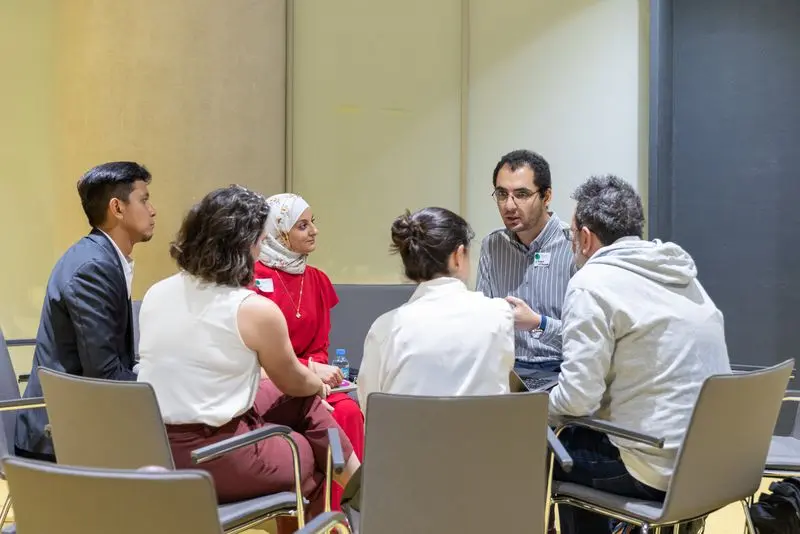
This post is the product of an experimental new way of working with artificial intelligence (AI) called “vibe teaming” (see a recent and for details). At the event, vibe teaming enabled rapid synthesis of group discussions into one-page policy briefs. Each group used a specialized ChatGPT tool, the “Education Strategy Synthesizer,” to synthesize their discussion on how education policies in the age of AI can be designed to strengthen locally relevant teaching and learning and advance equity, quality, and inclusion.
Education systems worldwide are under growing pressure to respond to rapid technological change, widening inequities, shifting labor markets and demographics, and rising concerns about student well-being. Yet global convenings that bring diverse actors together often struggle to capture, organize, and act on the volume of ideas participants generate in real time. On the margins of the WISE 12 Summit in Doha, Education House’s second event, “Education for the Era of Human Flourishing and AI,” brought over 200 educators, youth, policymakers, researchers, and civil society actors together to explore the future of learning and human flourishing in an AI-mediated world. Led by the Brookings Institution’s SPARKS Global Network, the final session utilized vibe teaming, a human-human-AI teaming approach developed by Brookings’ Jacob Taylor and Kershlin Krishna, as a way to crowdsource insights, rapidly synthesize dialogue across tables, and test whether AI could help translate rich discussion into concrete outputs.
This human-AI teaming structure enabled participants to draw on their diverse, context-rich expertise, and in just one hour, create thematic policy one-pagers rooted in lived experience, local knowledge, and collective wisdom.
For the session, participants were divided into 13 groups to address a specific subtheme of the overarching question:
How can education policies—including those involving AI—be designed so that they strengthen locally relevant teaching and learning and advance equity, quality, and inclusion?
Groups explored the following themes in order to collectively tackle the larger question:
- Beyond academics
- Future skills pathways
- Teachers as facilitators and guides
- Training teachers in the 21st century
- Acknowledging invisible pedagogical mindsets
- AI for non-teaching roles
- Localized pedagogies
- Equity in innovation
- Resources and infrastructure
- Partnerships for pedagogical change
- The power of networks
- Expanding the reach and impact of networks
How vibe teaming was applied in Doha
Each of the 13 groups produced a one-page synthesis through a shared workflow—recorded dialogue, AI-generated draft, collective revision, and submission for cross-group synthesis based on the vibe teaming methodology:
- Record the dialogue. Facilitators used Otter AI to capture the full conversation, passing the phone as a “talking stick” to ensure equitable voice and accurate transcription.
- Generate the first draft. The table’s transcript was uploaded into a customized ChatGPT, the “Education Strategy Synthesizer,” that generated a draft one-pager using a standardized prompt.
- Collective refinement. Participants collaboratively reviewed the AI-generated draft, adding missing nuance, correcting misinterpretations, and contextualizing recommendations to reflect local realities.
- Submission for synthesis. Each group submitted its refined one-pager for cross-group synthesis during the final share-out session.
Source: Visualization created by Rachel Dyl.
Why vibe teaming?
The approach allows for:
- Distributed expertise. Teachers, youth, policymakers, researchers, community leaders, and civil society actors contributed as equal partners to diagnosing challenges and imagining future pathways.
- Structured inquiry. A shared workflow ensured coherence across 13 distinct discussions, making it possible to synthesize insights across subthemes without flattening contextual nuance.
- Human + AI co-creation. AI served as a collaborative teammate, drafting, organizing, and summarizing—while participants ensured cultural relevance, feasibility, and ethical grounding.
Vibe teaming, as conceptualized in the working paper, is designed to redistribute cognitive load so teams can devote more time and energy to the “higher-order” components of collaboration: sensemaking, creative problem-solving, and co-dreaming. In Doha, this enabled participants to generate actionable, high-quality one-pagers in under an hour, something the model has demonstrated in other global settings as well.
The resulting one-pagers form a collective policy knowledge base that reflects both practitioner wisdom and analytical rigor. They demonstrate how human-AI teaming can support inclusive, rapid policy design grounded in diverse lived experiences. At the same time, using vibe teaming at this scale also surfaced important limitations and design questions that must be addressed if such approaches are to support—not distort—collective sensemaking.
Methodological reflections and limitations
Participants emphasized that vibe teaming is not a neutral accelerator, but a deliberately experimental methodology. It was used in this convening precisely because global conferences and convenings often succeed in convening diverse voices, yet struggle to translate rich dialogue into concrete, shared outputs or clear “what next” insights. Vibe teaming was tested as a way to address this gap: to capture diverse perspectives at scale, generate tangible artifacts in real time, and support collective sensemaking that could inform policy conversations beyond the event itself.
At the same time, participants were clear that while the approach enabled breadth and speed, it also introduced risks that warrant explicit acknowledgment:
- Normalization of voice. AI-assisted synthesis tended to smooth disagreement and emphasize familiar or widely shared language, sometimes diluting sharper critiques, minority perspectives, or emotionally charged insights. In several cases, facilitators and authors had to actively probe the AI outputs and reinsert tensions that were central to the original discussions.
- Question design bias. Facilitators noted that how questions were framed shaped not only how participants responded, but also how AI later interpreted, organized, and stabilized those responses. When questions were broad or implicitly centered on AI, this framing sometimes redirected conversations away from lived experience and toward more abstract or polarized debates.
- Legibility versus richness. Ideas that were easier for AI to summarize—clear recommendations, familiar concepts, or widely used policy language—became more visible in early drafts. Contextual, political, relational, or emotionally grounded insights often required deliberate human intervention to remain present in the synthesis.
The use of vibe teaming reflects an intentional effort to experiment with how AI might support—not replace—collective sensemaking, while also making visible the tradeoffs involved when human dialogue is translated into shared outputs at speed. The value of the convening lay less in “proving” the method than in surfacing where it fell short and where it holds promise, and in highlighting where design and policy choices can either reinforce existing constraints or open space for more locally grounded, human-centered approaches in education.
The Brookings Institution is committed to quality, independence, and impact.
We are supported by a diverse array of funders. In line with our values and policies, each Brookings publication represents the sole views of its author(s).
