

Join our zero2eight Substack community for more discussion about the latest news in early care and education. Sign up now.
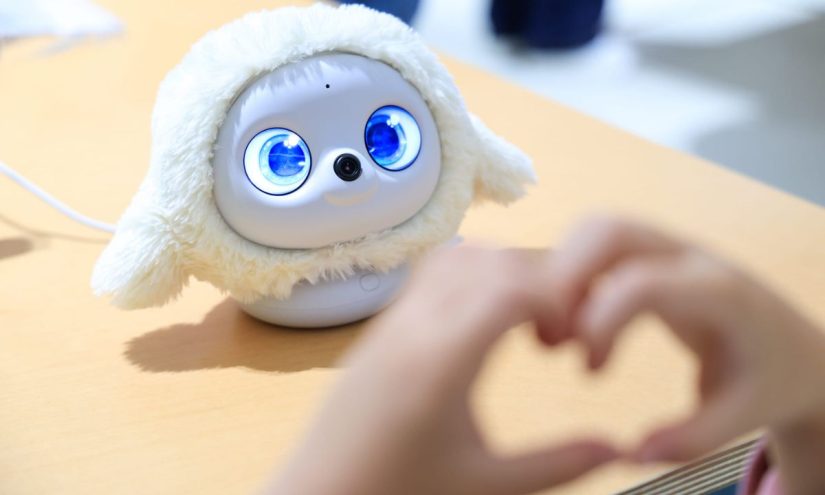
AI is newly electrifying every corner of our lives, charging ahead faster than most of us can follow. If adults are barely keeping up with tools like Chat GPT and Claude, how are babies and young children supposed to make sense of a stuffed dinosaur that sings them songs or a plush bear that draws them into conversation?
We are developmental cognitive neuroscientists who study how children’s daily interactions with parents, caregivers, teachers and peers shape brain, cognitive and emotional development. We are not anti-AI, but we are extremely concerned about corporate efforts to market AI toys to parents and educators of young children. We do not yet know how many young children are already engaging with generative AI bots, but if trends from older youth are any indicator, this is a rapidly growing market.
Some companies say their toys and devices are “age-appropriate” and will support children’s learning and development, but that’s not always the case. For instance, the makers of Kumma, a plush teddy bear, promised to build conversational skills for children from ages 3 to 5. But the toy was pulled from the market last year after it was caught encouraging researchers testing it to play with knives and light fires.
Beyond these physical safety risks, we have essentially no data on how interacting with generative AI “friends” will shape very young children’s foundational brain, socioemotional and language development. Rather, the preponderance of evidence about how brain development works in the earliest years of life suggests that families should proceed with caution before letting their littlest children play with these new technologies in the form of toys.
We are not alone in this concern. Together with scientists around the world who study the exquisite, human-to-human interactions that shape early brain and cognitive development, we recently released an urgent warning about the risks of direct infant-AI interaction.
Decades of scientific studies paint a clear picture of optimal development in the first few years of life. Babies and toddlers grow and learn through daily, moment-to-moment interactions with their close caregivers. Indeed, humans cannot develop fully without these foundational “serve and return” interactions. Present, responsive, real-time interactions shape children’s language, sculpting their growing understanding of new words, grammar, pronunciation and social intentions.
AI ‘Slop’ Is Flooding Children’s Media. Parents Should Be Very Alarmed.
These real-time interactions shape children emotionally, helping them map their inner experiences to their outer perceptions. There is evidence that when a caregiver and a young child interact, they sync up on every level — from eye contact to to heart rates, oxytocin levels, and even brain activity.
Unlike AI models, which can parrot human-to-human interactions, caregivers pair their words with touch, eye contact and facial expressions that signal their love and attention. Real conversations include inside jokes, local dialects, family lore, cultural wealth and the distinct conversational patterns that make a family a family and a community a community.
Development is about real-time rhythm, and every unique caregiver-child dyad develops their own. It’s not about perfection. It’s about presence, something an AI model can never and will never be able to provide.
In fact, toys that imitate social responsiveness may interfere with an infant’s developing sense of how people relate to one another. The better these toys get at mimicking a parent, a child care provider, a grandparent or other adult caregiver, the more concerned we should be, particularly in the earliest years when infants and toddlers are developing a distinction between self and other — a growing awareness that the other humans who surround them each have inner worlds of their own.
From a policy perspective, now is the moment to put up guardrails. There is much more to learn about these new technologies before parents let their babies play with them.
Without these policy protections, parents and educators must take the lead, avoiding AI toys that simulate social reciprocity, replace face-to-face caregiving, or are designed to replace soothing behaviors that infants and toddlers need from caregivers in order to build attachment, trust and human connection.
The earliest recorded scientific experiments with electricity happened 3,000 years ago. Today, access to electricity has raised the standard of living for nearly the entire world. Still — after more than a hundred years of widespread use, safety standards and engineering to wield electricity for the common good — no responsible adult would let a child anywhere near it in raw form.
AI has the power to improve human lives, but these are early days. We take for granted that we cover our light sockets to protect all our community’s children. We must take the same protective stance with AI.
Did you use this article in your work?
We’d love to hear how The 74’s reporting is helping educators, researchers, and policymakers. Tell us how
