

Get stories like this delivered straight to your inbox. Sign up for The 74 Newsletter
There’s a rule every elementary school principal enforces without a second thought: no running in the halls.
Once a month at Impact Puget Sound Elementary, I break it on purpose.
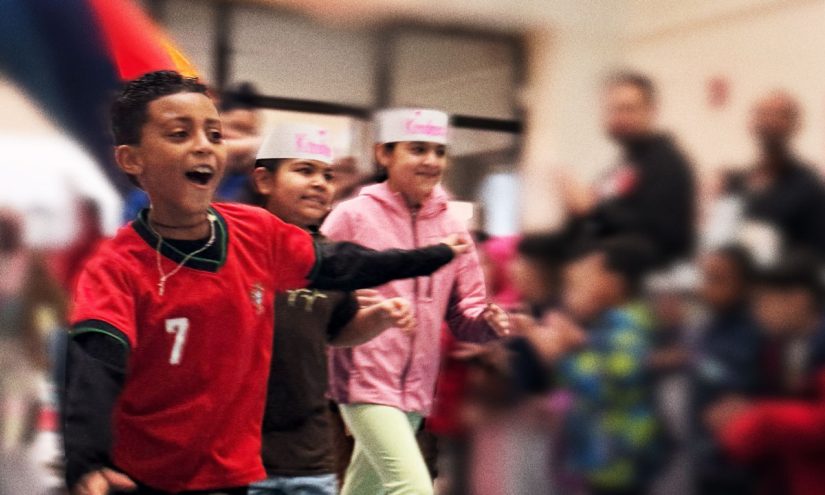
We call it Hallway Holler. About once a month, teachers nominate scholars who have embodied our school’s Core Values and Commitments in meaningful ways. Those students get to sprint down the hallway — full speed, arms pumping, sneakers squeaking — while their classmates line the walls, arms outstretched to form a tunnel, cheering as loud as they possibly can. Teachers run right alongside their kids. The noise is glorious. The joy is real.
I know how that sounds. But I’d argue it’s one of the most direct things I do to address one of American education’s most stubborn problems: getting kids to show up.
Hallway Holler started at our Tukwila campus, in a single ground-floor hallway, almost as a small experiment. The idea was simple: Take something we care deeply about — our core values — and make the recognition of it feel like the biggest deal in the building. It worked so well, so fast, that we expanded it to all four of our schools and moved it to monthly. Now it’s a founding pillar of who we are as a charter school network.
What I didn’t fully anticipate was what it would mean to the kids. One first grader told me: “My favorite part is that we get to run. When I am chosen to run, and people are cheering for me, it makes me feel proud of myself.” A fourth grader put it even more plainly: “I always want to be at school to see if I am running again. I want to work even harder.”
When we surveyed families about what they wanted as we expanded to middle school, Hallway Holler came up unprompted. Not from parents. From kids. Students told their families about it. That feedback loop — from a child’s excitement to a family’s sense of belonging — is not something I could have manufactured with a policy memo.
I want to be honest about what Hallway Holler is not. It is not a reward for perfect behavior or a prize for the most popular kids in class. Teachers nominate scholars who have embodied our values in meaningful ways: spreading kindness in the classroom, in common spaces, at recess and beyond. Recognition rotates, so that every child gets seen across the year for something real.
I think about one of our fourth graders who, just a year ago, struggled to find his footing. Third grade had been difficult: academically, socially and in how he experienced school. This year, he set a goal: to show up each day as his best self. He knew Hallway Holler wasn’t about perfection, but about growth.
Over time, through small consistent choices like choosing kindness in the classroom, supporting peers at recess, and taking responsibility when things went wrong, he grew! He even stepped up as a buddy to a younger class. When his name was finally called for Hallway Holler, it wasn’t for being the loudest or the most polished. It was for that steady, daily effort.
Since then, he has grown more than 15 points in both reading and math, a reflection of what can happen when a student feels seen, valued and motivated to keep showing up.
The kids who aren’t running this month are forming the tunnel, dancing and cheering and sending love as their peers sprint past. They are part of it too. And they know their moment is coming.
That deliberateness matters. This isn’t about performance or perfection. It’s about the ongoing, daily work of noticing kids — and then making that noticing feel like the biggest deal in the building.
The joy work and the academic work are not in competition. They are the same work,and the field doesn’t talk about that enough.
Chronic absenteeism is one of the most stubborn problems in American public education, and the conversation around it tends to focus almost entirely on removing obstacles — calling families, connecting them to resources, offering transportation. All of that matters and we do all of that. But that framing treats attendance as a problem to be solved rather than a behavior to be motivated. What gets talked about far less is the other side of the equation: making school a place kids are genuinely, viscerally excited to return to.
When Students Don’t Show Up, It’s Not the Kids Failing. What Schools Should Do
And when kids are in school, they’re learning. At Impact Puget Sound Elementary, 65.3% of our students meet grade-level standards in ELA and 65.8% in math — outpacing our local district, Tukwila School District, by 13.9 percentage points in ELA and 25.8 points in math. I don’t think that’s a coincidence.
A child cannot learn on a day they are not here — and a child who wants to be here shows up. At Impact Puget Sound, we have over 90% average daily attendance which places us on pace with and slightly above the national average for all students. Nationally, schools where 75% or more of students qualify for Free and Reduced Lunch average attendance rates of 80% to 85%. At Impact Puget Sound, where 79% of our students qualify, we’re at 90.8% — a gap our team and families have earned.
But it requires knowing your community well enough to find the specific version of joy that lands for your specific kids. For us, it turned out to be something as elemental as permission to run in the hallways while your whole school cheers your name.
Some of my students don’t fully understand the data behind attendance yet. They don’t know what chronic absenteeism costs them in the long run. But they know the feeling of rounding a corner at full speed. They know their teacher is running beside them. They know that this — this specific, loud, joyful moment — only happens because they showed up and lived our values.
That’s enough. For now, that’s everything.
Did you use this article in your work?
We’d love to hear how The 74’s reporting is helping educators, researchers, and policymakers. Tell us how
