

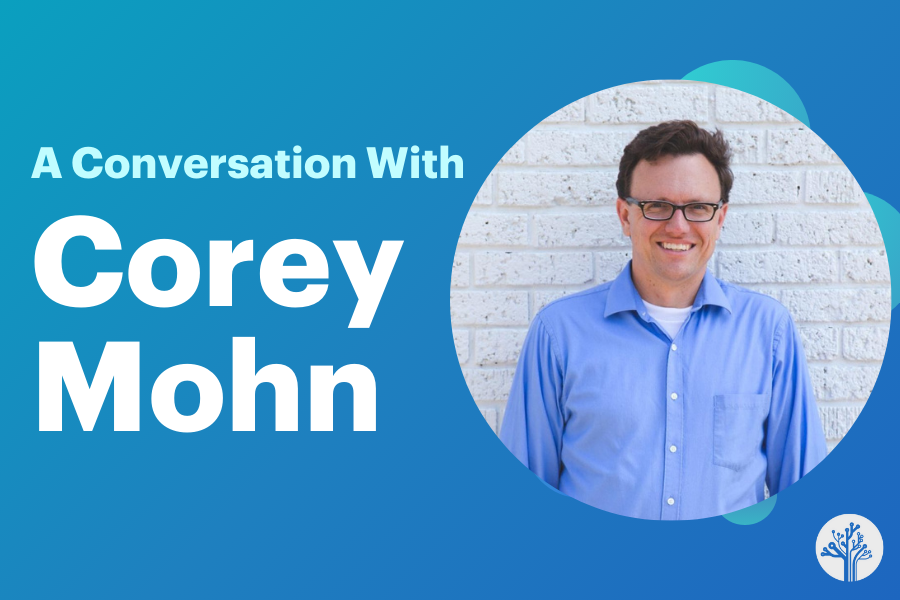
Hello, I’m Tom Vander Ark. When I think about the future of education, one name that consistently comes to mind is Corey Mohn and the incredible work happening at the CAPS Network. So, when I had the chance to sit down with Corey at the Getting Smart and Britebound Pathways event, I knew we’d dive into a powerful conversation about unbundling pathways, student agency, and the future of profession-based learning. There’s something truly inspiring about how CAPS empowers students to chart their own course, blending exploration with tangible, real-world experiences.
Corey described CAPS as the difference between building a pre-designed Lego set versus having a box of blocks to create something entirely unique. This metaphor stuck with me because it captures the essence of what CAPS and innovative career pathways are all about: giving students the tools to design their own futures, with professionals and mentors guiding them along the way. These programs are not only building durable skills but also fostering student confidence and love for learning. You can read more about that in their recent alumni impact report. It’s rare to hear alumni talk about their high school experiences with such deep emotion and positivity, but that’s exactly what CAPS is achieving. It’s a model that’s truly reshaping the conversation about student success and career readiness.
Tom Vander Ark: Hey, this is Tom Vander Ark. You’re listening to the Getting Smart Podcast. We’re joined today by Corey Mohn, the CEO of the CAPS Network. Hey, Corey.
Corey Mohn: Hey, Tom. It’s good to see you.
Tom Vander Ark: As always, it’s great to see you. We’re here at ASU for another Getting Smart and Britebound Pathways event. Great that you could participate in that.
Corey Mohn: We’re in Scottsdale, and I approve. Coming from the Midwest in the deep of the winter, this is great—great to be here.
Tom Vander Ark: I really appreciate ASU. We’re here at SkySong, which is a cool new campus they developed 15 years ago. Tidbit: we held our first ASU+GSV Innovation Summit here in the SkySong office building.
So, this has been a place for really important convenings over the years. There are a lot of things I appreciate about ASU. Is there anything in particular you appreciate about ASU and their leadership?
Corey Mohn: I mean, I just appreciate the open thinking. Michael Crow obviously has done an outstanding job of thinking about postsecondary differently. I’ve heard him speak a number of times, but I heard him speak at the Edison Awards a couple of years ago. His story of how he came to be in his own youth and then set out on this whole journey—you can clearly feel it deep within him that he really wants any student who has the desire to get into postsecondary and do cool things to have that opportunity.
Tom Vander Ark: Yeah, I do. I love that they’ve embraced being more open access and excellent.
Corey Mohn: Yes.
Tom Vander Ark: Hard to do both.
Corey Mohn: Right.
Tom Vander Ark: And they’ve just done such a great job of it. You know, they’re one of the biggest universities in the world, and at least on a number of dimensions, the best.
Corey Mohn: Yeah.
Tom Vander Ark: So anyway, absolutely great to be here.
We’re at a Pathways event. We’ve talked about this in the past, but our Pathways campaign has been about trying to help every student find or create a pathway linked to opportunity. This Pathways event sort of celebrates unbundled pathways—pathways that are assembled, that students, perhaps with some guidance, were able to put together as a set of experiences they might not have had access to in the past.
I just think the CAPS Network is really the best in the business on that front—creating amazing profession-based experiences for young people. So, we just wanted to explore what was new at CAPS.
Corey Mohn: Yeah. Well, I appreciate your comments, and you’ve been a great supporter of CAPS, served on our advisory board, and I appreciate everything you’ve done.
To me, the visual that came to mind when you started talking about unbundled pathways—and the way we kind of view it inside of the CAPS model—is it’s the difference between having a set of LEGO blocks and a diagram or model that you’re building. This is the model, and everyone’s trying to build and stack their way to create whatever that image or creation is that’s already predetermined.
Versus: here’s a whole set of LEGO blocks. Each of them can be utilized to help you build something, but you get to create what it ultimately looks like. That flexibility, I think, is a differentiator for models like CAPS. It’s messy. It’s not the cleanest way to go about things, but it’s so powerful for students to see what’s possible for themselves and to have enough autonomy to make those decisions.
The only other thing I would say about that upfront is there are pathways in a linear sense, right? Like a stacked pathway to a certain area.
Tom Vander Ark: Sequential experiences kind of back that, yes, from a job posting.
Corey Mohn: That’s right.
Tom Vander Ark: Right.
Corey Mohn: And there’s absolutely nothing wrong with that. If you know that’s where you want to head as a young person, that’s really powerful. But what about the exploration that happens horizontally and the ability to have that really powerful self-discovery process, particularly for those who are 18 or younger and part of a K-12 system?
It’s safe for them to do that, and that’s really where we put our focus.
Tom Vander Ark: This reminds me a little bit of one of your superstar alumni. We’re going to talk about CAPS alumni today.
Corey Mohn: Yeah.
Tom Vander Ark: But Sophia Porter—you and I had a chance to visit some CAPS members with her. She’s now leading safety and philanthropic efforts.
Corey Mohn: That’s right.
Tom Vander Ark: Just, you know, doing some of the most important work in the world. That is after she was a rocket scientist.
Corey Mohn: That’s right.
Tom Vander Ark: Right.
Corey Mohn: Literally.
Tom Vander Ark: And the cool thing about Sophia’s story is CAPS really launched her journey, but it wasn’t linear at all. She bounced around at a bunch of different opportunities, but she was able to discover her red thread through those experiences to put her in the position she’s in today.
Corey Mohn: That’s exactly right. No, she moved around from medicine to technology to aerospace engineering while she was in high school and her CAPS program at Blue Valley Schools in Overland Park, Kansas.
She also went into classrooms where she wasn’t enrolled because she saw things within them that were interesting or she saw that the instructor could help her with her journey. I joke that she audited a number of courses at CAPS unofficially. Like, we don’t have a process for that, but she figured it out.
There are a lot of students who do figure that out and realize this is a great opportunity for them.
She’s a great example. We have a lot of other examples of students doing amazing work once they get into postsecondary, into their careers, or start a business. It’s about that mindset—you don’t have to lock into something someone else has created for you and select one of two or three options that are pre-curated. You can build your own adventure.
Tom Vander Ark: Yeah, right.
Corey Mohn: And that’s incredibly important. Sophia’s a great example of it.
Tom Vander Ark: Speaking of alumni, you just posted some new results from your alumni survey. What are CAPS alumni saying?
Corey Mohn: Really excited. Today, as we’re sitting here, this is the day we’ve been able to publicly release the 2025 Alumni Impact Study.
What I’m thrilled about is not only that so many alumni were willing to come back and take a pretty extensive survey to share their thoughts, but what’s behind the numbers and what it really says.
I would share that there are three highlights of this report. A couple of them are more quantitative, and one is qualitative.
The quantitative ones:
CAPS alumni, when compared to their peers, are accelerating faster. When you look at their earnings—whether it’s their first career job or where they are currently—those salary numbers are well ahead of their peers. So, when it comes to just brass tacks, if we’re measuring whether they’re going to have a sustainable living, that is absolutely there, and it’s very impressive.
The second thing, which is also quantitative but in a different way, is something we think is really powerful. We look at the development of confidence and durable skills in students. What we’re seeing is incredible scaling and growth around what these students are doing.
When they start in a CAPS program as juniors or seniors in high school, on a scale of one to five, they rate themselves somewhere between 2.5 and 3.2 on things like leadership, project management, time management, communicating with professionals, and building a professional network that enhances their social capital. So, they’re kind of in the middle of the road.
When they’re out of the system—out of K-12—and reflecting back on what’s important to them, they’re now rating these same skills much higher. The level of importance and how they bring themselves to this work is pushing five out of five. These average numbers are incredibly high, which is heartening because we know that’s what’s really going to matter for our students going into a future where things are changing rapidly.
The third one, which I don’t want to miss because it’s the one that gets me the most excited, is when former students talk about their experience and reflect on what happened when they were in CAPS years later. They use language that is so deep and positive in emotion.
Now that we live in a world where AI is a thing, we can take all of this language that our former students are putting into comments and answers and analyze it. We worked with the University of Northern Iowa and their research group, SMS, to do this analysis. When we pulled out the key themes and words, the number one answer was “love.”
Tom Vander Ark: Mm-hmm.
Corey Mohn: I’m sorry, but it’s really hard to get high school students and former students to reflect on high school and hear them say that.
Tom Vander Ark: Right.
Corey Mohn: About their learning experience. So, it was “love.” I think the second word that came through was “enjoy.” Then you start getting into other words like “hands-on,” “professional,” and “real-world.” But “love” was number one. That’s motivation.
Tom Vander Ark: Yeah.
Corey Mohn: That’s motivation to keep going.
Tom Vander Ark: Unusual. Remarkable. Let’s back up and talk about what CAPS is. You know, it started at Blue Valley CAPS—Center for Advanced Professional Studies—a career center, kind of an updated career center focused on some modern pathways. It started with some really important design principles.
What are the design principles that now hold the network together?
Corey Mohn: Yeah, so we have five core values in the CAPS model:
- Profession-based learning: How do we keep professionals front and center in authentic ways, connecting with students?
- Self-discovery and exploration: I would argue this is the reason we do the work. How do students figure out who they are, what they’re good at, what they love to do, and how they want to deploy themselves? Then, give them chances to deploy, creating a cycle where they learn more about themselves before they leave high school.
- The entrepreneurial mindset: Building that mindset, knowing that failure—small, left failure—is a good thing. Lean into it, learn from it, and be iterative in your actions. Being adaptable and able to pivot is really important.
- Being responsive: If you’re a program, school, or teacher wanting to lift up something like this model, how do you ensure that what you’re doing stays current with what’s happening in the world and what opportunities are available for students? That’s incredibly important.
- Professional skills: Durable skills are the term that has really taken off lately, thanks to Tim Taylor and the team at America Succeeds. CAPS professional skills are those durable skills, and that’s what we measure in terms of our success.
Employers and parents tell us, “My student is great at cranking an academic formula or tackling a defined challenge, but if it’s ambiguous—like most of the world is—they’re a little bit of a deer in the headlights.” So, how do we encourage the development of those skills that help students problem-solve in a world that’s changing? That’s really the core of what CAPS is.
Tom Vander Ark: Let’s shout out a couple of the really remarkable CAPS members because that’s what it’s all about.
Corey Mohn: Yeah.
Tom Vander Ark: You have affiliate sites all over the country that are just doing extraordinary things for kids.
Corey Mohn: Yeah.
Tom Vander Ark: We’re here at this Unbundled conference, and it reminds me of my last visit to Bentonville Ignite.
Corey Mohn: Yes.
Tom Vander Ark: Bentonville Public Schools have a CAPS program called Ignite. One of the things I really appreciate about it is its five business-immersive campuses around town: one at the airport, one for legal and education, one in a commercial kitchen, and one devoted to healthcare. Students are really on business sites doing real profession-based learning in the community with business partners. I thought it was remarkable.
Corey Mohn: Yeah, no, they’re doing fantastic work. Jessica Mol is the director of that program, and she comes from a background of working at Walmart corporate. Obviously, Bentonville is the home of Walmart. She brought that business edge to her work but also had experience working in alternative education. And so, she really understood the idea of personalizing learning and creating engaging, hands-on experiences. That combination was powerful. She went in and taught their global business class and absolutely knocked it out of the park. Then she had the opportunity to take over as the director.
Dr. Debbie Jones down there also provides incredible leadership. They are now positioned where they are essentially—and it’s not a small program; it’s a growing program that takes, I don’t know, probably up to 600 or 700 students at a time now in Ignite—they’re about to quadruple that.
Through the generosity of Alice Walton and a medical school campus she’s opening, they’re now going to expand this opportunity for many of the districts around that northwest Arkansas region. I know there’s a lot of work being done right now to figure out how to scale this up with integrity, but we’re incredibly excited about what they’re doing in Bentonville.
Tom Vander Ark: Little Rock has a great CAPS program.
Corey Mohn: They do.
Tom Vander Ark: They’ve been strong for more than a decade.
Corey Mohn: They do. In fact, we highlighted one of their former students in the Alumni Impact Report that came out this morning—Zandria Brewer.
She’s a great example of a student who caught fire in high school, not only around this model of learning but also in medicine and healthcare in particular. She saw a pathway for herself that got her right into the profession straight out of high school.
She earned some nursing credentials, went into the workplace, and is now, while working and providing bedside care, going back to get her RN. She works at Arkansas Children’s Hospital, and in her spare time, while doing that and pursuing additional education, she comes back and serves at what used to be called Excel CAPS—it’s now called Metro CAPS in Little Rock.
She actually goes back into the classroom with her former teacher and helps the students understand what skills are necessary. She’s a near-peer to them.
Tom Vander Ark: Yeah, awesome.
Corey Mohn: And so, we’ve got a little blurb and a highlight of her in our Alumni Impact Report. I would encourage everybody to check that out. She’s fantastic.
Tom Vander Ark: One more site you want to call out?
Corey Mohn: Oh man, well, you know, this gets me in trouble because it’s like choosing among my children in some ways.
You know, I might point to—so we’ve got Bentonville and Little Rock. They kind of serve different environments. Bentonville is more of a suburban environment.
Tom Vander Ark: Right.
Corey Mohn: Little Rock is an urban environment.
Tom Vander Ark: You have lots of new rural affiliates.
Corey Mohn: Yeah, let’s talk rural.
Tom Vander Ark: That’s super exciting.
Corey Mohn: Yeah, let’s talk rural. A couple of things I would point out there: one is we’ve got a big initiative going on in the state of Kansas where we said, “Let’s experiment. Let’s actually create a scenario where smaller districts can participate in the CAPS Network.”
We went out and found funding to subsidize their inclusion in the network. Then we’ve been layering in additional levels of support from those—many of whom I know you’re familiar with, Tom—that provide additional world-class professional learning support.
So, not only are we bringing the CAPS model into communities across rural Kansas, but we’re also bringing in folks like Dr. Chris Unger to help them with AI and how to leverage it. We’re bringing in Seed Folk Partners, a group in Kansas City led by Katie Kimbrell, who works really well in terms of that design thinking process and open way learning.
We’ve also partnered with Open Way Learning, founded by Adam Haigler and Ben Owens, to help with the development of that profession-based learning piece alongside what we do. So, there’s a lot of great things bubbling up in rural Kansas.
If you really want to see something that kind of blows your mind in rural areas, go to little Fairfield, Nebraska.
Tom Vander Ark: Hmm.
Corey Mohn: Fairfield, Nebraska—600 students, K-12, over 750 square miles. Their high school in Fairfield, Nebraska, is wall-to-wall CAPS. It looks like a CAPS facility. They’ve embedded it in everything they do, and they’re doing remarkable work.
So, it’s a little bit of a jaunt to get there, but it’s worth seeing. If you want to see an oasis on the plains, that’s where I would take you.
Tom Vander Ark: That’s beautiful.
Anything you can tell us about what you’re cooking up for middle-grade experiences?
Corey Mohn: Absolutely. The timing’s really good on this one as well, Tom.
Just last week—we’re recording this here in early February—just last week, we actually had the inaugural CAPS Middle School Network first convening.
What we’re doing there is working with ASA, now known as Bright Bound, on a middle school initiative where we’re doing two things.
We’re building out a framework that is based on the CAPS pedagogy for middle school, but simultaneously, we are bringing together a network of middle school educators, administrators, and districts interested in this work at the middle school level.
We’re doing both at the same time. It’s actually kind of funny. We started thinking, “Let’s build the framework and then get the network of people that fit the framework.” Then we realized at CAPS, that’s not how we normally roll.
We like to fly the plane and build it while we’re flying it. We knew the information from really awesome, innovative people would help us finalize the framework.
So, we’re doing both at the same time, starting with districts already connected to CAPS through the high school model to tease this out. Then we anticipate next year we’ll open this up as an offering for any district.
A lot of work has been done. We’ve done a lot of interviews and research. We are open ears on what makes sense for those middle-level learners, but what we do know is that career exploration and durable skill development are critical and can really move the needle with students in fifth, sixth, seventh, and eighth grades.
Tom Vander Ark: We’re talking to Corey Mohn, who leads the CAPS Network. Where can people find information about CAPS Network and particularly your new alumni survey?
Corey Mohn: Absolutely. The best place to go is our website, which is yourcapsnetwork.org. If you put a backslash on that and type “alumni,” you’ll go to a landing page that will allow you to gain access to the Alumni Impact Report.
Tom Vander Ark: Corey, thanks for joining us today. I look forward to a great convening with you.
Corey Mohn: Oh man, can’t wait. Here we go.
Tom Vander Ark: Go CAPS. Until next week, keep learning, keep leading, and keep innovating for equity.
Guest Bio
Corey Mohn
Corey is the President and Executive Director of CAPS Network, empowering high school students to fast-forward into their future through real-world business projects and the development of professional skills. Prior to CAPS, Corey served as Director of Statewide Programs for the Kansas Center for Entrepreneurship. In July 2015, CAPS launched CAPS Network, a consortium of school programs committed to this model of profession-based education. CAPS Network has grown to include 121 affiliate programs, including over 180 school districts across 25 states and four countries.
