

Listen to the article
This audio is auto-generated. Please let us know if you have feedback.
AUSTIN, Texas — There are many reasons to feel gloomy about the K-12 system right now — funding pressures, many students not as engaged as educators would like, and uncertainty about artificial intelligence’s impact on learning, to name a few.
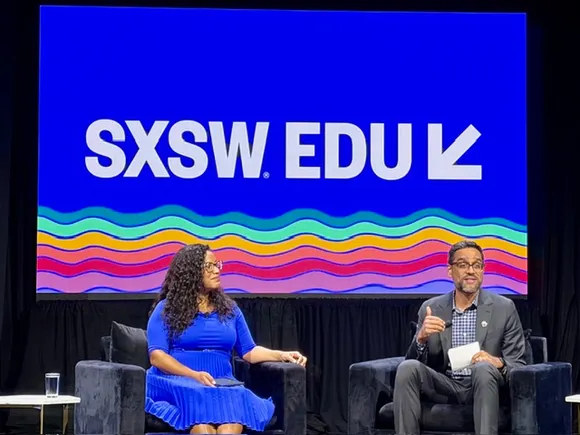
But two nonprofit leaders, speaking during a March 10 session at SXSW EDU, pointed to bold approaches, promising practices and gains in achievement that they said are fueling their optimism for the current and future state of education.
“I often feel like I’m operating as a chief evangelist officer for the field,” said Frances Messano, CEO of NewSchools Venture Fund, a philanthropy that works to transform education.
Messano was joined on stage by Aneesh Sohoni, CEO of Teach for America, which recruits, trains and supports recent college graduates and professionals to teach for two years in under-resourced public schools.
Sohoni said being or staying optimistic about K-12 amid the challenges is actually a choice. “It’s a leadership strategy to both accept the realities of what is true today, and to believe that a different future is possible,” said Sohoni. Maintaining a hopeful mindset helps guide educators’ time and energy, he added.
Messano said she’s encouraged by people who have innovative ideas about helping students and schools. “We are thinking about pragmatic optimism as a strategy by taking those deliberate bets, by learning as we go, by identifying what distinguishes an organization that’s really having strong results, and continuing to reinvest in those ideas so many more folks can benefit from those outcomes,” she said.
Messano also said students’ desire for meaningful and purposeful learning experiences gives her hope, as do schools that are expanding engaging programs like dual enrollment, industry credential courses and career studies.
“This is a moment for great possibility,” said Messano.
For Sohoni, it’s the academic gains that some states and districts are making that keep him energized. For instance, he pointed to successful efforts in Tennessee over the past decade to increase student academic proficiency rates.
He also mentioned work being done in Houston to increase academic achievement. “Now this progress is not perfect, and there’s much more to do, but what I’m seeing on the ground in Houston is this deep belief around civic leadership coming together to say a different future is possible.”
Sohoni said he’s a “bit of a skeptic” when it comes to AI’s influence on student learning. “It’s the wild wild west out there,” he said. “I do worry a little bit.”
At the same time, Sohoni said AI “holds deep potential, deep promise” especially when the technology is aligned with best practices for effective teaching and learning.
Sohoni is also sanguine as to the potential for the K-12 sector to support progress toward better outcomes for students from all backgrounds.
“We know what it takes to make generational progress in education, and so what gives me hope and what gives me optimism is that I know we can do it again if we choose to act our way into that future as well,” he said.
