

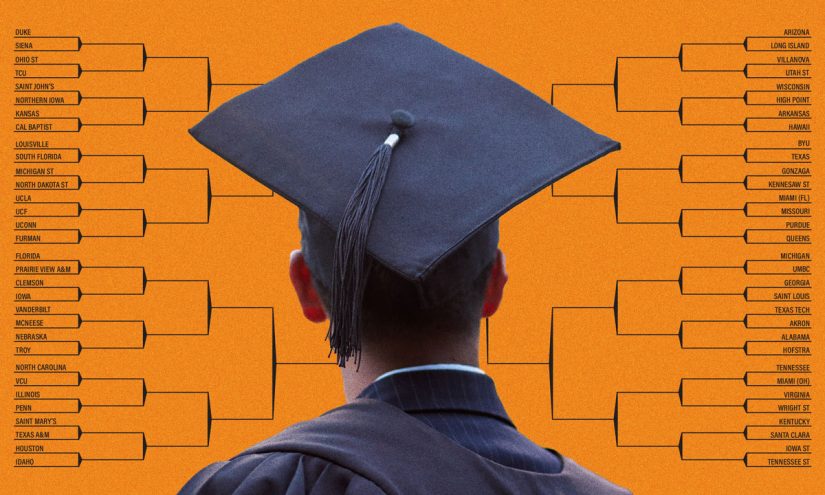
March Madness, that anxious, exciting and promising time for players and fans alike, is upon us. Like millions of others, I have been really enjoying these three weeks of competitive games full of surprises and awesome athletic feats. However, beyond the thrills, this moment highlights the stakes not just for the players, but also for colleges and their broader missions. While loyal students and alumni have experienced moments of joy and grief as they followed their schools’ progress, and administrators hoped for wins that will increase applications and donations, even more important for the nation is how these colleges enable upward economic mobility for their graduates.
American higher education is experiencing one of the most challenging times in its history. Since 2017, when The 74 began publishing a Social Mobility Tournament bracket composed of colleges participating in the Big Dance, the percentage of surveyed adults who believe a four-year degree is not worth the cost has risen from 40% to 63%.
This loss in public support that colleges previously took for granted has made them targets of both left- and right-leaning critics and policymakers. They are demanding that schools take greater responsibility not only for educating students, but for ensuring that the education they receive leads to employment with meaningful earnings.
With this in mind, our bracket aims to shift the focus to the broader mission of higher education: advancing economic mobility. Beginning in 2017, each year we have taken the schools competing in the NCAA Division 1 basketball tournament and plotted them in a parallel bracket, where winners and losers are determined not by their prowess on the court, but by how well the colleges put students on the road to financial security.
To do this, we employ the Economic Mobility Index (EMI) created by the former director of the U.S. Department of Education’s College Scorecard, Michael Itzkowitz. This index uses information from the department and the Census Bureau to rank 1,320 bachelor’s degree-granting institutions by how well each provides economic mobility for its students. Taking into account the key concerns of students, parents and policymakers, the EMI first assesses the return on investment for lower- and moderate-income students at each college by calculating the out-of-pocket costs required to earn a four-year degree.
Placement in the Economic Mobility Index (EMI) is calculated by dividing each college’s average cost of an undergraduate degree by its graduates’ average earnings 10 years after enrollment, minus the typical salary of a high school grad, and multiplying that by the school’s percentage of Pell Grant recipients. The EMI captures both the proportion of under-resourced students enrolled and students’ return on investment in their college education.
The index then considers the added financial benefits students gain from attending one of these schools. This earnings premium is the additional income graduates accrue compared to someone with only a high school diploma. In effect, the lower the out-of-pocket costs and the higher the earnings premium, the quicker a student will receive a return on the investment needed to obtain the degree. Lastly, the index rewards schools for the proportion of financially challenged students they enroll and for the return on investment they deliver. (Click on each school in the bracket to see its Social Mobility score, total net price, earning premium and how long it takes graduates to pay off the cost of their education.)
BYU Is Tops in March Madness Bracket for Moving Grads Up the Economic Ladder
To make this clearer, consider the following: While the Wolverines of the University of Michigan and the Wildcats of the University of Arizona faced each other in this year’s NCAA Final Four, neither school went further than the second round in our Social Mobility Tournament bracket. After all, Michigan had a lowly score of 16.9 in the EMI and Arizona only a slightly higher ranking at 25.1. Digging into the data, this disparity shows the importance of each data point that composes the index’s score.
As a EMI breakdown shows, the University of Arizona, a public institution, has a total price of $41,000 but an earning premium of a mere $23,700 for graduates when compared with someone holding only a high school diploma. This translates into a price-to-earnings premium that allows Wildcat graduates to pay off the cost of their education in 1.7 years. But the University of Michigan enjoys a net price of just $15,850 and a handsome earning premium of $48,800, making it possible for grads to pay down the total cost of their degree in only 0.3 years.
While winning games in a tournament made up of proven champions is a difficult achievement for any college, helping students move up the economic ladder is no less a challenge, especially for schools serving a high percentage of low- and moderate-income undergraduates. That’s why we believe colleges should be honored not only for victories on the court, but also for earning a high ranking in the Economic Mobility Index.
So, which teams deserve the highest praise this year? Of the 68 teams in the Social Mobility Tournament bracket, only 16 are private universities, and just six of them advanced past the first round. Moreover, by the end of Round 2, just a single private school, Brigham Young University, managed not only to reach our Sweet 16, but, as it did last year, to go on to win our Social Mobility Tournament.
(Ethan Miller/Getty)
The main surprise here is that any private school could go that far, considering that the EMI is based primarily on affordability — how quickly the cost of a degree can be repaid — and the percentage of students enrolled who require financial aid. Therefore, beyond producing winning teams that can be invited to the NCAA tournament, private colleges must be inexpensive and serve a wide range of students to move up the Social Mobility Bracket.
Given these requirements, how did BYU win it all? Though the Cougars were beaten by the Texas Longhorns in the first round of the NCAA Tournament, they earned their 33rd straight bid by having a 23-12 season in which they defeated eight teams ranked among the Associated Press’ Top 25. In addition, BYU graduates have a price-to-earnings premium that permits them to pay down the cost of their degree in less than a year, a feat made possible through low tuition and generous financial aid. Meanwhile, the school serves a student body in which nearly 37% of students receive Pell Grants.
How about the other three teams that make up our Final Four? How did they get there? The South Florida Bulls, Houston Cougars and Tennessee State Tigers all have high EMI scores of at least 35%, giving them rankings that place them in the top 104 out of 1,320 colleges in the index. This translates into graduates who on average can pay down the cost of their degrees in fewer than four years, and all while having student bodies made up of at least 36% Pell Grant recipients. These, then, are excellent examples of schools working to increase the social mobility of their students.
In this highly polarized time, it is good to know that a bipartisan consensus exists around policies that require colleges to do more to help students gain employment with reasonable earnings. This state of affairs supports our nearly decade-long call to praise colleges like those in our Final Four. After all, few athletes will ever make the pros, but all students need to make a decent, family-sustaining living.
Did you use this article in your work?
We’d love to hear how The 74’s reporting is helping educators, researchers, and policymakers. Tell us how
