

Get stories like this delivered straight to your inbox. Sign up for The 74 Newsletter
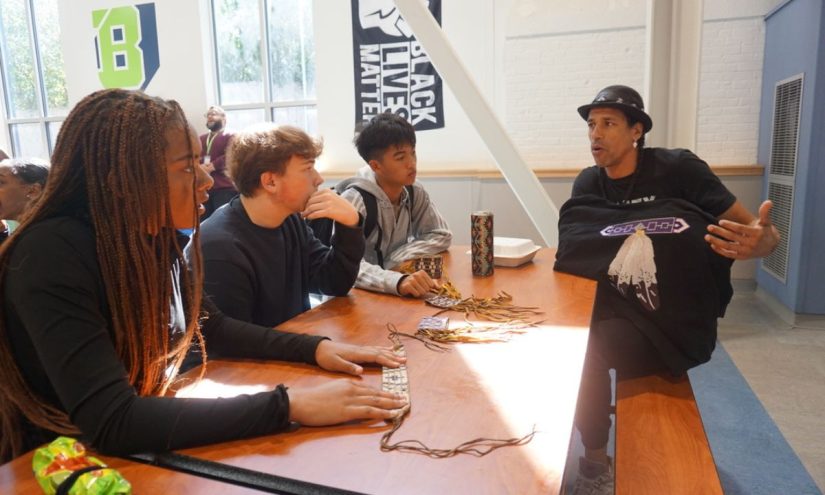
Annawon Weeden cuts an imposing figure, arriving at my classroom wearing a black T-shirt that says “Party Like It’s 1491,” a hat ringed with purple and white wampum, and New Balances,. Students launch into their questions: “Why did you become an activist?” “Do you ever think of giving up when others don’t listen?”
I’d invited Weeden, a Mashpee Wampanoag educator, to visit my high school English class in Boston. When I began teaching American Literature, I felt the course had to encompass Native American literature. I started with Tommy Orange’s novel There There. But the book is set in Oakland, California, and I wanted its message to ring closer to home.
Weeden had once driven from New England to California to protest a white math teacher’s use of redface. Before his visit, my students watched a video of his impassioned speech to the school board. We discussed how cultural appropriation undermines the right of all students to learn — and can, as happened with Weeden’s own brother, result in self-harm and suicide.
As a child, Weeden himself encountered racism in school. “It was the teachers, not even the students, who called me the worst names,” he recalls. “I had long braids. They’d call me sissy, queer, say, ‘The girls’ bathroom is over there.’”
Weeden’s own pedagogy couldn’t be more different than the harassment he faced in his youth. He meets students’ questions with some of his own: “Have you ever seen a square bird’s nest?” Heads shake no. “I’m gonna bet we’ll never see one. Because the square is not a shape we see in nature. Look around. We’re surrounded by squares.” He gestures to our classroom, students’ notebooks, the Boston skyline. Weeden asks students to consider whether the way things are now is natural.
In Massachusetts, students learn about Native people in two main ways: through the lens of Thanksgiving and in third grade, when the Massachusetts State History Standards allocate time for a deep dive into Native history. So that’s the age group Weeden primarily works with.
But there are certain topics — like forced sterilization or King Philip’s War, one of the deadliest conflicts in New England history — that you can’t broach with young kids. “We need middle school curriculum. We need high school curriculum,” Weeden says.
Story-Telling Key to Relating Native American Culture, Elders and Educators Say
For the past four years, I’ve partnered with Weeden in 10th and 11th grade English. At this age, students are deciding not only their postgraduate plans, but the values by which they will live. If students’ only in-depth exposure to Native Americans is in third grade, how can they be expected to understand Native people as adults?
“It should be every year,” Weeden says. “The key is consistency.”
Many of the students at Boston Collegiate Charter School, where I teach, have heritage outside of the U.S. — from Cape Verde to Ireland to the Dominican Republic. Many would consider their families indigenous to those places. But few claim Indigenous American heritage. So students’ final project, presenting a lesson to their peers, is an act of allyship — teaching about another culture without speaking for that group. Like There There, the project aims to expand their ideas of what it means to be Native.
One common oversight is to think of Indigenous people as a monolith, when there are so many distinct tribes. “The reason I’m a Wampanoag is because of the land that I’m on. Cape Cod is where you see the sun rise,” Weeden tells my students. “We always identify ourselves as People of the First Light. And right now, we are in Boston, home of the Massachusett tribe. People say that word, Massachusetts, without ever questioning, What does it mean? It means Great Barren Hill Place.”
In some other states, Native culture is more visible. In Washington State, tribes guided revision of the state history standards. Now Indigenous studies are addressed in every year of K-12 through the “Since Time Immemorial” curriculum. In the Southwest, Weeden says, “You can’t go there and not see the Navajo, the Apache, all their artwork and pottery. It’s synonymous with the culture.
“Why New England chooses to only promote colonial history…that’s something for New England to examine,” he continues. “I’m sad and disappointed for the focus to be just Thanksgiving. I don’t want to be a token add-on to that narrative.”
As an educator, I believe in not only teaching about Native history, but inviting Native speakers into my classroom. I’m grateful that my school has funded these visits. There are also low- and no-cost online resources to connect students with local tribes. But until Massachusetts and other states recognize that education about Indigenous peoples must be sustained, consistent and inclusive of living Native people, we will not be able to overcome the ignorance that characterized Weeden’s youth.
“A lot of what I was attacked for as a kid, it’s because people had no clue,” Weeden reflects. “I wouldn’t have encountered that abuse if people were taught the right things about our culture. I don’t even honestly work with Pre-K and early childhood enough — you can never start too early. It’s weird how our culture is considered so foreign even though we’re the Indigenous people of this land.”
Did you use this article in your work?
We’d love to hear how The 74’s reporting is helping educators, researchers, and policymakers. Tell us how
