

Get stories like this delivered straight to your inbox. Sign up for The 74 Newsletter
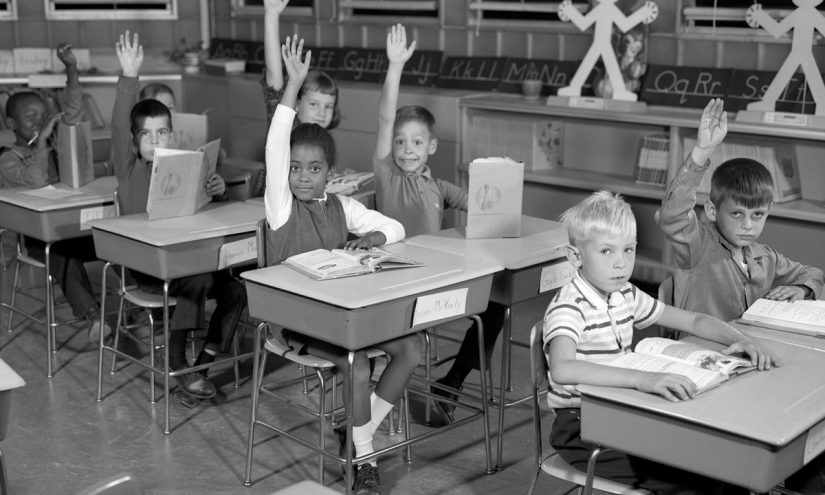
By the time children reach elementary school, teachers can usually predict which students will volunteer answers, speak easily in front of the class and move comfortably through discussion — and which will hesitate, look down or remain silent even when they understand.
What gets discussed far less often is that this pattern rarely begins in third or fifth grade, when participation gaps become easier to see. It begins in children’s first classroom experiences, where they learn whether speaking feels safe, whether mistakes are survivable and whether the classroom has room for the way they enter language.
The problem is not simply that some children talk more than others. It is that schools often mistake fast, public participation for understanding and then build opportunity around that mistake. A child who speaks quickly and often is usually read as engaged, confident and capable. A child who hesitates, watches or offers little is more likely to be read as uncertain, underprepared or less able.
Yet speaking in front of others is not a simple measure of understanding. It requires children to process a question, organize language quickly, tolerate public attention and respond while everyone is listening. For multilingual learners, it may also mean searching across languages while monitoring pronunciation and trying not to make a visible mistake.
What can look like “just talking” is often thinking under pressure.
When schools confuse reduced public response with reduced competence, they begin shaping a trajectory. That trajectory is rarely built through cruelty or obvious exclusion. More often, it emerges through small instructional decisions that seem reasonable on the surface. When participation in whole-group discussion decreases, teachers—often out of care—may call on certain students less, simplify questions or stop asking for elaboration. Meanwhile, other students are invited to explain, justify, extend and defend their thinking.
Each decision appears minor, but over time they accumulate. Opportunities to demonstrate complexity expand for some students and quietly contract for others. This is how underestimation takes root in schools — not through overt exclusion, but through a subtle redistribution of opportunity.
The problem deepens when educators collapse many different experiences into the single category of “quiet.” From the outside, quiet students can look similar, but the reasons beneath the silence are not. Some are fluent and expressive in low-pressure settings but constricted in public ones. Others understand directions in two languages and still shut down the moment speaking becomes public.
In everyday classroom moments — during snack, in play, or beside one trusted peer — these same children often become animated and engaged. Expression can expand quickly when pressure is lowered, home language is welcomed, or an adult creates space for response.
In one kindergarten classroom, a child who rarely spoke during group instruction began, almost invisibly, by moving his chair a few inches closer to the circle each day. The teacher noticed and named the shift without demanding more than he was ready to offer. “You came closer today,” she told him, and later, “I see you’re staying with us.”
Within days, he began whispering answers to a partner, and within weeks he was participating in small-group discussion. His language had not suddenly changed. The environment had. That is the point schools too often miss: Participation begins before speech.
In early classrooms, many children participate long before they do so in polished verbal form. They move closer to the group, track the teacher’s face, point instead of answering, imitate actions, sort materials, whisper to peers or respond through gesture and gaze. These are not lesser forms of participation. They are participation in its earliest form.
Yet schools often reward only the most visible and verbally fluent version of engagement, while everything that comes before it is treated as secondary. For multilingual learners and other cautious children, this creates a profound mismatch: their bodies are already engaged while the classroom waits for a kind of public speech they are not yet ready to produce.
Student Engagement Is Key. Defining and Measuring it Is the Challenge
If schools want to turn this around, they do not need an expensive new program. They need to stop treating the fastest and most exposed form of response as the clearest proof of understanding.
That shift begins with classroom routines. Before asking for a public answer, teachers can build in real “think time” —10 or 15 seconds that give students a chance to process before the quickest voices take over. They can let students rehearse with a partner before whole-group discussion, so the first public response is not also the first act of language formation.
They can ask students to point to evidence, sketch an idea, jot a sentence or sort materials before speaking aloud. They can return to a child after another voice has entered the conversation, instead of treating one missed moment as closure. And they can widen what counts as participation so that gesture, writing, peer explanation, and home-language processing are recognized as evidence of thought.
Teachers can also lower the social risk built into participation by slowing the pace when questions become more demanding, avoiding rapid-fire questioning that rewards only the quickest responders, and making hesitation less punishing. “Take a second and think” invites participation differently than “Come on, you know this.” “Show me first” opens a door that “Use your words” can close.
Just as important, teachers can look for patterns instead of drawing conclusions from isolated moments. A student who is silent in whole-group discussion but expressive in play, writing, small groups or in another language is not showing an absence of understanding. That variability is information: It shows that expression is conditional, not fixed, and that classroom conditions shape what becomes visible.
These moves do not lower rigor — they make it more accurate. Rigor is not how fast a child can speak in front of others. It is whether a classroom can recognize thought before it arrives in its most polished, public form.
When silence is misinterpreted early, the consequences extend far beyond one discussion. Expectations drift downward. Opportunities narrow. Referrals increase. Children acquire identities they did not choose: hesitant, low, disengaged, behind. What begins as a participation gap becomes an opportunity gap, and over time the system names what it helped create.
The student who lowers her hand is not always unsure, unmotivated or disengaged. She may be calculating whether the room is safe enough for the way she speaks, whether there is time to find language without being rushed, and whether what she is about to say will be met with patience or correction. If schools want more students to participate, they should stop treating voice as something children either have or do not.
Participation is not a trait — it is a condition. Quiet students do not need louder prompts. They need safer entry points. If schools understood that earlier, they might stop asking why some students do not raise their hands and start asking the more important question: What have we taught them participation will cost?
Did you use this article in your work?
We’d love to hear how The 74’s reporting is helping educators, researchers, and policymakers. Tell us how
