

Get stories like this delivered straight to your inbox. Sign up for The 74 Newsletter
Three weeks ago, Americans woke up to the prospect of war with Iran. While experts weigh the costs, risks and global consequences, the conflict also highlights major gaps — and major opportunities — in how we educate students about history here at home.
In the past few years, the world has seemed to change faster than ever. Smartphones, AI, social media and the constant flow of information have transformed daily life. Yet one thing has barely changed: the history curriculum in K–12 schools. The world may be moving fast, but history textbooks are not.
The war in Iran shows how badly educators need to change the way we teach the past. We can’t begin with distant history — the 13 colonies, ancient Egypt or classical Greece — and expect students to figure out why any of it matters. We need to begin with the world students are living in now, with the headlines they already see every day. They need to understand what’s happening in Iran before they learn it was once the Persian empire. Once they understand the present, they can begin to understand why the story of how we got here matters.
History explains our nation’s politics, our institutions, our ideas and our wars. But why should students care about how we got to the modern world if they do not understand the modern world in the first place? It is hard to make sense of the past, or even care about it, if you do not understand the present.
And yet, America still teaches history from the colonial period or classical antiquity forward. Our curricula, though not our teachers, assume students will make the connection from past to present on their own. But the worldview of a 14-year-old, fresh out of middle school and getting most of their news from TikTok, will be incomplete at best.
Schools cannot begin with history without first asking what they know about the present: Do they know where Iran is? (They don’t.) What kind of government it has? How its economy works? Why the region matters geopolitically? If we asked, we would find that many students know very little about the wider world as it exists right now. That helps explain why they so often struggle to care about its history.
Because classrooms so often teach Ivan the Terrible and Alexander the Great in a vacuum, they get lackluster results. Scores in U.S. history have declined sharply, with just 13% of middle school students performing at grade level. Yet more than 75% of high school students say following current events is important to them, and 93% say they want more opportunities to discuss current events in the classroom.
Why History Instruction is Critical for Combating Online Misinformation
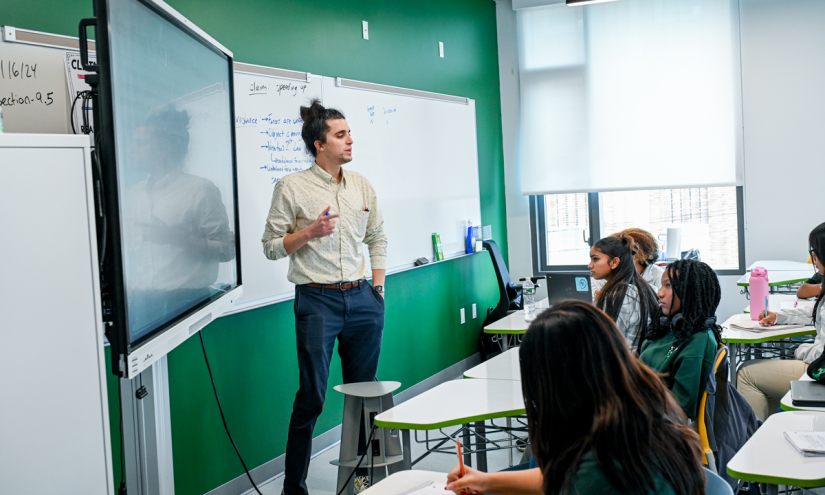
At our school, Comp Sci High in the Bronx, we focus on computer science, technology and internships. But our mission is larger than that: to prepare students to navigate the economy and the world. A year ago, when we looked at our graduating seniors, we found that many knew little about the world they actually live in. That is why we revamped our 9th-grade history curriculum.
Before teaching U.S. and world history, we teach students about the world as it exists today. In 9th grade, they study geography, economic systems, governments and culture in the present. That way, they can understand history as an attempt to explain the world around them, not as a random collection of facts.
We examine major powers and regions — Iran, China, the U.K., Mexico, Russia, Venezuela, Nigeria and the U.S. — and ask basic questions. How does each country’s economy work? What is its political system? How well does it serve the people who live there? What languages do people speak and what religions do they practice? How do states compete for power?
The result is that students have a framework for everything they learn later in high school.
So when federal food assistance was suspended a few months ago and students in my class were struggling to afford groceries, we turned that into a short study of federal systems and how different levels of government work. When the war in Iran began, our students already had baseline knowledge. I asked why they thought we were at war, and they talked about the strategic value of oil and the challenges of an authoritarian theocracy. They were able to think critically about what they saw on TikTok instead of simply absorbing it.
The crisis led to serious classroom conversations. Students were equipped with knowledge.
Rethinking how schools teach history takes on new urgency because social media now delivers global events to students instantly. They see what is happening in the world whether adults are ready for it or not. As educators, we have a responsibility to help them process that information with reason. We want them to think independently, not simply absorb what an algorithm feeds them.
That is especially important in an age of misinformation. It is also more engaging. When students do not see a connection between school and their own lives, absenteeism rises and disengagement follows. Starting from what is relevant to students’ lives and backgrounds is critical if we want to build students who are curious and eager to learn.
To my fellow educators, especially history teachers: I understand the hesitation. In a hyperpolarized political climate, teaching current events can be a scary and thankless task. But we have to be brave.
If our families and our students see that we are helping them make sense of what is happening in the world right now, they will remember why school matters and why our profession matters to our communities and our country. And if more people understand both the world we live in now and how it got this way, we may be able to educate a generation of leaders better prepared for the crises yet to come.
Did you use this article in your work?
We’d love to hear how The 74’s reporting is helping educators, researchers, and policymakers. Tell us how
