

Key points:
School leaders everywhere are working to implement change–new initiatives, new instructional frameworks, new technologies, new approaches to student support. Yet one of the most common frustrations educators express is not necessarily with the changes themselves, but with how those changes happen.
Too often, initiatives are designed far from the classroom and introduced to teachers as something to adopt, implement, or comply with.
The result is predictable: Enthusiasm fades, implementation varies widely, and the initiative quietly disappears when the next new idea arrives.
But sustainable change works differently.
Sustainable change happens when educators feel they have a genuine voice in shaping the work–not just carrying it out.
When teachers help define the problem, design the solution, and refine the practice over time, change becomes something they own, not something they endure.
Why voice matters for change
In schools, teachers are the closest adults to the daily reality of student learning. They see the small successes, the emerging challenges, and the subtle shifts in student engagement that data alone cannot capture.
When educators are excluded from shaping initiatives, schools lose access to this essential insight.
Even more importantly, teachers lose the sense that their expertise matters.
Research on organizational change consistently shows that people are far more committed to work they help design. In schools, this principle is amplified because teaching itself is an intensely professional act. Teachers constantly make instructional decisions, adapt strategies in real time, and respond to student needs.
When change is imposed without their voice, it can feel like a dismissal of that expertise.
When their voice is welcomed, something powerful happens: Educators begin to see themselves not just as implementers, but as co-architects of improvement.
Moving beyond feedback to co-creation
Many schools say they value teacher voice. Surveys are sent. Feedback forms are distributed. Staff meetings include time for questions.
But meaningful voice goes deeper than feedback.
Voice means involving educators before decisions are finalized, not simply asking for reactions afterward.
In practice, this can look like inviting teachers to help define the problem an initiative is meant to solve. Instead of presenting a fully formed plan, leaders might begin with questions:
- What barriers are you seeing in student engagement right now?
- Where are our current systems creating friction for teachers or students?
- What small shifts might make the biggest difference?
These conversations often surface insights leaders may not have anticipated. More importantly, they build a shared understanding of the work ahead. Once educators feel they have helped define the challenge, they are far more invested in building solutions.
Protecting teacher leadership in the process
Another key to sustaining educator voice is ensuring that teacher leadership is not limited to a small group.
Many schools rely on instructional coaches, department chairs, or committee representatives to serve as intermediaries between leadership and staff. While these roles are essential, they should not become the only channels for teacher input.
Instead, leaders can create multiple opportunities for educators to shape the work.
Some schools use structured inquiry groups where teachers test and refine instructional strategies together. Others create cross-department teams to examine schoolwide challenges like student engagement or literacy.
In many cases, the most powerful ideas emerge from teachers collaborating with colleagues across disciplines.
When these structures exist, change becomes distributed across the organization rather than concentrated at the top.
Small conversations that build ownership
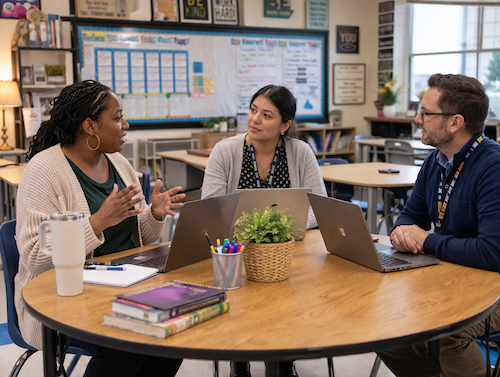
Educator voice does not only appear in formal structures. Often, it emerges in the everyday interactions between leaders and teachers.
A quick conversation in the hallway about a lesson that worked well. A brief check-in after a faculty meeting to ask what felt useful and what did not. A follow-up conversation about an idea a teacher mentioned in passing.
These small moments communicate something larger: that educators’ perspectives matter.
Over time, these interactions build trust. And trust makes it easier for teachers to engage honestly with change rather than simply complying with it.
From initiative fatigue to collective momentum
One of the most common challenges schools face today is initiative fatigue. Educators often feel that programs come and go without enough time to understand, refine, or sustain them.
Inviting educator voice can shift this dynamic.
When teachers help shape initiatives, the work evolves more slowly–but also more thoughtfully. Practices are tested, refined, and adapted to the realities of classrooms.
Because teachers helped build the work, they are more likely to sustain it.
And when new challenges emerge–as they inevitably do–schools already have a structure for responding collaboratively.
The goal is not simply implementing change.
The goal is building a school where change is something educators create together.
A leadership mindset shift
For school leaders, this approach requires a shift in mindset.
Leadership becomes less about delivering the perfect plan and more about creating the conditions for collective problem-solving.
This means listening carefully, sharing uncertainty when appropriate, and trusting educators as partners in improvement.
It also means recognizing that sustainable change rarely happens through a single initiative.
Instead, it grows through a series of conversations, experiments, and adjustments led by the people closest to the work.
In other words:
People sustain what they help build.
And when educators help shape the work of their schools, change becomes something far more powerful than an initiative.
It becomes a shared commitment to better outcomes for students.
Timothy Montalvo, Iona University & the College of Westchester
Timothy Montalvo is a middle school educator and leader passionate about leveraging technology to enhance student learning. He serves as Assistant Principal at Fox Lane Middle School in Westchester, NY, and teaches education courses as an adjunct professor at Iona University and the College of Westchester. Montalvo focuses on preparing students to be informed, active citizens in a digital world and shares insights on Twitter/X @MrMontalvoEDU or on BlueSky @montalvoedu.bsky.social.
Latest posts by eSchool Media Contributors (see all)
