

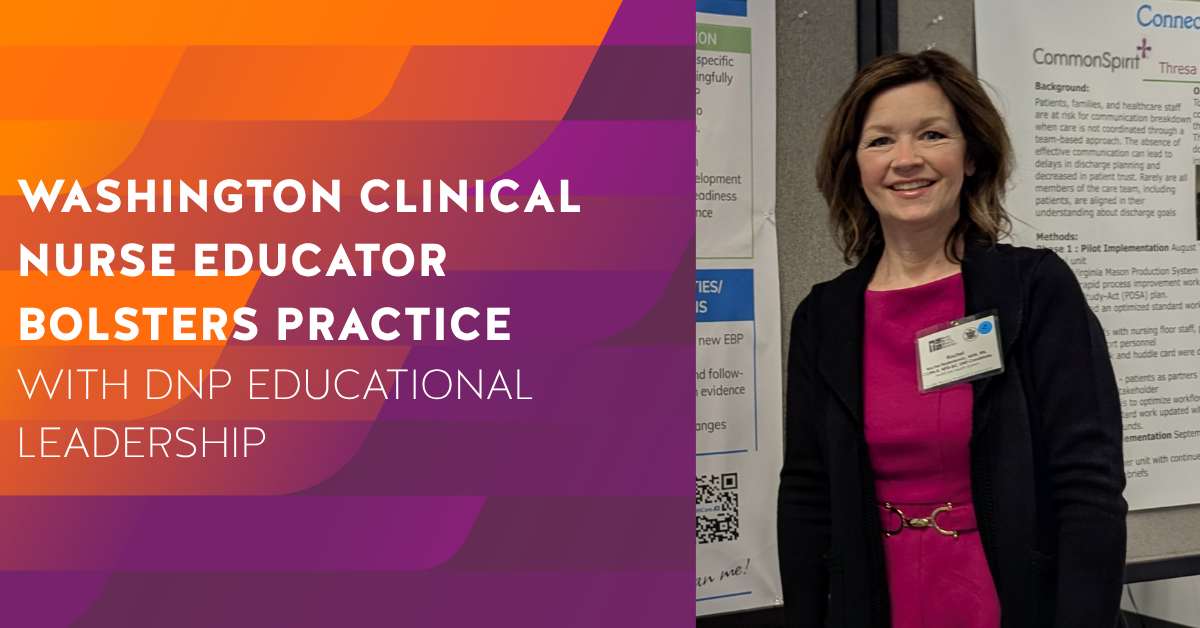
Rachel Radenkovic will never forget the day she stepped into a hospital and it felt like home.
She was 19, visiting her aunt after she’d just had a baby. “That moment, I realized I wanted to work in the hospital setting,” says Rachel, who was already familiar with hospitals thanks to her grandfather, a physician who often brought her to work when she was young. She’d been taking general education courses at community college in her hometown of Gig Harbor, Washington, planning a move to Pennsylvania. Once there, Rachel enrolled at York College to pursue the Bachelor of Science in Nursing (BSN).
The Nursing Path Begins
Rachel worked as a patient care technician at York Hospital while going to school, and proudly crossed the stage with the BSN in 1999. Once licensed as a Registered Nurse, she did a one-year critical care residency program at the hospital, then moved into the intensive care unit. A life change led her to Chicago, where she joined an agency to explore the area’s hospitals to find the best fit. That ended up being St. Margaret Mercy Healthcare on the Illinois-Indiana border—again in the ICU. “In critical care, you use every single skill you have,” says Rachel. “It’s high pressure and high intensity but so interesting.”
A Pivot to Educating New ICU Nurses
After seven years as a bedside nurse, Rachel developed a latex allergy that began causing severe breathing problems. She was forced to step away from the environment she loved to protect her health.
Rachel reached out to colleagues in the clinical care education department at St. Margaret Mercy—where she’d volunteered regularly to teach orientation to new ICU nurses—and learned about an open position as a critical care educator. She was hired and made the transition in 2006. Though she missed being on the front lines, helping new nurses acclimate to critical care was rewarding. “I loved it,” Rachel says. “As time went on, I’d hear from nurses who told me how much I helped them as they started their careers. That filled my cup.”
Along the way, Rachel met her husband, who worked for Rush University Medical Center. In 2013, she obtained the Master of Science in Nursing (MSN) from Rush through her husband’s employee benefits. That combined with her experience made her a perfect fit for a clinical instructor role at Purdue University Calumet, a regional campus in her town. “I was a Purdue employee but taught clinicals to pre-licensure nurses right at St. Margaret Mercy,” Rachel recalls. “It gave me so much joy, and many of the students reminded me of myself as a brand-new nurse.” In 2014, she joined Purdue full time.
A New Chapter and a Third Degree: Doctor of Nursing Practice
In 2016, Rachel and her husband moved back to her hometown, Gig Harbor, to raise their young children. She taught part-time at the University of Washington Tacoma while getting the
family settled, then joined MultiCare Health Systems as a critical care educator. When her hospital reorganized the education department during the onset of the COVID-19 pandemic, she took on a new challenge as program manager of evidence-based practice for the entire system of 13 hospitals.
That prompted Rachel to think about furthering her education. “My job involves integrating evidence-based practice into our policies, procedures, education, and scholarly projects,” she says. “My work is comingled with research, and I felt I needed to grow in that area. Also, as we’ve seen since the pandemic, things change fast in health care. I wanted to make sure my educational background was strong enough to live in any environment.”
Rachel’s chief nursing officer and two other MultiCare colleagues were pursuing doctoral degrees at Post University. “I picked their brains and did my own research, and decided Post was the best fit with my life and work.” In 2023, Rachel began the Doctor of Nursing Practice (DNP) in Educational Leadership at American Sentinel College of Nursing and Health Sciences.
Real-World Applicable Rachel went into the DNP program with high expectations. “Those were definitely met,” she says. “Every single class I’ve applied to my real-world work. The DNP has allowed me to grow and be a better professional because the classes have been so programmatic in what I do.”
In April 2026, Rachel completed her last class and defended her DNP capstone project. Now, she feels even more equipped to continue to shape new nurses. “I look forward to expanding evidence-based practice and helping MultiCare achieve Magnet designation,” she says. “I’d definitely teach in academia again too.” Above all, Rachel is grateful for the opportunity to influence the field of nursing. “I see about 600 new nurses a year through our residency program at MultiCare, which is so fulfilling. Many of them have gone on to be exceptional nurses and leaders, and I get to say I knew them first! I see my role as a life coach in addition to a nurse educator. It’s the best job.”
