

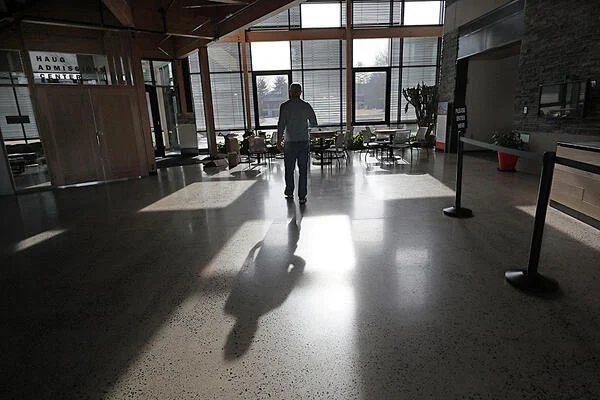
After years of challenges punctuated by a rapid financial decline, Hampshire College will close.
The private college in Massachusetts fended off closure several years ago, but it will finally shutter at the end of the fall 2026 semester due to what officials described as the combined effects declining enrollment, rising costs, fiscal instability and the financial headwinds affecting many small liberal arts colleges.
Founded in 1965 and known for its progressive values and student-driven curriculum, Hampshire is the latest in a string of small colleges to announce closures this year, including Labouré College of Healthcare (also in Massachusetts) and Lourdes University. According to new data from Huron Consulting, nearly a quarter of the country’s 1,700 private, nonprofit four-year institutions may be forced to close or merge over the next decade.
Hampshire also faced scrutiny from its accreditor, the New England Commission of Higher Education, which placed the college on show cause status last month due to concerns about its fiscal resources, particularly a $21 million bond that officials had been unable to refinance. Hampshire’s latest audit shows that the college had not met debt covenants on certain bonds, which could trigger immediate demand for repayment for failing to abide by terms. That audit, dated November 2025, indicated that the college’s ability to continue to operate was “contingent on securing financing for these bonds.”
But with the clock ticking, the college was unable to refinance its bonds.
Though college officials had made some moves to avoid closure—including laying off employees and attempting, unsuccessfully, to sell land—those efforts were not enough to keep the doors open at Hampshire. Officials noted in the closure statement that they had explored every possible alternative. Ultimately, they concluded it was best to dedicate their limited resources to an orderly closure.
“The financial realities we face: declining enrollment, the weight of long-standing debt, and stalled progress on land development left us no other responsible path. Our commitment now is to ensure that every student, employee, and member of this community is treated with the care and respect they deserve,” Hampshire board chair Jose Fuentes said in a statement.
The closure comes less than a year after Hampshire missed its enrollment target by nearly half.
Officials told local media in January that Hampshire enrolled 168 new students in the fall, well short of its goal of 300. Officials put enrollment at around 750 full-time students earlier this year, which is down by almost 100 compared to fall 2024, when head count stood at 844 students—a recent high point. While Hampshire typically enrolled 1,200 or more students in the 2010s, the college has not approached that number since it staved off a near closure in 2019. Federal data shows Hampshire’s enrollment has fallen by almost half since fall 2015.
In 2023, when Florida governor Ron DeSantis moved to transform New College of Florida from a quirky liberal arts college into a conservative bastion, Hampshire offered refuge to students who wanted to continue their liberal arts education. Roughly three dozen NCF students made the transfer, boosting enrollment, albeit temporarily.
As enrollment shrank, Hampshire had few financial resources to fall back on. Its latest audit shows an endowment valued at close to $26.5 million, with $23.5 million in restricted funds.
An Experimental Legacy
Laura De Veau, a visiting professor in the Education Leadership and Higher Education Department at Boston College (and an administrator at Mount Ida College when it closed in 2018), said that Hampshire officials seemed to be proactive but faced circumstances beyond their control. One such example is when plans to sell nearly eight acres fell through late last year after a developer walked away from the project amid permitting and environmental concerns.
“You can’t just replace a major land sale with another financing option,” she told Inside Higher Ed. “I can’t say that was the nail in the coffin, but it’s a reality that when something like that doesn’t come to fruition, you’ve really painted yourself into a corner in terms of options.”
Enrollment volatility also created budget challenges.
“I’ve been in a room where we were 10 students short [of the enrollment target], and we’re like, ‘OK, how are we going to handle this?’ But 100 students short, that’s a different conversation. From the public record, I see this place pulled many of the levers they needed to, but the clock ran out,” De Veau said.
Ken Rosenthal, whose connections to Hampshire stretch back to 1966, even before the college opened in 1970, believes leaders explored every option to keep the doors open. The former chief financial officer, trustee and interim president told Inside Higher Ed that while he was saddened by the news, he believed an orderly closure was the best option.
“I was more optimistic a couple of months ago, but looking at it today, I think Hampshire took the only step, and I’m glad it took it now and didn’t wait until it had to close completely next fall,” Rosenthal said.
He added that he hopes Hampshire is “remembered as a place that tried to make a difference in higher education through welcoming new ideas and welcoming students having a greater say in the development of their own education than they would have in other colleges.”
William “Wolfie” Krebs, a Hampshire student set to graduate in May, said he was in a state of disbelief over the news. Krebs came to campus in 2022 uncertain whether he even wanted to attend college; now, after four years at Hampshire, he’s headed to a Ph.D. program in math this fall.
During his time at Hampshire, he competed on the track team, embraced the college’s self-directed curriculum and said he “fell in love with mathematics in a whole different way.”
Now he hopes others remember the college for its experimental legacy.
“I hope it’s not seen as a failure, because it wasn’t. It’s brought so much influence into the world and into the community, the immediate area,” Krebs told Inside Higher Ed. “I think it will be a fond memory for many people, and I’m excited to see how the nostalgia manifests in the future.”
