

Get stories like this delivered straight to your inbox. Sign up for The 74 Newsletter
In 1977, Karen Hawley Miles’ family left Chapel Hill, North Carolina, for Washington, D.C. She was a junior in high school, a particularly rough time to be uprooted from her friends and neighborhood.
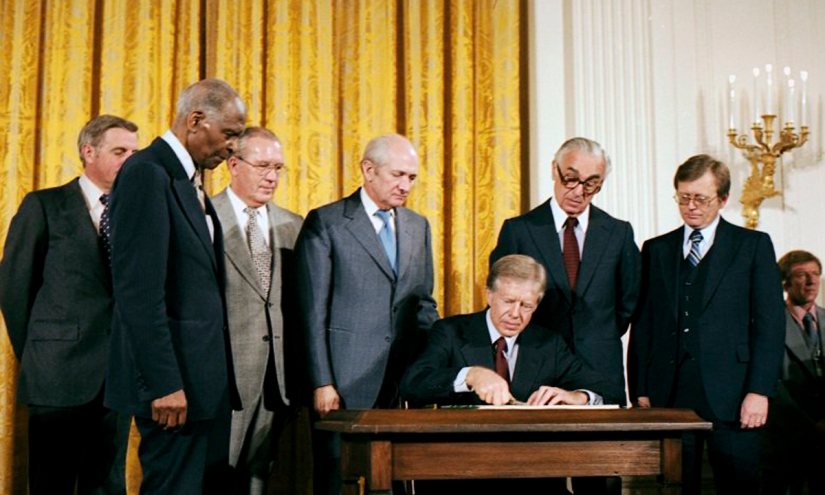
Still, she appreciated the reason the Carter administration summoned her father to the nation’s capital. Willis Hawley, a prominent researcher who focused on school integration, was part of a team tasked with creating a new cabinet-level education agency.
The goal was to bring all of the various education programs scattered across multiple departments under one roof.
Willis Hawley, second from left, was among those tasked with creating the Department of Education. (Courtesy of Karen Hawley Miles)
“I remember the sense of fervor and purpose that surrounded the work that they were doing,” she said.
Almost 50 years later, Miles leads Education Resource Strategies, an organization that helps districts make sense of regulations tied to department funds. She’s quite familiar with complaints that those rules are confusing and can make spending money difficult, but the grumbling hasn’t changed her view about the department’s original mission.
“Part of the federal role,” she said, “is to be a safeguard for the nation in the stewardship of those dollars.”
Such requirements are at the center of a long-running debate over the department’s existence. With her most recent announcement that the Treasury Department would take over student loans, Education Secretary Linda McMahon is reversing history and redistributing her department’s major responsibilities across the federal government. K-12 programs are going to the Labor Department, while the Department of Health and Human Services is expected to absorb special education.
Like President Donald Trump, McMahon dismisses her staff’s oversight functions as unnecessarily burdensome and says parceling out the department’s functions will reduce red tape. Washington should “get out of the way,” she said in January when she granted Iowa a waiver to blend some federal funds into a block grant.
But others say those rules ensure that schools spend the money the way Congress intended.
“The more flexibility you have, the more you run the risk that people may take advantage of that flexibility,” said Vic Klatt, who worked at the department during George H.W. Bush’s administration and then spent several years working on education policy for House Republicans.
‘Just very loose’
During a November CNN interview, McMahon defended her actions and described the Education Department as a mere “pass-through” agency for funds Congress appropriates. Before the department was established, programs like Title I for low-income students and the Individuals with Disabilities Education Act “were handled very well,” she said.
But that wasn’t what civil rights advocates found in 1969 when they took an extensive look at how districts spent the funds. An often-cited example from their report was how the Claiborne Parish schools in Louisiana used Title I funds, meant to improve achievement among educationally “deprived children,” to build two Olympic-sized swimming pools at Black schools.
A school in Oakland, California, used the money for an exercise program to “prevent heart trouble” and increase the “flow of blood to the brain,” the report found. When parents asked if the funds might be better used to teach their kids to read, school officials told them that the P.E. program would improve the students’ reading skills.
Education Dept. Green Lights Iowa’s Block Grant Request
“It was just very loose,” said Nora Gordon, a Georgetown University professor who has written extensively about the history of Title I. “They weren’t breaking the law at the time, but they were violating the spirit of the law.”
Title I was meant to be supplemental. Districts had to “sign an assurance” that they wouldn’t cut their own spending when they received Title I funds, the report said, but there were no penalties for doing so. Audits uncovered numerous examples of districts using Title I to pay for general expenses that should have been covered with state and local funds, like building classrooms and stocking libraries with books at Black schools.
When Congress amended the Elementary and Secondary Education Act in 1970, members wrote a “supplement, not supplant” provision into the law — three words that have generated immense confusion through the years. The rule has prompted countless “guidance” documents that can be equally confusing and spawned a cottage industry of consultants and lawyers who advise districts how to avoid mistakes.
The department, for example, presumes that districts are supplanting if they used state or local funds to cover an expense in the previous year or if they’re spending federal funds on something the state mandates, like teacher training in the science of reading.
Some argue that the department has gone so overboard with requirements for documentation that states and districts worry more about compliance than whether the students those programs are meant to help are making any progress.
In 2006, an Office of the Inspector General review found almost 588 requirements related to the No Child Left Behind Act — so many that a manual describing states’ and districts’ responsibilities only included about 60% of them. The Inspector General questioned whether all those rules were necessary.
“Sure, there is flexibility in how you spend federal dollars,” said JoLynn Berge, deputy superintendent and chief financial officer at the Northshore School District near Seattle. “But you really have to be this high-level expert to understand how to comply with the rules.”
Lucky for Northshore, she is. She previously oversaw district finances for the Seattle Public Schools and before that, worked for the Washington state superintendent’s office, where she monitored districts’ use of federal dollars. She sees value in the push for flexible block grants instead of holding funds for different programs “in these little buckets,” each with their own rules.
“You have to trust that people are going to do things right,” she said. There will always be “bad actors,” she said. “But that’s what you have auditors for.”
Back to the Future: GOP Pledge to Abolish Education Department Returns
For some district leaders, procurement rules — those governing how districts purchase everything from tutoring services to software programs — are a common frustration. To use federal funds, like those for kids with disabilities, a district has to conduct a bidding process.
But that timeline can stretch out for weeks and cause delays in students getting the help they need, said Jay Toland, chief financial officer for the Cumberland, North Carolina, district.
“Sometimes we might have to do something on the fly with exceptional children,” he said, like hiring a speech pathologist. ”We’re still providing those services; we just have to find another funding source.”
‘Risk-averse’
According to McMahon, states and districts should have more say over how they spend federal dollars. During the extended government shutdown last fall, her team took to social media to mock the department’s oversight role.
“We might be away from our desks attending strategic assessments, creating more red tape and doing nothing to improve student outcomes,” said the post, signed “bureaucratically yours.”
During the government shutdown last fall, the Department of Education posted a note saying that it does “nothing to improve student outcomes.” (Department of Education)
But the Education Department isn’t the only agency that asks districts to complete tedious administrative tasks, and many of those will stay in place whether the department exists or not.
The requirement that school staff document how much time they spend on a federal grant, for example, comes from the Office of Management and Budget.
States are known for layering their own rules on top of the federal guidelines. Jeremy Vidito, chief financial officer for the Detroit schools, previously worked in California and Louisiana, but called Michigan “the most restrictive place” he’s worked when it comes to spending federal dollars.
“They must approve all travel and conferences in advance. They approve service vendors and materials,” he said. “At this point, we know what they will and won’t approve, so we don’t try to do anything creative.”
The public also has expectations for how districts spend that money.
The law requires districts to spend Title I in schools with poverty rates of 75% or higher, and they can direct funds to schools with much lower poverty rates if they have some left over. Berge, in the Northshore district, described it as “peanut buttering” the funds around to keep everyone happy. Legally, leaders could concentrate that money in just the poorest schools, but pushback from the community would be intense.
“The federal government doesn’t prohibit you from doing that. You’re just dealing with local politics,” said Marguerite Roza, who directs the Edunomics Lab at Georgetown University and advises districts nationwide on budget and spending issues.
In January, Education Secretary Linda McMahon, center, visited Broadway Elementary in Denison, Iowa, to announce a waiver allowing the state to combine some federal funds at the state level. (Department of Education)
With achievement gaps wider since the pandemic, and low-performing students continuing to lose ground, she challenges districts to rethink how they spend Title I. But district officials, she said, are a “risk-averse” group and tend to stick with spending plans that state officials and auditors have signed off on in the past.
In conversation with a group of districts last fall, she proposed that they use all of their Title I funds to pay non-teaching staff members, like instructional coaches and assistant principals, to work as tutors for low-income students. One leader from a midsized Midwestern district said the idea wouldn’t work because Title I instructors must be certified teachers. Roza reminded her that tutoring isn’t core instruction.
“So this was actually a non-issue,” she said.
California provides another example of how districts can get locked into misconceptions about what’s allowed. In 2012, advocates for arts education found that districts were reluctant to use Title I funds for the arts even though the U.S. Department of Education encouraged it. A “culture of ‘fear of reprisal’ seemed to permeate the Title I world,” their report said.
It took a letter from the state education department and extra assurance from a federal official to convince districts it was OK. Klatt, the retired Congressional staffer, is among those who predict that even if some federal rules disappear, district leaders will likely still manage those funds like nothing has changed.
“It’s hard to break that mold,” he said.
But there’s another reason, experts say, why those spending federal dollars might not be able to tell much difference between this administration and those that came before. Other than granting the Iowa waiver, which observers say was not a significant change, McMahon has mostly reiterated what the law already allows.
Thank you to my friend @EDSecMcMahon for visiting us at the Department of Labor’s HQ last week 🇺🇸
I’m excited about the partnership we’ve established between @USDOL and @USEDGOV.
Together, we are focused on training and preparing the future workforce of America by bridging the… pic.twitter.com/q0e6nvsWrI
— Secretary Lori Chavez-DeRemer (@SecretaryLCD) March 23, 2026
In January, she released a letter highlighting the way schools can use Title I funds for schoolwide improvements (on the books since 1978) and blend federal grants with state and local funds (added in 1994). She’s made similar announcements about “existing” flexibilities related to career and technical education, transferred to the Labor Department last year.
If anything, Klatt doesn’t buy McMahon’s argument that moving K-12 programs there is a way to lighten the bureaucratic load. After all, it’s the agency that enforces strict rules related to workplace safety and overtime pay.
“Almost everybody at the Labor Department,” he said, “is involved in some kind of regulatory activity.”
Did you use this article in your work?
We’d love to hear how The 74’s reporting is helping educators, researchers, and policymakers. Tell us how
